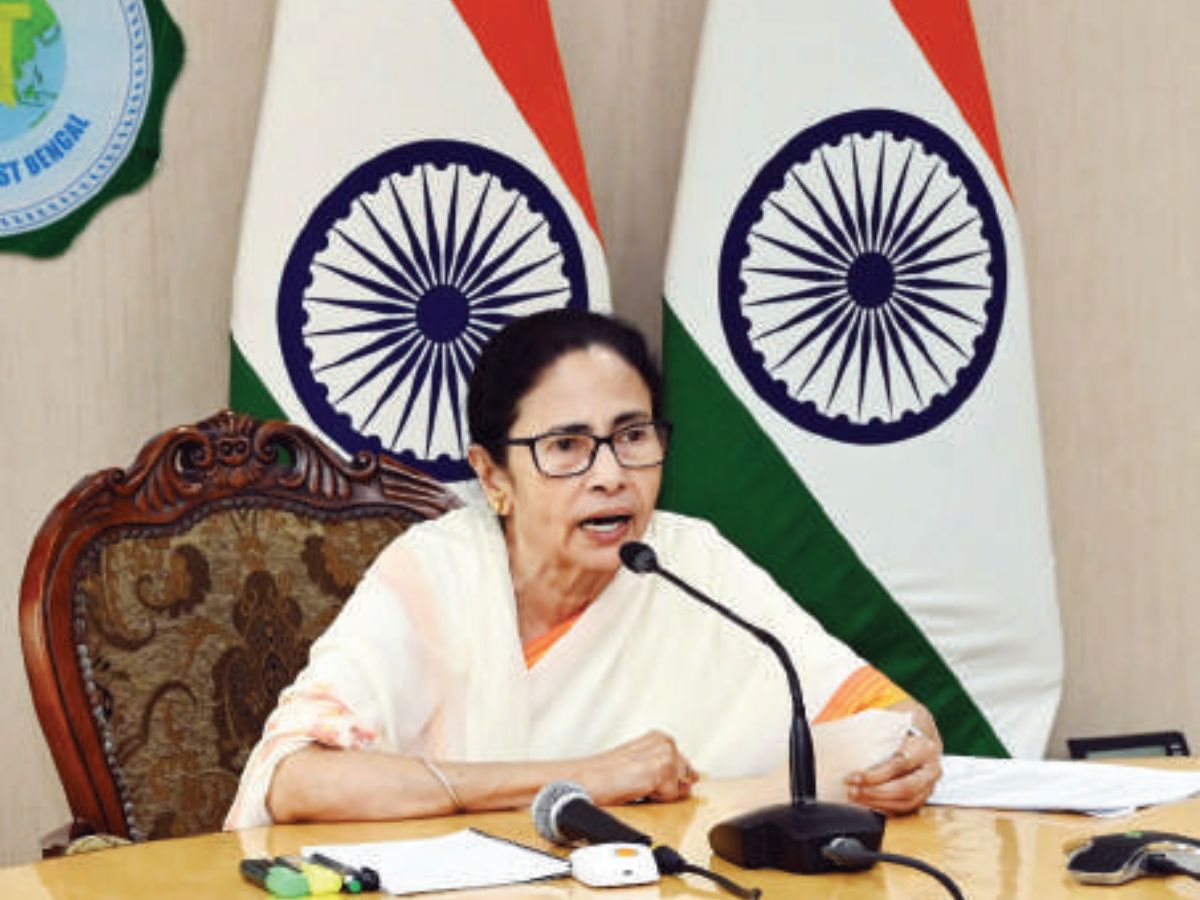
West Bengal Chief Minister Mamata Banerjee. File photo
Kolkata: In keeping with its oft-repeated complaint that the Central Government does not respect national icons, West Bengal Chief Minister Mamata Banerjee has launched a scathing attack on the Centre following the passage of the VB-G RAM G Bill, which replaces the Mahatma Gandhi National Rural Employment Guarantee Act (MGNREGA).
Banerjee announced that her Government will rename the State’s rural employment scheme after Mahatma Gandhi, in direct response to the Centre’s decision to drop his name from the national programme. The Viksit Bharat–Guarantee for Rozgar and Ajeevika Mission (Gramin), or VB-G RAM G Bill, was cleared by Parliament on December 18, 2025, replacing the 20-year-old MGNREGA. Opposition leaders have decried the move as an erasure of Gandhi’s legacy.
Speaking at a business conclave in Kolkata on December 18, Banerjee expressed dismay over the removal of Gandhi’s name from the flagship rural employment scheme. “I feel ashamed that Mahatma Gandhi’s name has been removed. Are we forgetting the Father of the Nation?” she asked. The Chief Minister declared that West Bengal’s Karmashree scheme would now bear Gandhi’s name, stating that if others did not know how to respect Gandhi, West Bengal would show them how.
The Lok Sabha passed the Viksit Bharat–Guarantee for Rozgar and Ajeevika Mission (Gramin) Bill on December 18, dismantling the two-decade-old MGNREGA framework. The legislation has triggered widespread opposition from non-BJP-ruled states across India.
A key point of contention is the new cost-sharing arrangement. Under the revised framework, the Centre and States will split costs in a 60:40 ratio for most States, a significant departure from the earlier system under which the Centre bore nearly all unskilled wage costs. Northeastern and Himalayan States will receive a more favourable 90:10 split.
TMC MP Sushmita Dev criticised the change, noting that while the Centre previously provided around 90 per cent of MGNREGA funds, it would now contribute only 60 per cent. “This undermines the scheme’s core purpose by forcing States to bear the financial burden,” she said.
Banerjee has repeatedly alleged that the Central Government has blocked MGNREGA funds to West Bengal in recent years. “We are running Karmashree with our own resources. We will ensure employment for our people even if Central funds are stopped. We are not beggars,” she declared, underscoring her Government’s commitment to self-reliance.
Opposition parties across the board have come together to criticise the new legislation. They maintain that the new scheme fundamentally alters the rights-based character of MGNREGA. Under the previous Act, rural households were legally entitled to employment within 15 days of application or to an unemployment allowance if work was not provided. The scheme operated on a demand-driven model, with the Centre obligated to provide supplementary funding when actual demand exceeded projections.
The VB-G RAM G Bill replaces this open-ended labour budget mechanism with normative, State-wise allocations based on what the Centre describes as “objective parameters”.
Economist Abhirup Sarkar told The Sunday Guardian that the new scheme “effectively caps the employment guarantee despite the Government’s promise of increased workdays from 100 to 125”.
Banerjee’s stand also found support from Tamil Nadu Chief Minister M.K. Stalin, who joined her in opposing the Bill, arguing that it imposes severe financial burdens on States while reducing their developmental autonomy. Opposition parties including the Congress, DMK, Samajwadi Party and RJD have united against the legislation.
The Trinamool Congress escalated its opposition with a 12-hour dharna outside Parliament. TMC MPs displayed banners reading “Don’t kill MGNREGA, like you killed Gandhi”. MP Dola Sen invoked strong rhetoric, stating that Gandhi had been “assassinated again” when his name was removed from the scheme.
The TMC has also criticised the rushed passage of the Bill without scrutiny by a Parliamentary Standing Committee. “Such significant legislation affecting millions of rural workers deserved detailed examination and debate,” said Derek O’Brien of the Trinamool Congress.
In a direct challenge to the Centre, Banerjee announced plans to expand Karmashree from 75 to 100 workdays, positioning West Bengal as more committed to rural welfare than the national Government. The State Government will fund this expansion independently, according to the Chief Minister.
Senior officials in the Rural Development Ministry defended the legislation, arguing that MGNREGA was designed for 2005 conditions and “no longer reflects current rural realities”. The Government has cited declining poverty levels and improved rural connectivity as justifications for reform.
Officials maintain that the new framework will create more durable infrastructure and address longstanding concerns about fund misappropriation and poor asset quality under MGNREGA. A Government official said Gandhi’s name was added to the scheme in 2009 for “political purposes” and that the “substantive Gandhian principles remain intact in the new legislation”.
Senior Trinamool MP Kalyan Banerjee said: “Even NDA ally Telugu Desam Party raised concerns during the parliamentary debate. TDP MP Lavu Sri Krishna Devarayalu noted that, as a revenue-deficient State, Andhra Pradesh would struggle with the 40 per cent cost burden and requested continuation of previous Central funding support. But Narendra Modi doesn’t listen to anybody.”
He added that the Bill introduces several changes that reduce State autonomy. Only the Union Government can now notify areas where the scheme operates, States must bear increased costs, and the shift from a demand-driven model to fixed allocations reduces States’ ability to respond to local employment needs.
For West Bengal and other Opposition-ruled States, these changes come amid ongoing tensions over fund allocations, GST compensation and federal prerogatives.
Political observers say Banerjee’s aggressive response serves multiple purposes. By framing the issue around respect for Mahatma Gandhi, she is positioning herself on cultural and nationalist terrain typically claimed by the BJP. “Her promise to run a more generous State scheme with West Bengal’s own resources counters accusations of dependency on Central funding,” said political observer Biswanath Chakraborty.
“The Centre’s over-zealousness has given Opposition parties a unified cause, bringing together Chief Ministers and parties across ideological lines in defence of rights-based welfare and federal principles,” said O’Brien.
Trinamool sources said that as the Bill moves to the Rajya Sabha, where the Government lacks a clear majority, Opposition parties may attempt to force amendments or modifications. However, the Government’s ability to leverage its Lok Sabha majority and the Bill’s classification as a money Bill could limit Opposition manoeuvring.
For now, the battle lines are clearly drawn. West Bengal will implement its Gandhi-named scheme while challenging the Centre’s policy direction, setting the stage for a prolonged confrontation over rural employment, fiscal federalism and the legacy of India’s independence movement.
