NEW DELHI:
In the last four months, starting May, the various arms of the government—specifically the Ministry of External Affairs, Defence, Commerce and Trade, the Cabinet Secretariat, and the Prime Minister’s Office—have been working in battle mode, responding to unexpected pressure from global entities, particularly the Donald Trump administration.
The larger picture that has emerged since then is how New Delhi, while refusing to buckle under Washington’s demands—many of them described by officials as unreasonable and not limited to trade and tariff—has, through quick steps and a flexible outlook, pivoted to a position of strength.
This runs contrary to the view among critics that India’s rise could be checked if sufficient pressure was applied.
Official sources told The Sunday Guardian that India’s role in South Asia’s economic and strategic landscape has grown sharply, with both Russia and China having long-term plans built on India’s vast market. According to them, ties with Moscow are “as good as they ever were,” illustrated by developments in recent weeks and set to be reinforced by the possible arrival of President Vladimir Putin to India.
Similarly, after almost five years of lull in relations, interaction and business with Beijing have increased “multifold.” This, officials said, has been possible because concerns on both sides have been discussed without inhibitions, aided by a series of high-level visits in recent months.
Recent developments suggest that officials in Beijing have indicated that they do not view India as an expansionist power, reinforcing the point that New Delhi’s influence lies in demand rather than territorial ambition. India’s size, consumption growth, and trade leverage now form one of the most important anchors in Eurasian geopolitics.
Trade numbers underline the scale. India imported $52.7 billion worth of Russian oil in 2024, according to UN trade data. That made Russia India’s largest crude supplier, accounting for between 35–41 percent of India’s total oil basket through 2024 and 2025. Shipments averaged 1.5–2 million barrels per day, volumes negligible before the Ukraine war but which have since displaced traditional suppliers from the Middle East. For Moscow, facing Western sanctions and a shrinking customer base in Europe, this revenue stream is crucial. Roman Babushkin, Russia’s chargé d’affaires in New Delhi, recently confirmed that India continues to benefit from discounted supplies, calling the mechanism “very, very special” and noting that India was securing oil at roughly 5–7 percent below global benchmarks. Russian foreign minister Sergei Lavrov, in talks with External Affairs Minister S. Jaishankar, has underlined Moscow’s interest in joint energy projects with India in the Arctic and Far East, signalling that oil ties are being reinforced with long-term collaboration.
China’s trade relationship with India has also hit record highs. In 2024–25, India imported $101.8 billion worth of goods from China while exporting only $2.6 billion, leaving a deficit of $99.2 billion. The bulk of imports were industrial products: in the first half of 2024, 98.5 percent of Indian purchases from China were in electronics, machinery, and consumer durables. Across these categories, China accounted for 29.8 percent of India’s total industrial-goods imports. Official Chinese data confirms that India represented 3.48 percent of China’s global exports in 2024.
These numbers, while highlighting the asymmetry—Russia profiting from India’s energy demand and China from India’s dependence on manufactured and intermediate goods—also underline the interdependence at play. India’s appetite and capability are not set to decrease any time soon, making its market a stabilising anchor for both.
India’s series of developments with Moscow and Beijing has come amid a tariff war and vocal tirades launched by U.S. President Donald Trump, who has threatened duties of up to 50 percent on Indian goods and warned of penalties over Russian oil imports. The words and actions from Washington are not being ignored—but the scale of India’s economic engagement with Russia and China shows they no longer carry the potential to intimidate.
That point was underscored by the latest round of diplomacy with Beijing. During Chinese Foreign Minister Wang Yi’s recent visit to New Delhi, India and China agreed to reopen border trade through three Himalayan passes, resume direct flights, ease visas for journalists and tourists, and set up a new working group on border affairs.
Prime Minister Narendra Modi described the outcomes as “steady progress” towards stabilising relations, while Wang said the two nations were now on a “steady development track.” Beijing also promised to address India’s concerns over access to rare earths, fertilisers, and machinery—areas where Chinese supply has remained critical.
At the same time, India is broadening ties with partners outside the U.S. orbit. The Free Trade Agreement with the United Kingdom, signed during Modi’s London visit in July 2025, sets a target to double bilateral trade to $120 billion by 2030. Tariffs are being lowered on textiles, whisky, and cars, while a social-security pact will make it easier for Indian professionals to work in Britain. Officials noted that the U.K.—despite being one of Washington’s closest allies—pressed ahead with the deal because of the gains it brings to its own economy. The agreement, they said, demonstrates that Washington cannot dictate transactional ties between two influential economies.
The decreasing influence of Washington, attributed to multiple reasons, is also aided by the hypocrisy it indulges in.
Putin recently pointed out that since the current U.S. administration took office, Russia–U.S. trade has grown by 20 percent. Officials here say the comment lays bare Trump’s hypocrisy—attacking India for buying discounted Russian oil even as Washington’s own trade with Moscow expands.
According to officials, India’s relationship with Washington, if charted on a bar graph, plateaued in May and has been sliding slowly but steadily since then. They added that while Trump’s tenure is being seen in New Delhi as an aberration—with the potential to cause long-term damage to bilateral ties if allowed to be executed—the expectation remains that saner voices in Washington will prevail.
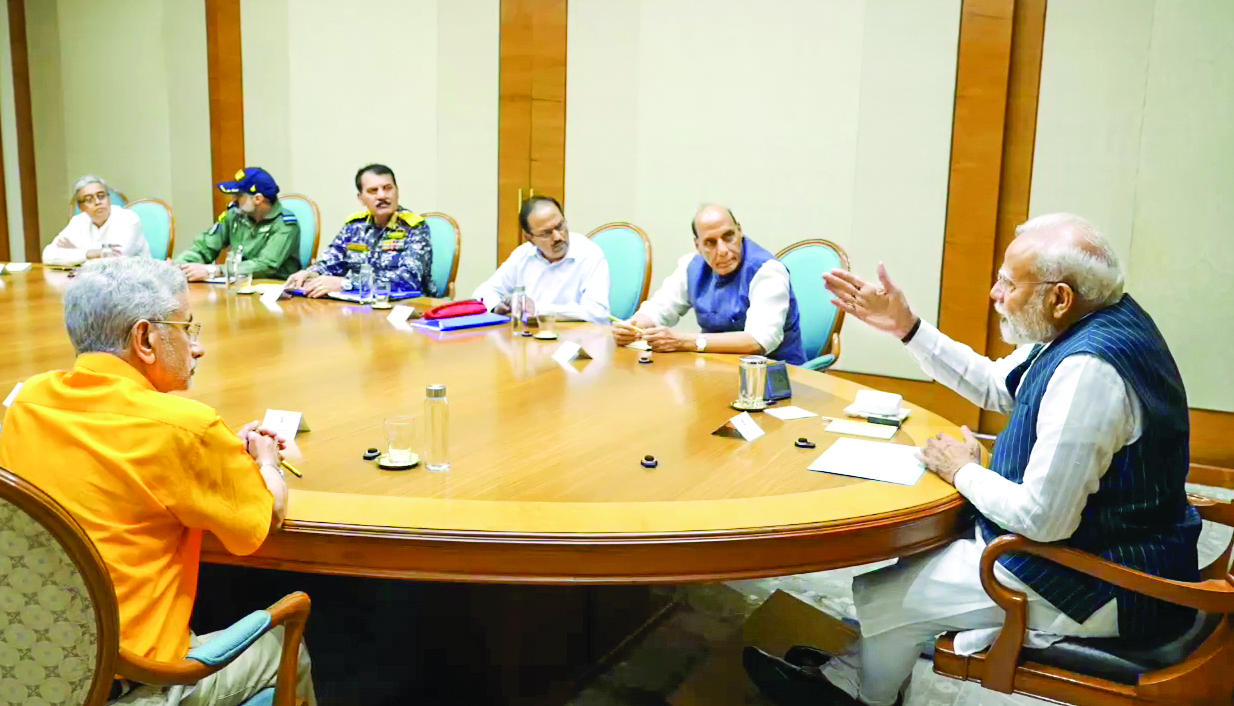
The pivot is also being backed at home. On Monday, Prime Minister Modi chaired a high-level meeting with senior ministers, secretaries and economists to discuss the roadmap for Next Generation Reforms, signalling that India’s external assertiveness is tied to a domestic agenda of economic strengthening. Earlier this month, in his Independence Day address, Modi stressed self-reliance, manufacturing, and a new push for exports—framing them as essential for safeguarding India’s sovereignty in an era of global volatility. Together, the two steps underline that foreign policy manoeuvres are being reinforced by internal capacity-building.
If India’s recent moves show anything, it’s that Washington’s bark—no matter how loud—is losing its bite. U.S. rhetoric, especially during the Trump-era tariff wars and veiled threats over defence ties, might rile the market, but hasn’t undermined India’s strategic autonomy.
The real cost of pushback may prove to lie with the U.S.—not Delhi.
Take defence. India’s 2025–26 budget stood at ₹681,000 crore ($81 billion), a 9.5 percent increase from the previous year, comprising 1.9 percent of GDP. Investment is flowing into modernization and indigenous procurement—75 percent of it domestic—as the government pushes self-reliance. Defence currently makes up 13.4 percent of the overall budget. Observers such as EY argue that this needs to rise to 2.5–3 percent of GDP to match the scale of threats along India’s frontiers.
A June 2025 report recommended a permanent defence modernization fund and a steep increase in R&D to lessen reliance on imports. Analysts at think tanks such as Stimson note that India’s posture still depends heavily on imported platforms, largely from the U.S. and Russia, but the ambition is unmistakable: tilt toward a domestic ecosystem. All of which means that, in the medium to long term, U.S. defence and aviation companies could lose ground and are likely to be restricted from earning from the Indian market, for which many novel ways exist.
India is tightening conditions on foreign suppliers under its “Make in India” framework and tilting procurement towards home-grown industry, even while balancing external partners where essential.
Washington has also stated that it will raise tariffs on Indian products such as pharmaceuticals and gems to curb their access to the American market.
India shipped $86.5 billion worth of goods to the United States in 2024–25, led by pharmaceuticals, engineering goods, electronics, gems, and textiles. Pharmaceuticals alone contributed $30.5 billion, with 70 percent of exports going to North America and Europe. India supplies 40 percent of all U.S. generic drugs and more than 50 percent of global vaccines, figures that make the sector indispensable. Gems and jewellery, another potential U.S. target, generated $48 billion in export revenue in 2024 and are entrenched in markets from Europe to the Gulf. India’s share of the global gemstone market has risen from 16.3 percent in 2018 to 36.5 percent in 2023, underscoring that these are not products tied to a single buyer.
Even if tariffs restrict certain goods, America cannot touch India’s most powerful export engine: services. Indian IT and business-process firms earn roughly $150 billion annually from the U.S. market, supplying software, back-office support, and consulting services that underpin Fortune 500 companies.
This trade in services is not subject to the same tariff levers, making it a structural link that U.S. policymakers cannot sever without damaging their own corporate base. Services now account for nearly half of India’s total exports to the U.S., putting technology and consulting ahead of traditional goods.
The U.S. may choose to weaponize tariffs, but the nature of India’s strongest exports—essential medicines, life-saving vaccines, globally demanded jewellery, and irreplaceable services—means they will continue to find buyers. Such restrictions would raise costs for American consumers, hospitals, and corporations without choking India’s trade, which can pivot to Europe, Africa, the Gulf, and Latin America.
For Russia, India is now the indispensable buyer of oil. For China, it is the single largest untapped consumer market capable of offsetting losses in the West. For Britain and other blocs, a free trade agreement offers entry into a surging economy. Washington remains a partner—but no longer the gatekeeper. India is not just the strategic bulwark of South Asia; its demand engine is shaping Eurasian trade flows—and everyone knows it.
