
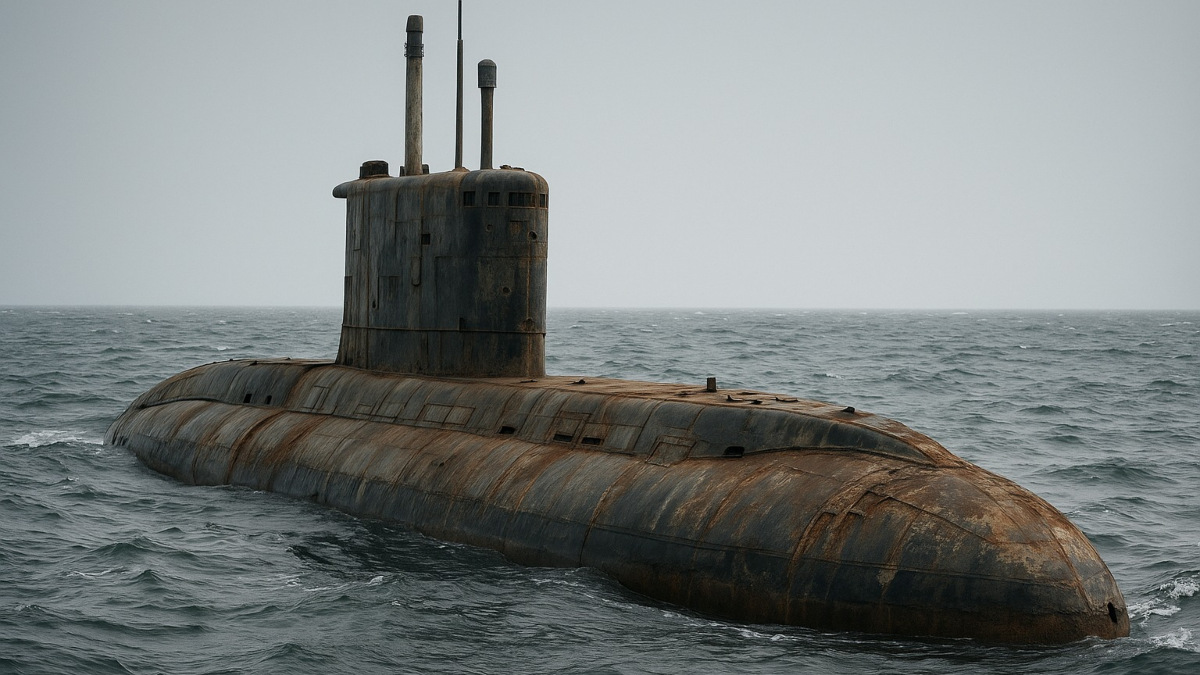
New Delhi: As India celebrated it’s 79th Independence Day, Pakistan’s Navy marked what it hailed as a milestone: the launch of its third Hangor-class submarine at Wuhan’s Wuchang Shipyard. Official statements described the event as proof of modernisation and a sign of stronger deterrence in the Arabian Sea.
Yet the timing was striking. While steel hulls entered the water in China, Pakistani families at home queued up for subsidised flour, coped with double-digit food inflation in recent years, and endured hours-long power cuts as electricity tariffs rose. For citizens, the contrast sharpened a painful truth: their country spends billions abroad on prestige submarines while struggling to provide affordable bread and reliable power.
This paradox of maritime ambition and domestic fragility lies at the heart of Pakistan’s “Hangor pangs.” The submarines may extend endurance underwater, but they show how misplaced priorities deepen economic and social crises on land.
HANGOR FLEET AMID FISCAL FIRE
The Hangor programme traces back to April 2015, when Islamabad signed a contract with Beijing for eight submarines based on China’s S26 export version of the Type-039A/B Yuan-class. Four are being built at Wuhan, while four are to be assembled at Karachi Shipyard and Engineering Works (KS&EW) under a transfer-of-technology package. The August 2025 launch marked the third hull built in Wuhan.
The price tag is substantial. Independent assessments place the programme’s cost in the USD 5–6 billion range—though Pakistan’s Ministry of Defence has never disclosed an official figure. This opacity feeds concerns about transparency and accountability. Transfer-of-technology promises also remain contested. Chinese original equipment manufacturers continue to control integration, and Karachi Shipyard’s role is largely assembly.
Delays and cost overruns have been reported in the domestic batch, adding to scepticism. The propulsion system poses risks. Instead of German MTU-396 diesel engines—barred from export by Berlin—the Hangors will use Chinese CHD-620s. Thailand’s S26T submarine, based on the same Yuan-class export design, faced a 1,217-day delay when Bangkok had to accept CHD-620 integration. The precedent is troubling. Naval analysts note the CHD-620 remains untested in export service, raising doubts over its acoustic performance and long-term reliability.
Regionally, the Hangor is not China’s first submarine export. Bangladesh acquired two Type-035G Ming-class boats in 2016 for USD 203 million. Myanmar inducted a Chinese-built Ming-class in 2021. Both are older-generation designs, used more for training than deterrence. These precedents reveal a pattern: Chinese submarine exports bring prestige headlines but deliver limited operational utility. Pakistan’s Hangors, though newer and more expensive, risk following the same trajectory.
DEFENCE UP, WELFARE STAGNANT
The FY2025–26 federal budget reveals Pakistan’s skewed priorities. Defence spending climbed to PKR 2.55 trillion, up from PKR 2.12 trillion the previous year—a 14% year-on-year rise. By contrast, the Benazir Income Support Programme (BISP), Pakistan’s flagship welfare scheme, rose modestly to PKR 716 billion. The Public Sector Development Programme (federal share) was held flat at PKR 1.0 trillion.
Meanwhile, debt servicing soared to PKR 9.6 trillion, consuming over half of federal outlays. This imbalance squeezes social investment and infrastructure. The IMF’s May 2025 review acknowledged Pakistan’s fiscal consolidation efforts, but stressed that “timely tariff adjustments” must be paired with structural reforms to secure the energy sector’s viability. For citizens, this meant higher utility bills, even as welfare lagged.
The arithmetic is unforgiving. Defence is growing faster than welfare; debt outpaces development. In practice, the state is better at paying for submarines than at paying for schools or flour subsidies.
HUNGRY FAMILIES
Behind the numbers lie human struggles. Although headline CPI inflation eased to 3.2% in June 2025, the legacy of high food inflation through 2023–24 continues to bite. The World Bank estimates that 42.3% of Pakistanis were living below the lower-middle-income poverty line in FY2024. The World Food Programme found that 82% of households cannot afford a healthy diet, highlighting deep structural vulnerability.
Wheat imports illustrate the pressure. After importing just 0.1 MMT in 2024/25 due to favourable harvests, Pakistan is projected by USDA to import 1.0 MMT in 2025/26 to stabilise food supply. At global prices, this will cost hundreds of millions of dollars. Yet Islamabad allocates only PKR 38 billion for flour subsidies, leaving the poor to absorb the shock of higher food costs.
The social toll is visible. Malnutrition rates remain high, with child stunting above 35% in several provinces. Urban blackouts disrupt refrigeration and food storage, worsening shortages. Real wages fell by 2% year-on-year, according to PBS, eroding household resilience. The message from these figures is simple: Pakistan’s “food security deficit” is widening, even as its naval procurement ambitions expand.
IMF LOANS, CHINESE SHIPYARDS
Pakistan’s financing paradox is clear. Since July 2023, Islamabad has received USD 4.5 billion in IMF disbursements. These tranches were tied to tough conditionalities—subsidy cuts, tax hikes, and cumulative 45% electricity tariff increases between 2023 and 2025. Citizens endured austerity to keep reserves afloat.
Yet large chunks of foreign exchange are earmarked for Hangor payments to Chinese yards. The IMF props up reserves; the submarines drain them. It has also been noted that defence imports add pressure to reserves and magnify rupee risks. Depreciation inflates local-currency costs of foreign contracts, worsening fiscal strain.
In practice, IMF loans subsidise strategic imports more than they cushion households. For Beijing, the Hangor contract is lucrative and strategically significant. For Pakistan, it is a programme financed with borrowed dollars and paid for with citizen austerity.
THE AIP MIRAGE
Hangor publicity has focused on air-independent propulsion (AIP), which allows submarines to stay submerged longer without surfacing. But AIP is no magic cloak. The Pakistan Navy has not confirmed exact specifications, and experts caution against overstating its value.
It is important to understand that AIP extends endurance but does not prevent detection—especially in shallow, noisy littorals like Karachi and Ormara, where acoustic signatures travel far. Geography works against Pakistan’s submarines.
India’s anti-submarine warfare network compounds the problem. New Delhi operates 12 Boeing P-8I Poseidon aircraft, which conduct wide-area submarine surveillance. It commissioned its first squadron of MH-60R Seahawk helicopters with dipping sonar and torpedoes in March 2024. Four Kamorta-class corvettes patrol the coasts, and on 18 June 2025, India inducted INS Arnala, the first of a new shallow-water ASW craft. Together, these assets form a layered detection net that shrinks the Hangors’ room to manoeuvre.
HANGOR OR HUNGER: RETHINKING SECURITY
The Hangor debate forces Pakistan to confront a deeper question: what defines national security? For elites, it is fleets and platforms. For citizens, it is food prices, electricity supply, and education.
Prominent voices in Pakistan itself have increasingly questioned this imbalance, with arguments that prestige fleets mean little when children go hungry. The Auditor-General of Pakistan has flagged repeated procurement irregularities in defence, reinforcing concerns that opaque, costly projects are advanced without accountability. Civil society voices and economists have emphasised that stability depends on investment in people.
In this framing, submarines are not irrelevant—but they are symbols of a state that misallocates resources. Real security must begin in the kitchen and the classroom, not just in the shipyard.
PAKISTAN’S HANGOR PANGS
The Wuhan launch gave Pakistan an image of maritime strength. But it also sharpened the contradictions of a country that spends billions on submarines while millions struggle with hunger, malnutrition, and poverty.
The Hangors extend endurance underwater. They also extend dependence on China, drain scarce reserves, and highlight the cost of ignoring welfare.
True security begins with feeding families, powering homes, and educating children. Until Islamabad aligns its budgets with these priorities, every submarine launch will be shadowed by hunger at home.
These are Pakistan’s Hangor pangs—proof that a nation can buy endurance at sea, but not endurance against endless hardship on land.
Ashish Singh is an award-winning senior journalist with over 18 years of experience in defence and strategic affairs.




