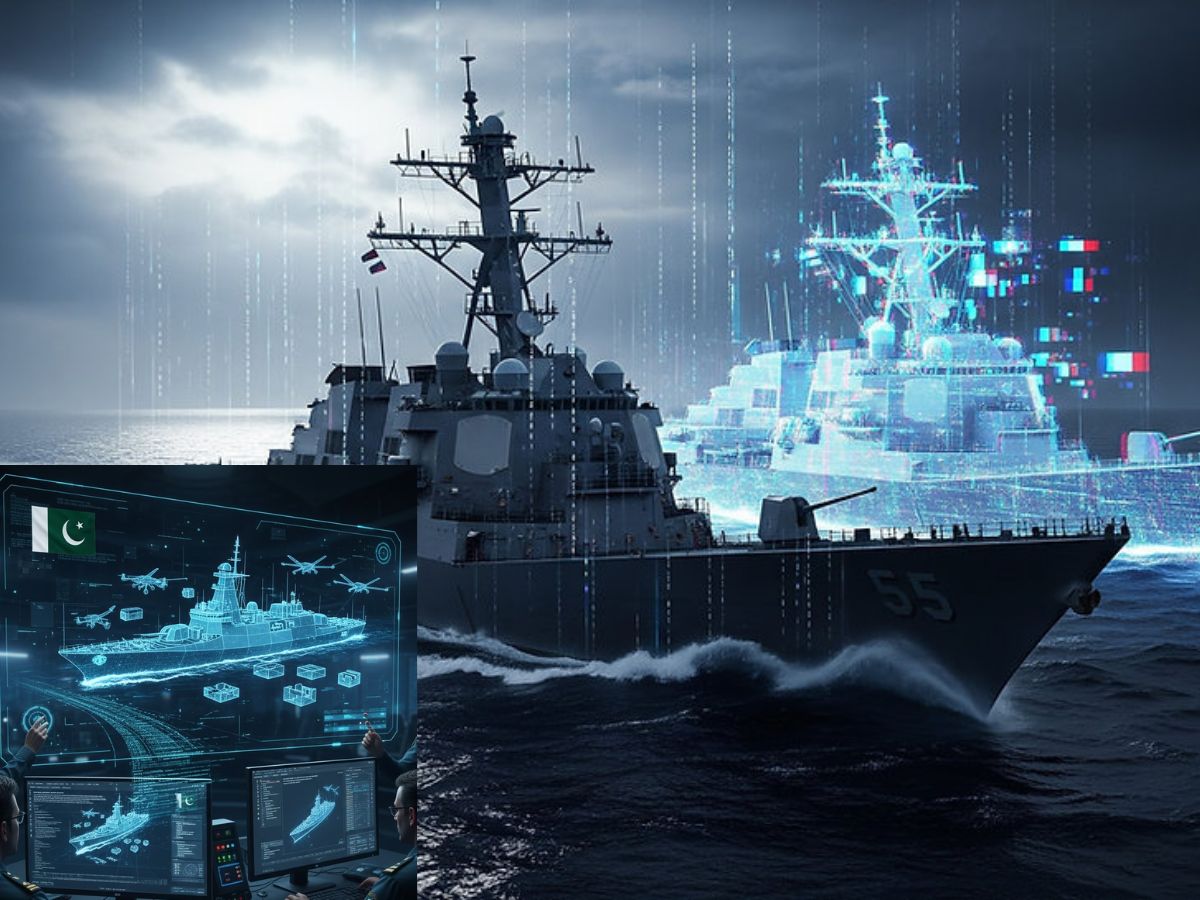
Pakistan is constructing a virtual navy using AI and editing software
New Delhi: When Pakistan’s military publicity arm released a short video in late November showing a missile rising from a grey warship into a pale sky, the clip appeared to signal a new phase in the country’s naval ambitions. The accompanying statement from the Inter-Services Public Relations (ISPR) described a successful flight test of an indigenously developed anti-ship ballistic missile capable of striking “sea and land targets with high precision.” It was a routine announcement of the kind that militaries issue every year across the world.
Yet the reaction that followed was anything but routine. Within minutes of the video going online, Pakistan’s defence-themed social-media channels began circulating strikingly different interpretations. These accounts—many of which have amplified ISPR messaging for years—described the test as a milestone in South Asia’s military balance. Some claimed that the missile was hypersonic. Others placed its range at nearly 800 kilometres. A few declared that Pakistan now possessed a system capable of neutralising India’s aircraft carrier, INS Vikrant, at extended ranges. The brief clip was reshaped into a much larger story of strategic breakthrough.
Independent analysts saw a more familiar pattern. The official statement, though celebratory, offered almost no technical detail. It did not identify the warship that launched the missile. It did not mention range, speed, or seeker type. It did not provide telemetry or tracking information. The video itself showed only a single launch shot and a distant impact on what appeared to be a stationary floating target. In the highly scrutinised world of missile testing, the lack of supporting data was notable.
But the most striking part of the episode was not what the video showed—but what began circulating soon after. In the hours following the ISPR announcement, social platforms in Pakistan were flooded with clips purporting to show far more advanced capabilities than those acknowledged officially. Some videos featured missiles striking moving vessels in cinematic sequences. Others depicted manoeuvring projectiles diving onto what appeared to be Indian warships. Several included inconsistent lighting, artificial smoke trails, or impact frames resembling past tests. Many were traced by analysts to recycled or digitally altered footage.
These clips formed the backbone of what regional observers are now calling Pakistan’s “AI Navy”—a parallel digital identity crafted through synthetic media, deepfakes, and stylised videos that bear little resemblance to the operational limitations of Pakistan’s actual fleet. While the Pakistan Navy faces well-documented constraints in sea availability, maintenance and modernisation, its online portrayal suggests a far more robust capability—one sustained not through procurement but through production of a different kind.
Pakistan’s naval modernisation has slowed over the past decade. The country’s surface fleet is limited in size and technologically uneven. Several of its major warships have faced readiness issues, including propulsion and systems challenges. Longstanding plans to expand the submarine arm through the Hangor-class programme have faced delays. The Navy’s budget remains constrained by broader economic pressures that have reduced space for capital expenditure.
Against this backdrop, the sudden surge in long-range missile narratives appears incongruous. Independent defence databases describe Pakistan’s P-282 “SMASH” missile—the system believed to have been tested—as a short-range anti-ship ballistic missile with an estimated reach of between 290 and 350 kilometres. This aligns with the specifications of China’s CM-401, a coastal anti-ship missile widely assessed as the system’s technological foundation. No reputable defence source lists SMASH as hypersonic or long-range, and Pakistan’s official communications have not made such claims.
Yet online, the missile’s performance was reconstructed almost instantly into something far more ambitious. This divergence between official ambiguity and unofficial amplification is becoming a hallmark of Pakistan’s defence communication strategy. The military’s formal announcements remain cautious and measured, while a loose constellation of defence influencers, semi-official pages and nationalistic commentators produce a more assertive narrative that goes uncorrected.
The spread of synthetic ASBM footage is only one part of a broader shift in Pakistan’s information posture. In recent months, India’s security community has encountered a troubling new trend: AI-generated deepfake videos targeting senior Indian military leaders, including the Chief of the Naval Staff and senior operational commanders.
In one widely circulated clip, India’s Navy Chief appeared to criticise the government’s handling of Operation Sindoor, suggesting that political decisions had impeded naval readiness. The Deepfakes Analysis Unit (DAU) later determined that the video combined authentic visuals from an older address with synthetic audio engineered to mimic the admiral’s voice. A second manipulated clip, attributed to a senior operations official, suggested internal disagreement over India’s maritime deployment patterns. It too was found to be fabricated.
These deepfakes emerged in the same online spaces that amplified Pakistan’s ASBM hype. Although there is no public evidence directly linking them to state institutions, the ecosystems through which they circulated are known to routinely align with ISPR narratives. Analysts say these incidents indicate a shift from traditional propaganda towards cognitive warfare, in which the identities and voices of military leaders become the new targets of disinformation.
The contrast between Pakistan’s online naval narrative and its real-world maritime posture was particularly evident during Operation Sindoor, India’s naval deployment following the Pahalgam terror attack. In the days that followed, India positioned nearly three dozen warships—including a carrier battle group—across the Arabian Sea in what officials described as a deterrent posture. Open-source tracking and regional reporting indicated that Pakistan Navy vessels remained largely within the vicinity of Karachi during the same period, with several ships constrained by readiness issues.
Yet online, Pakistan’s digital navy was far more active. Doctored clips portrayed Indian vessels under attack. Recycled footage from foreign conflicts appeared with captions claiming Pakistani strikes. Simulated radar screens and missile-impact animations were circulated as evidence of battlefield events. None of these claims were corroborated by official sources in India or independent observers. The narrative, however, gained momentum among Pakistani audiences eager for signs of parity at sea.
This divergence—between operational restraint and virtual aggression—highlights what experts describe as a growing tendency among resource-constrained states to compensate through perception warfare. In this view, synthetic videos and AI-enhanced content are used not only to boost morale domestically but also to influence regional perception and obscure capability gaps.
Pakistan’s digital naval narrative frequently appears in parallel with coverage in Chinese defence-linked outlets. Chinese analysts have praised Pakistan’s missile developments, often framing them as stabilising forces in the region. China’s own state media has amplified several of Pakistan’s missile tests, and Chinese social-media channels have circulated the same digitally enhanced videos seen in Pakistan.
Strategic analysts say this alignment reflects the broader China-Pakistan defence relationship. China has a longstanding interest in shaping information environments in the Indo-Pacific, and Pakistan’s narrative framing often mirrors Beijing’s emphasis on countering Indian maritime influence. While there is no evidence that China produces Pakistan’s synthetic media, the synergy in message and timing suggests that the two countries benefit from similar information effects.
Synthetic military content represents a different kind of risk for South Asia. Unlike ordinary propaganda, AI-generated deepfakes and doctored missile videos can distort situational awareness during moments of tension. A fabricated strike video trending online could create public pressure for escalation. A manipulated statement attributed to a senior Indian admiral could fuel speculation about internal dissent or command instability. The speed at which such narratives spread makes them difficult to neutralise in real time.
For India, which faces the dual challenge of real security threats and synthetic ones, the concern is not only operational but informational. As AI tools become more accessible, states and non-state actors can manufacture credible-looking content at low cost. Verification lags behind creation; denial often follows virality rather than preventing it.
Pakistan’s information posture suggests that the next phase of South Asian maritime competition will unfold on two levels. The first remains the physical domain of ships, submarines, aircraft and missiles. The second, increasingly relevant, is the digital domain—where images, voice clones and simulations shape perceptions before operations begin.
Pakistan Navy’s real modernisation is slow. But its synthetic modernisation is advancing quickly. What it cannot build in steel, it constructs in pixels. For a country facing economic hardship and limited capital budgets, the appeal of this strategy is obvious. But its consequences for crisis stability, regional trust and public understanding are far less predictable.
In this emerging environment, the Indian Navy’s challenge will not only be to maintain maritime superiority but to protect informational integrity. The first shot in a future crisis may not be fired from a missile launcher. It may be uploaded from a keyboard.
