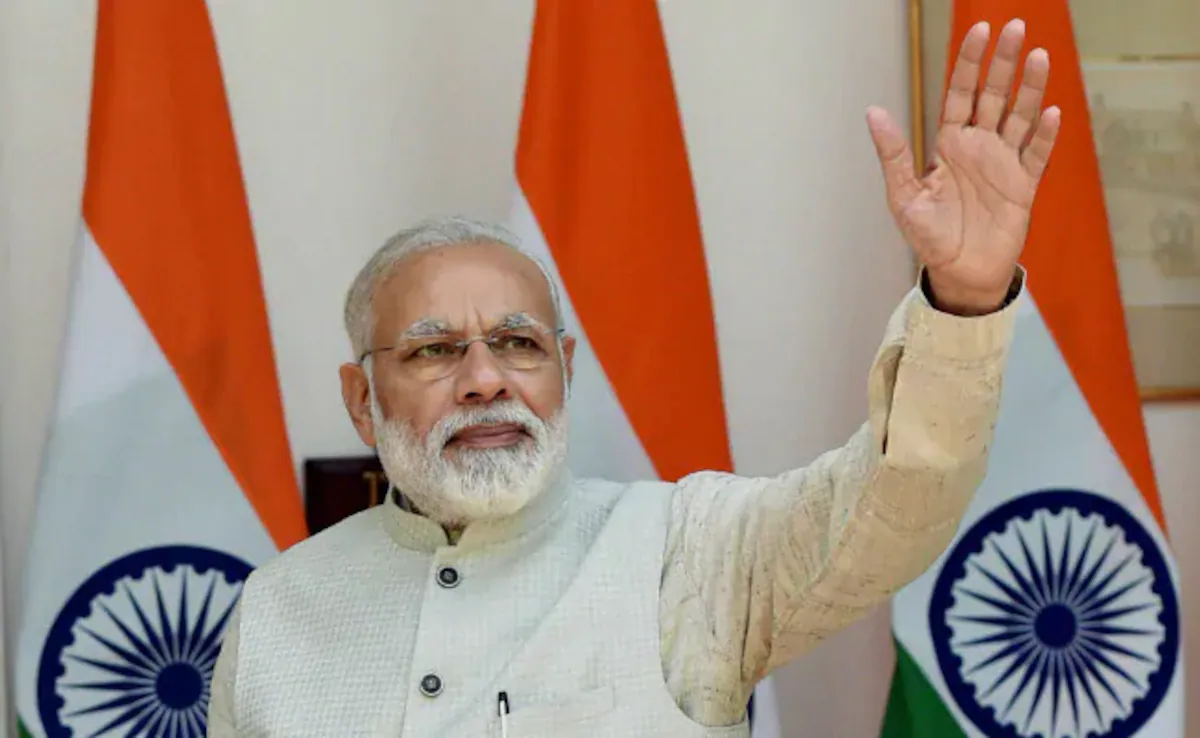
KOLKATA: Prime Minister Narendra Modi’s high-profile visit to Kolkata on August 22 turned into a politically charged event, setting the stage for the Bharatiya Janata Party’s campaign ahead of the 2026 West Bengal Assembly elections. PM Modi delivered a message sharply focused on a four-pronged strategy designed to energize the state BJP and create a robust counter-narrative to the Trinamool Congress (TMC) government. With the Assembly polls less than a year away, PM’s Kolkata visit set the ground rules for the BJP’s Bengal offensive.
By flagging the need to address shifting demography, vaulting Central support, slamming alleged corruption in the TMC camp, and claiming the mantle of development, he charted a clear course for local party cadres. Addressing a massive rally, he began by raising concerns about the changing demography in the border areas of West Bengal, a recurring theme in BJP’s national security discourse. He asserted that “demography is being changed in border areas,” pointing a finger at alleged infiltration and accusing both Congress and TMC of enabling such activity.
According to PM, this phenomenon is not just a local issue but “poses a danger to the country as a whole”. PM Modi announced a “special demography mission against infiltration,” referencing his Independence Day speech as he vowed decisive action. “Those who have come here to snatch the livelihoods of our people, those who have stayed by forging documents... they will have to leave,” he declared, linking demographic change to broader social unrest. The Prime Minister alleged that farmers and tribals in border districts are being deceived, land is being seized, and the fabric of society is threatened—all issues he tied to lax administration under the TMC.
In his second thrust, he underscored what he called the Centre’s generosity in extending unprecedented financial and project support to West Bengal. “Over the past 11 years, the BJP government at the Centre has consistently provided every kind of support for the development of West Bengal,” PM Modi stated, contrasting BJP governance with that of previous governments. He highlighted flagship infrastructure developments inaugurated during his visit, including several new Metro routes—such as Noapara-Jai Hind Bimanbandar, SealdahEsplanade, and BeleghataHemanta Mukhopadhyay lines—aimed at connecting Kolkata’s airport, reducing congestion, and transforming urban mobility.
He also laid the foundation for the 7.2 km six-lane Kona Expressway, a Rs 1,200-crore elevated corridor set to revolutionize port connectivity and regional commerce. “The budget for railways in Bengal has also been increased threefold compared to before,” PM Modi stated, adding that three times more funds have been allocated for National Highways compared to the previous Congress-led UPA government. He tied these investments to a vision of “Viksit Bengal”—a developed Bengal integral to realizing the dream of a “Viksit Bharat”, or developed India. In an unrestrained attack, the PM accused the TMC government of rampant crime and corruption, asserting that funds sent by the Centre are being systematically looted and diverted to benefit TMC cadres. “Crime and corruption have become the identity of the TMC government.
Till the TMC is in power in the state, there will be no development,” he said, calling for “parivartan”—a transformative change—in the state’s political leadership. The Prime Minister cited high-profile scandals, such as the teachers’ recruitment scam, which saw a TMC minister jailed with cash hoards allegedly recovered from his residence. “Another TMC minister is accused of looting the rations of the poor,” the PM added, questioning whether such individuals have the right to remain in government. He asserted: “The real change will come only when the TMC is removed from power... Criminals and corrupt people should be in jail, not in power.”
He extended the charge to the broader misuse of Central funds, saying: “The money that the Central government sends for development is being looted and is spent on TMC cadre,” marking the diversion of welfare schemes away from intended beneficiaries. Drawing parallels, he pointed out that once BJP governments took charge in Assam and Tripura, welfare schemes reached citizens directly, in stark contrast to West Bengal. PM’s final messaging positioned the BJP as synonymous with development across India—a party whose record stands in marked contrast to that of its opponents.
He paid tribute to Dr Syama Prasad Mukherjee, lauding him as the architect of India’s first industrial policy, and lamented that the Congress “never gave due credit” to Bengal’s contributions. “Today, when India is moving towards becoming the third-largest economy, the role of Dum Dum, Kolkata increases further... Today’s India is working for the development of every city,” he declared, pointing to the expansion of Metro networks, green mobility and electric buses as evidence.
“The BJP fulfils every resolution it makes,” he affirmed, alluding to recent successes such as Operation Sindoor on the security front. The PM concluded that West Bengal’s development is not just an isolated aspiration but a national imperative: “It is impossible to fulfil the dream of ‘Viksit Bharat’ without the development of West Bengal, as it is one of the most populous states in India. The BJP believes in ‘Bangalar Uday, Tobei Viksit Bharater Jai’ (The rise of Bengal leads to the victory of a developed India).” Political observer Biswanath Chakraborty told The Sunday Guardian: “Narendra Modi’s message to the state BJP was unequivocal: Bengal’s path to progress depends on defeating the TMC status quo.
The four-pronged strategy announced in Kolkata aims not just to mobilize support but to present the BJP as the only credible alternative capable of delivering prosperity, integrity, and security for all Bengal’s citizens. Now all depends on how far new state president Samik Bhattacharya is able to galvanise the cadre down the line to realise Modi’s vision for Bengal.” TMC FIGHTS BACK Following Prime Minister Narendra Modi’s rally, the Trinamool Congress (TMC) swiftly countered his fourpronged attack, dismissing his allegations of corruption, infiltration, and stalled development under Chief Minister Mamata Banerjee.
TMC leaders Kunal Ghosh and Shashi Panja challenged the claim of Centre’s generosity, demanding a white paper detailing allocations to West Bengal post-2021, following the BJP’s resounding defeat in the last Assembly polls. “Modi remembers Bengal only when elections are near. His visit is only to befool people. Migratory birds may fly in, but Bengal does not give them nests,” said a TMC statement, accusing the Prime Minister of political opportunism and selective engagement.
TMC leaders slammed the BJP for double standards, citing the continued party membership of Suvendu Adhikari, who was earlier named in corruption allegations. They rebuffed the PM’s reference to the Constitution (130th Amendment) Bill—proposing removal of a corrupt CM or PM if jailed for 30 days—as political grandstanding unlikely to pass Parliament. Ghosh alleged that PM Modi was targeting opposition parties through such laws, while inducting “tainted” leaders into the BJP fold.
On the issue of border infiltration, TMC insisted it was the Ministry of Home Affairs’ job to secure the borders. Ghosh pointed out, “If illegal intruders are a problem, Amit Shah is responsible,” adding that infiltration—like the entry of Rohingyas—was also occurring via BJP-ruled Tripura, undermining PM’s argument that only Bengal was at risk. Regarding development, Panja claimed unemployment had skyrocketed under the NDA government and credited Bengal’s progress to Mamata Banerjee, not the BJP.
She demanded that the Centre clear Bengal’s dues of Rs 1.93 lakh crore and noted that major initiatives like “Banglar Bari” were being provided without Central assistance. The TMC also attacked the BJP’s anti-corruption record, pointing out that only eight convictions resulted from nearly 6,000 Enforcement Directorate cases and that many BJP MPs faced criminal charges.
Ghosh stated, “People have witnessed the scale of corruption in BJPruled states.” Confident about the upcoming elections, Ghosh forecast a fourth consecutive term for Mamata Banerjee with a record number of MLAs, reiterating that Bengal’s electorate would again reject the BJP. TMC’s leaders maintained that PM’s charges are politically opportunistic, deflecting BJP’s own shortcomings, and Bengal’s development story belongs to its own government—not to the Centre.
