
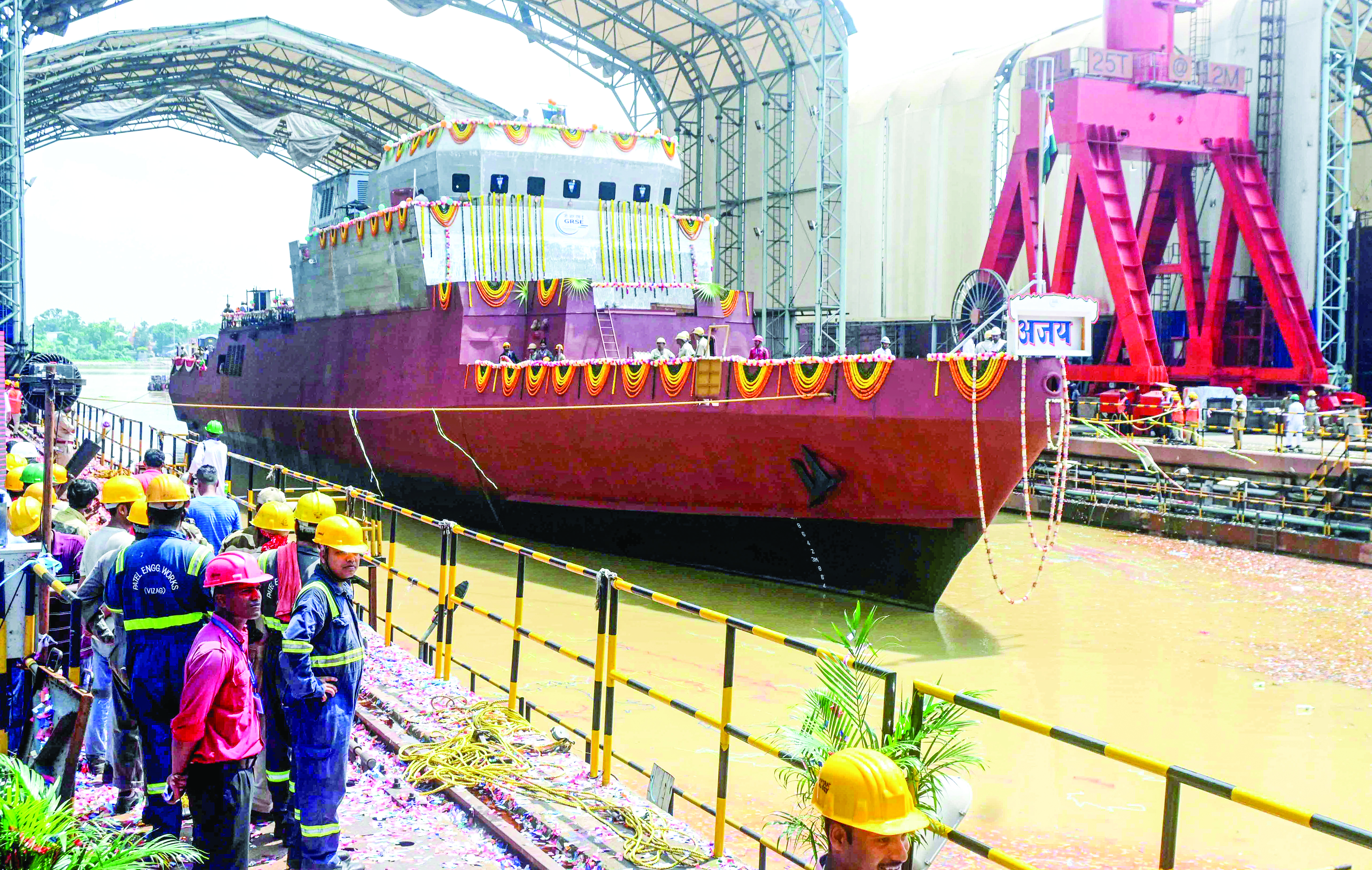
NEW DELHI: On 21 July this year, at the Garden Reach Shipbuilders and Engineers (GRSE) facility in Kolkata, confetti drifted through the air as the Indian Navy’s newest anti-submarine warfare (ASW) vessel gently touched the waters for the first time. The vessel, aptly named Ajay, is the eighth and final craft in a series of specialised Anti-Submarine Warfare Shallow Water Crafts (ASWSWC). Its launch marked not merely the completion of a naval shipbuilding contract, but a significant milestone in India’s larger effort to counter submarine threats in its maritime backyard.
The importance of vessels like Ajay is clear: Indian waters are no strangers to submarine threats, particularly given the evolving geopolitical dynamics in the Indo-Pacific region. With increasing naval activity from China and Pakistan, particularly in submarine construction and deployment, India’s Navy has been quietly but steadily enhancing its anti-submarine capabilities. Defence experts widely acknowledge that India’s current ASW modernisation effort is among the most comprehensive underway anywhere in the Indo-Pacific.
The ASW Shallow Water Crafts, such as Ajay and its sister ships like INS Arnala—commissioned on June 18, 2025—are specifically tailored to operate effectively in the littoral zone, where waters are shallow, noisy, and traditionally challenging for submarine detection. According to official GRSE statements, these warships are equipped with advanced sonars, including Hull-Mounted Sonars and Low-Frequency Variable Depth Sonars (LFVDS).
They pack an extensive arsenal comprising lightweight torpedoes, anti-submarine rockets, and sea mines. Additionally, they’re fitted with defensive armament such as a 30 mm Close-in Weapon System (CIWS) and 12.7 mm Stabilised Remote-Control Guns, enabling these vessels to engage multiple threats simultaneously. Beyond coastal operations, India’s anti-submarine strategy extends into deeper waters. To secure the vast stretches of the Indian Ocean, the Indian Navy has developed a formidable multilayered ASW capability, integrating large surface combatants, airborne patrol platforms, and sophisticated underwater surveillance networks. At sea, the Kamorta-class corvettes and the stealthy Nilgiri-class frigates—part of the ongoing Project 17A initiative—are among India’s frontline blue-water ASW vessels.
Equipped with advanced sensors, these warships can conduct extensive submarine detection and tracking missions far beyond coastal waters, ensuring maritime dominance well into the oceanic expanse. In the air, the Indian Navy has significantly strengthened its capabilities with advanced US-made aircraft and helicopters. The Boeing P-8I Poseidon maritime patrol aircraft has emerged as a cornerstone asset, providing unmatched long-range detection, tracking, and prosecution of submarines across the Indian Ocean. Additionally, the recent induction of MH-60R Seahawk helicopters has dramatically enhanced the Navy’s rapid-response capability against underwater threats.
Defence establishment sources emphasise the transformational impact of these aerial assets, highlighting their critical role in swiftly identifying and neutralising potential submarine threats before they approach strategic maritime zones. Equally critical are India’s indigenous advancements beneath the waves. The Defence Research and Development Organisation (DRDO), along with Naval Physical and Oceanographic Laboratory (NPOL) and Naval Science and Technological Laboratory (NSTL), have jointly developed a robust network of underwater sensors and unmanned underwater vehicles (UUVs).
These autonomous technologies significantly expand India’s surveillance capability, enabling persistent monitoring of critical maritime areas such as the Malacca Strait, the Gulf of Aden, and the Mozambique Channel—strategic chokepoints crucial to global maritime commerce and India’s national interests. According to senior naval officials, this integrated underwater sensor grid is unprecedented in scale and sophistication for the Indian Navy. The comprehensive network enhances situational awareness, dramatically reducing the risk of surprise submarine intrusions. This multi-dimensional expansion reflects a strategic shift within Indian naval thinking—from reactive coastal patrolling to proactive maritime deterrence. Senior officials within India’s defence and security establishment describe this shift as crucial in countering growing Chinese and Pakistani naval activities in the region.
China, despite fielding a numerically superior submarine force—including nuclear-powered and airindependent propulsion (AIP) submarines—faces significant operational issues. Defence analysts highlight maintenance problems, limited acoustic stealth, and performance limitations as recurring issues in Chinese-made submarines. Chinese submarine exports to countries like Myanmar and Bangladesh have reportedly encountered reliability and operational problems, further eroding confidence in Beijing’s submarine technology capabilities. Pakistan’s submarine ambitions face similar hurdles. The much-touted Hangorclass submarine project, developed jointly with China and derived from the Chinese Type 039B design, remains delayed and operationally unproven. Defence analysts have consistently raised concerns about its integration, reliability, and combat readiness, particularly given Pakistan’s history of inconsistent performance in submarine operations.
Against this backdrop, India’s growing ASW strength creates a substantial strategic advantage. Defence experts from institutions such as the Observer Research Foundation, Jane’s Defence, and the Institute for Defence Studies and Analyses have broadly noted the widening capability gap between India’s increasingly modernised fleet and the problematic submarine programs of its regional adversaries. Looking ahead, India’s naval ambitions continue to grow unabated. With 16 warships currently under construction at GRSE alone—including advanced frigates, survey vessels, and offshore patrol vessels—India aims to operate one of the most advanced ASW fleets in the Indo-Pacific by 2030. Such sustained investments emphasise India’s determination to maintain maritime superiority. Indeed, vessels such as Ajay, Arnala, and their sister ships stand as clear symbols of India’s maritime aspirations and commitment to securing its waters from evolving submarine threats.
These platforms, part of a broader strategic shift, collectively represent India’s transformation into a maritime power increasingly capable of asserting regional dominance and safeguarding critical sea lanes. For potential adversaries contemplating intrusions beneath the waves, India’s rapidly evolving anti-submarine capabilities deliver an unmistakable message: the silent hunters of the Indian Navy have decisively reshaped the strategic landscape beneath the Indian Ocean, establishing India’s underwater dominance quietly yet firmly. * Ashish Singh is an awardwinning senior journalist with over 18 years of experience in defence and strategic affairs.




