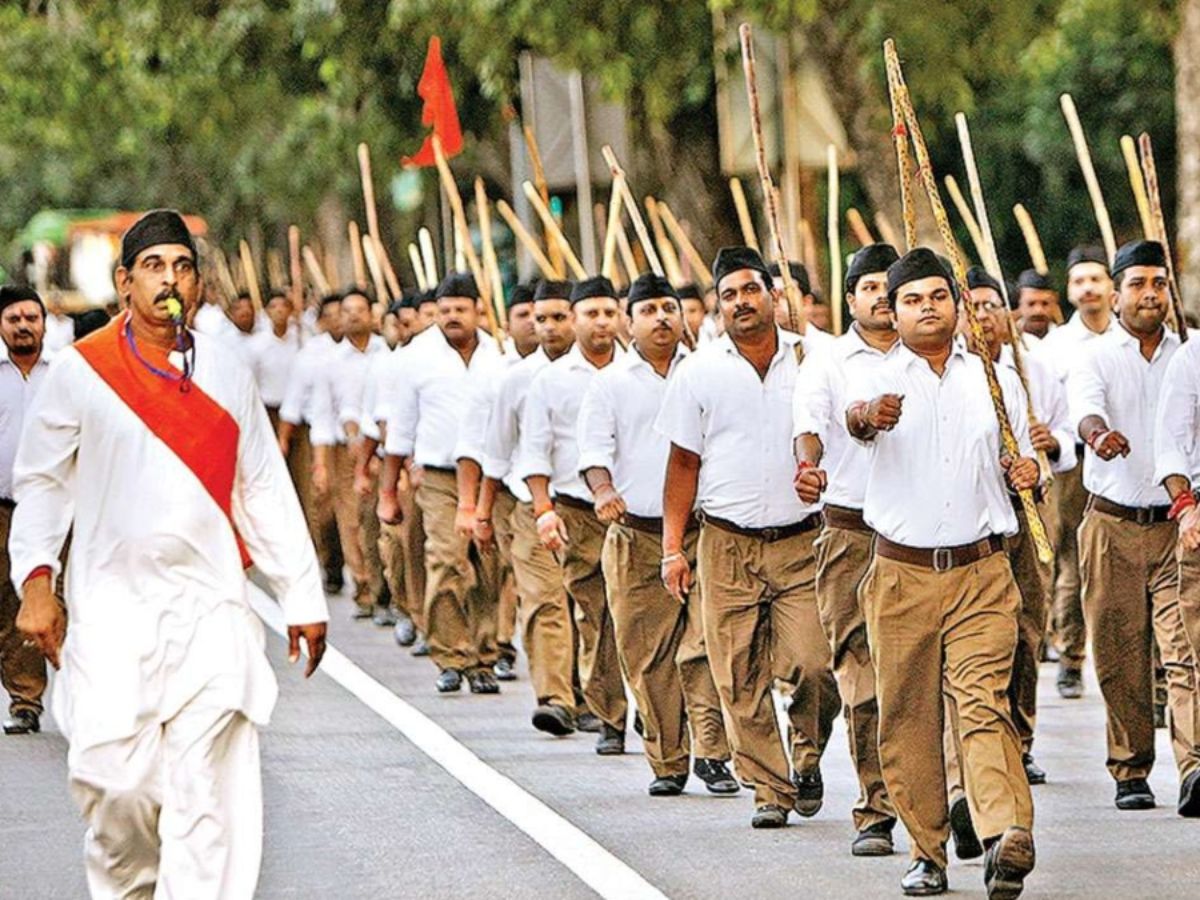
The RSS and the move towards increased inclusiveness (Image: X)
Washingt on, DC/New Delhi: When the government of Indira Gandhi declared a state of Emergency on 25 June 1975, RSS workers expected a crackdown by the government because of their active role in spreading the protests against corruption and poverty. The wrath had more to do with RSS’ support for the student movement in Bihar which the government interpreted as the main cause for the strengthening protest movement led by Jayaprakash Narayan, who had acquired a national reputation and following for his reform efforts. Madhukar Dattatraya Deoras (aka Balasaheb) had recently assumed position as the third RSS head (1973-1994) and had already put the organization on a much more activist path than that of his predecessor, the religiously inclined Madhav Sadashiv Golwalkar (1940-1973), who focused on rebuilding the RSS after the 1947-1948 ban on it for its alleged role in fomenting violence in the aftermath of Independence. Deoras’ first public speech, in fact, denounced the caste system, especially its treatment of those at the bottom. He also developed a positive relationship with Narayan, whose work he admired.
Narayan, in turn, also developed an admiration for the more activist activities of the RSS under Deoras on behalf of the poor and powerless. Narayan, while addressing an RSS training camp in Bihar, said “the RSS is truly a revolutionary organization. No other organization in the country comes anywhere near it. It alone has the capacity to organize the society. Its very name is rashtriya or national. You call your organization Rashtriya Swayamsevak Sangh, not Hindu Swayamsevak Sangh.”
Although much has been written about the Emergency and its excesses, much less is known about the activist roles of the RSS and Deoras in opposing it. Balasaheb Deoras, the Sarsanghchalak, along with other senior and junior RSS functionaries, was arrested during the 1975-1977 Emergency. Deoras and his RSS colleagues used the occasion to meet and work with a broad swathe of Indian public opinion—and work out areas for cooperation while they were in jail. This cooperation extended long after the Emergency ended.
The arrests and the Emergency did however make a huge difference in the calculations of the RSS members on politics and the larger issue of inclusiveness, especially after their release from jail. They were pressuring their leadership to take on an activist stand on reform projects, politics being one. Some even advocated making the RSS a political party. While every RSS head, including Deoras, has rejected this proposal, the experience opened up possibilities to take a much more activist stand, including in politics. On March 12, 1978, at the RSS Pratinidhi Sabha meeting (the RSS national parliament), Deoras said, “politics could not be considered undesirable just because some people have slipped; like one cannot stop bathing just because we slipped in the bathroom.” On April 15, 1978, he outlined the changing course within the Sangh and said, “under Hedgewar, RSS had a political orientation and under Guruji [Golwalkar], a cultural orientation and now the RSS will have a social orientation.” Clearly defining what the term Hindu meant, he said, “Hindu is an eclectic term that connotes a national ethos, national tradition. Muslims and Christians residing in our country are not foreigners.”
He clearly defined the term “Hindu” in a cultural and geographical term, not necessarily as a religious one, though Hinduism as a religion contains important cultural and philosophical elements that constitute the larger context of what it is that makes one Indian. Critics have, however, stressed more on its Hindu religious meaning rather than its cultural sense, which has often informed the oft-repeated critique of the Sangh as being anti-Muslim and anti-Christian, which ignores much evidence to the contrary. These inclusive aspects have been constantly reinforced by the RSS, most forcefully by Deoras and recently by Mohan Bhagwat, the current Sarsanghchalak (2009-present). About 1,200 swayamsevaks attended the RSS camp in Jammu where Deoras in his speech said the RSS version of Hindu rashtra includes all Indians irrespective of religion. All Christians and Muslims in the country are, he argued, Hindus culturally and ethnically. All Indians, he further said, have the same fathers. The Sangh, therefore, considers the term Hindu and Bharat synonymous, but the Sangh would not give up the term Hindu just because some people don’t like it. Deoras’ speech covered three elements: (1) the common ancestry and shared history regardless of religious orientation; (2) the inclusiveness of the term “Hindu”; and (3) a message to people on the outside that the RSS was going to be more forthcoming in explaining its stance on how it would achieve its goal of social cohesion through greater inclusiveness.
On March 11, 1979, Deoras said in a speech there was no reason to give up the RSS’ basic constructive work of Hindu Sanghthan (unity) and uplift of society even as the former Jan Sangh elements in the Janata Party organized with their political colleagues from the resistance to form a government in post-Emergency India. Nor do we intend, he argued, to enter the arena of power politics or have any desire for power or fame, a stand that has been upheld by all six of the RSS leaders. This was a powerful statement as it sought to answer those who have accused the Sangh of being power hungry, especially in the context of the Janata Party government having members associated with the RSS. The dual membership issue between the Jan Sangh and the RSS on the one side and the rest of the Janata Party on the other was a constant irritant and a hindrance that prevented the Janata from emerging as a cohesive unit. It also led to the formation of the Bharatiya Janata Party that now rules India under the leadership of Narendra Modi, a former pracharak (full time worker) of the RSS.
The RSS, at least at the leadership level, now sees its major goal the creation of a social space at all levels of the organization starting with the neighbourhood shakha, where people from all levels of society can interact with each other as equals and comrades. This extends to the dozens of affiliates that were established to address specific areas impacting the lives of Indians (labour, students, farmers, political workers etc). With the possible exception of the Vishwa Hindu Parishad (which deals with the Hindu ecclesiastical establishment), the RSS and all its affiliates include people from all religions and regions and social strata. While there is a women’s affiliate (one of the first established in the 1930s), all now include women, and its Indian affiliate for women often works closely with the RSS and the other affiliates on a wide range of projects. The overseas national affiliates, such as the ones in the US and the UK, include women and girls. The focus on inclusiveness is now a core element in what the RSS ideology is all about. It is perhaps best argued in Deendayal Upadhyaya’s notions on what he referred to as integral humanism.
Dr Walter K. Andersen, Senior Adjunct Professor of South Asia Studies at Johns Hopkins University, has, along with Shridhar Damle, written two books on the RSS, “The Brotherhood in Saffron: The Rashtriya Swayamsevak Sangh and Hindu Revivalism” (1987); and “The RSS: A View to the Inside” (2018). Dr Aishwarya Pandit is Professor at Jindal Global Law School.
