
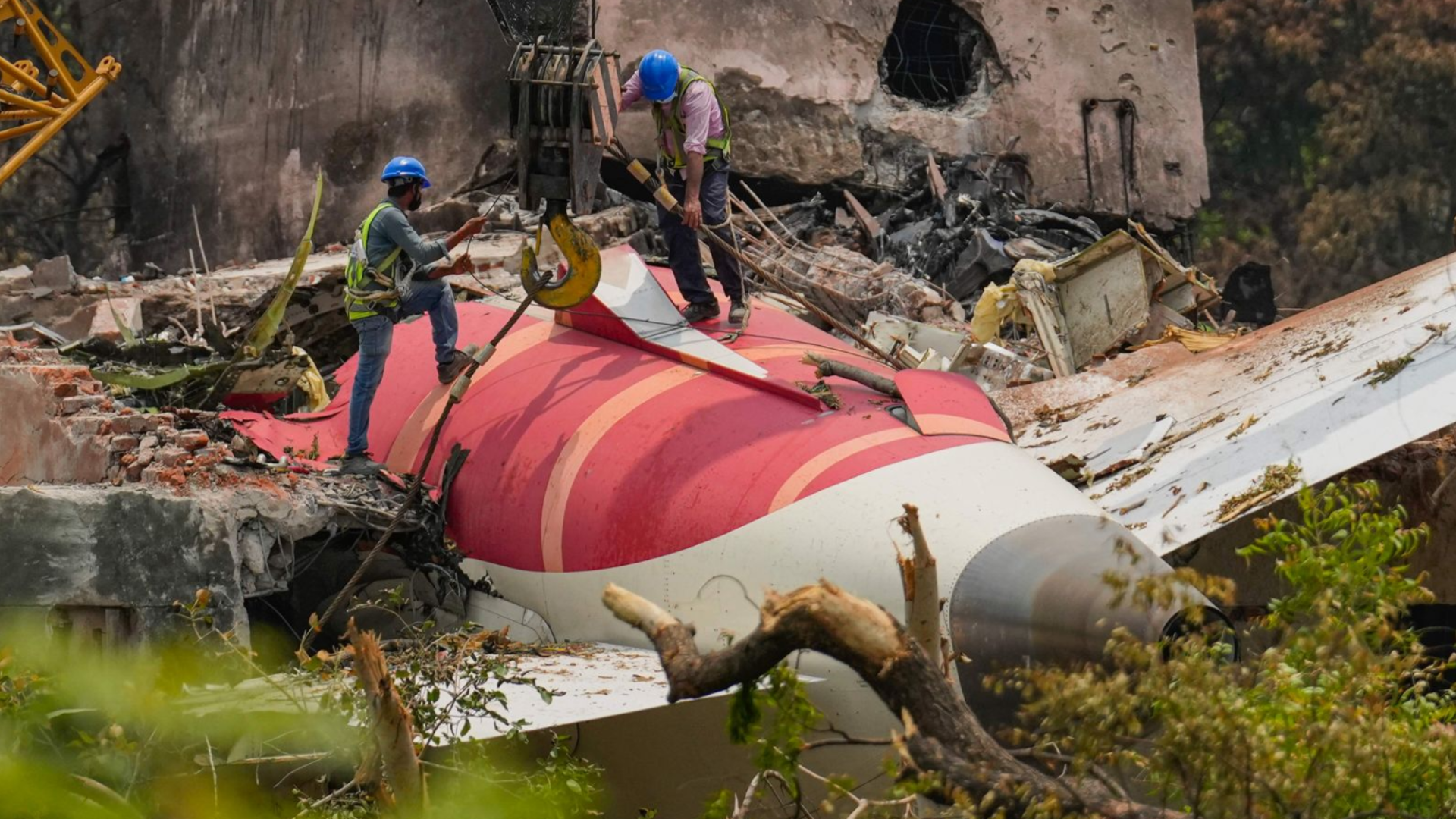
NEW DELHI: A preliminary report into the catastrophic crash of Air India’s Boeing 787-8 Dreamliner (VT-ANB) that killed over 260 people last month in Ahmedabad has highlighted anomalies in engine control behaviour, with no current evidence implicating pilot error a narrative that was pushed by some sections, especially in international media. Flight AI171, bound for London Gatwick, crashed on 12 June 2025, just seconds after take-off from Sardar Vallabhbhai Patel International Airport.
The aircraft failed to gain altitude and struck the BJ Medical College Hostel, killing 241 onboard and 19 people on the ground. Only one passenger survived. According to the 15-page preliminary report prepared by the Aircraft Accident Investigation Bureau (AAIB), the crash followed the near-simultaneous shutdown of both engines. The aircraft’s flight data shows that both engine fuel control switches transitioned from “RUN” to “CUTOFF” within one second of each other during initial climb, cutting off fuel supply. According to data retrieved from the aircraft’s Enhanced Airborne Flight Recorder (EAFR), the aircraft reached its maximum indicated airspeed of 180 knots at 08:08:42 Coordinated Universal Time (UTC) (13:38 Indian Standard Time, IST). Immediately afterward, both fuel control switches transitioned from “RUN” to “CUTOFF”—Engine 1 first, followed by Engine 2 one second later. This caused the N1 and N2 values (engine fan and core speeds) to drop rapidly. One pilot is heard asking, “Why did you cut off?” with the other responding, “I didn’t do so.”
The exchange has been documented by investigators as part of the cockpit voice recording and is considered significant in reconstructing the final moments. The circumstances—particularly the near-simultaneous engine shutdown and the crew’s clear surprise—have brought attention to possible anomalies within the engine control systems, which are under review. Although the flight data clearly shows that both engine fuel control switches transitioned from “RUN” to “CUTOFF” mid-air (Page 14), the switches were physically found in the “RUN” position in the wreckage (Page 10).
The AAIB report does not offer a definitive explanation for this discrepancy. It remains unclear whether the switch positions changed due to postimpact forces or if a system malfunction caused the engines to shut down despite the switches not being physically moved. The issue is under investigation. Investigators recovered approximately 49 hours of flight data covering six flights, including the accident flight, and two hours of cockpit voice recordings from the Enhanced Airborne Flight Recorder (EAFR). The recovered audio captured the sequence leading up to the crash, including the final exchange between the pilots.
As per industry insiders, the fuel control switches on the Boeing 787-8 are located between the two pilots, behind the thrust levers, and are protected by a locking mechanism to prevent accidental activation. For both switches to move from “RUN” to “CUTOFF” in rapid succession typically requires manual action— something not corroborated by the cockpit voice data.
The aircraft began to lose altitude before it could clear the airport perimeter wall. CCTV footage showed the Ram Air Turbine (RAT) deploying during the initial climb, a sign of critical loss of engine power and electrical systems. As per flight data, both engines’ N2 values had dropped below minimum idle speed, prompting the RAT’s hydraulic pump to begin supplying power. The RAT, a small wind-powered emergency turbine, deploys automatically during total engine failure to provide hydraulic power needed to keep essential control systems functioning. At 08:08:52 UTC (13:38 IST), the Engine 1 fuel switch was moved back to RUN, followed by Engine 2 at 08:08:56 UTC (13:38 IST), triggering the automatic relight sequence managed by the Full Authority Digital Engine Control (FADEC) system. Exhaust gas temperatures (EGT) began rising in both engines, indicating ignition. In simple terms, N2 refers to the speed of the engine’s high-pressure core—the part responsible for keeping the engine running by compressing air and sustaining combustion.
When both engines’ N2 values dropped, it meant the core sections of the engines had effectively shut down, cutting off thrust and making it impossible for the aircraft to maintain altitude. Engine 1’s core deceleration stopped and began to reverse, showing signs of recovery. In contrast, Engine 2 struggled to maintain core speed, with fuel reintroduced multiple times, in an effort to relight. Relight was automatically initiated, but the aircraft was already too low for the engines to recover in time. The EAFR recording ended at 08:09:11 UTC (13:39 IST), moments before the crash. Wreckage findings indicate that both thrust levers were found in idle position, flight data confirms they remained forward at take-off power until impact (Page 10).
The reverser levers, though bent from the crash, were still in their normal stowed position, indicating they were never deployed (Page 10). Additionally, the flap handle and landing gear lever were found correctly set for take-off (Page 10), and the APU inlet door was open—consistent with the aircraft’s automated emergency response (Page 10). These details point to a properly configured aircraft and no apparent errors by the crew (Pages 10, 14-15). As per the report, U.S. Federal Aviation Administration (FAA) had issued a Special Airworthiness Information Bulletin (SAIB NM-18-33) on 17 December 2018, warning of potential disengagement of the fuel control switch locking mechanism.
The advisory was based on reports involving Model 737 aircraft but noted that the same locking feature design— specifically part number 4TL837-3D—was used in multiple Boeing aircraft, including the B787-8. While the concern was not deemed severe enough to merit an Airworthiness Directive, and therefore not mandatory, Air India confirmed it did not conduct the suggested inspections on VT-ANB, as the SAIB was purely advisory in nature (Page 6).
Maintenance records show that the throttle control module on VT-ANB had been replaced in 2019 and again in 2023, though the replacements were not linked to the fuel control switches. No related defects had been reported since 2023, the report said. All other aircraft and crew parameters were found to be within normal limits. The flaps were set correctly at 5°, fuel quality was verified, the pilots were medically fit and adequately rested, and no bird activity or dangerous goods were recorded on board. At this stage, the AAIB has not recommended any action for other B787-8 or GE GEnx-1B engine operators. The investigation remains open, with further analysis pending of the throttle quadrant, mechanical switch assemblies, and other recovered components.
The final report is expected to examine whether a latent design issue, overlooked advisory, or rare mechanical fault contributed to the event. Following the late Friday release of the AAIB preliminary report—when global markets were closed—Boeing issued a statement saying it would defer to the AAIB for information on AI171, in line with Annex 13 of the International Civil Aviation Organization (ICAO), which assigns investigatory responsibility to the national authority where the incident occurred. As per ICAO rules, manufacturers, operators, and other stakeholders may participate in investigations but are not permitted to release public statements independently during the inquiry. Air India also issued a public statement following the report’s release early Saturday morning. “Air India stands in solidarity with the families and those affected by the AI171 accident. We continue to mourn the loss and are fully committed to providing support during this difficult time.
We acknowledge receipt of the preliminary report released by the Aircraft Accident Investigation Bureau (AAIB) today, 12 July 2025. Air India is working closely with stakeholders, including regulators. We continue to fully cooperate with the AAIB and other authorities as their investigation progresses. Given the active nature of the investigation, we are unable to comment on specific details and refer all such enquiries to the AAIB,” the airline said on X.




