
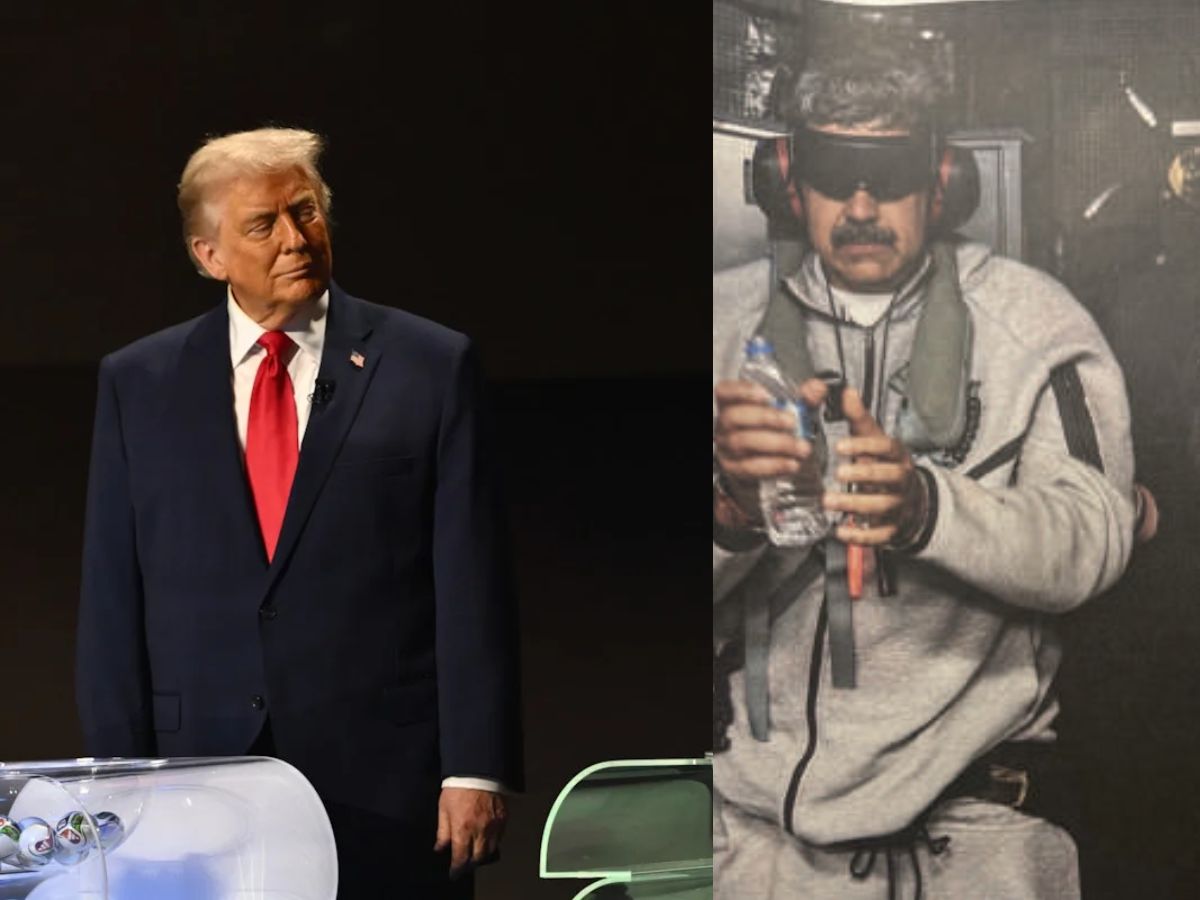
New Delhi: The United States on Saturday carried out a direct military operation in Venezuela that resulted in the capture and removal of President Nicolás Maduro, marking one of the most consequential US interventions and regime changes in the western hemisphere in decades and a sharp escalation from years of sanctions, diplomatic pressure, and covert efforts to isolate his government. Washington described the action as a limited “special military operation”, involving air and special ground assets inside Venezuelan territory. US officials said the operation was aimed at detaining Maduro on longstanding criminal charges filed in US courts and restoring “democratic order” in the country. President Maduro and his wife Cilia Flores would be flown to the US and tried for “narcoterrorism” conspiracy and other related charges, officials said.
While operational details remain contested, the intervention represents a rare instance in which the United States has openly used military force to remove a sitting head of state without a prolonged conflict or an accompanying occupation. The White House said the action followed years of failed diplomatic initiatives and economic sanctions intended to pressure the Maduro government, which Washington accuses of large-scale corruption, narcotics trafficking, and human rights abuses. US officials cited federal indictments and “narco-terrorism” allegations against Maduro as part of the legal rationale for the operation. President Donald Trump did not seek or receive explicit congressional authorization prior to the strike. In recent weeks, the US Congress had debated, and rejected, measures that would have required congressional approval before further military action against Venezuela or Venezuelan-linked targets. The administration maintained that the operation fell within the president’s constitutional authority.
The timing of the intervention has drawn particular attention internationally. Just hours before the US action, Maduro had hosted a senior Chinese delegation at the Miraflores Presidential Palace in Caracas, sent by President Xi Jinping, to reaffirm bilateral ties and review extensive cooperation agreements covering energy, infrastructure, and finance. China has been one of Venezuela’s principal economic partners for nearly two decades, investing tens of billions of dollars in the country since 2007 and remaining a major purchaser of Venezuelan crude oil. Analysts said the US move appeared to signal that Chinese diplomatic and economic engagement would not deter American military action in the western hemisphere.
Russia, another key backer of the Maduro government, also did not respond militarily. Moscow has supplied arms to Venezuela over the years, including air defence systems, and signed a strategic partnership agreement with Caracas last year. The Kremlin issued a statement condemning the US operation but stopped short of announcing retaliatory measures. Analysts said the lack of response from either Beijing or Moscow could have broader implications for their perceived ability to protect partner governments facing US pressure outside their immediate regions.
Energy considerations are also central to the geopolitical context. Venezuela holds the world’s largest proven crude oil reserves, a factor that has long shaped its strategic importance. While US officials did not frame the operation in energy terms, analysts said control over political decision-making in a major oil-producing state could influence future access, financing, and export flows, particularly amid tightening global energy markets.
Beyond Venezuela, the operation has prompted renewed debate over international norms governing the use of force. By detaining a sitting head of state without a United Nations Security Council mandate, the United States has tested long-standing assumptions about sovereign immunity and the limits of unilateral military action. No Security Council authorisation was sought or obtained, and no immediate cross-border threat was cited publicly by Washington.
Comparisons are already being drawn with earlier US interventions. Unlike Iraq in 2003 or Afghanistan in 2001, the Venezuela operation did not follow a full-scale invasion or extended military campaign. Libya in 2011 came closer in form, but that intervention unfolded amid a civil war and under a Security Council resolution authorising civilian protection. Venezuela, by contrast, was not formally in a state of civil war, and the government retained control over most of the country prior to the operation. Regime change was achieved through a rapid, leadership-focused action rather than through prolonged conflict.




