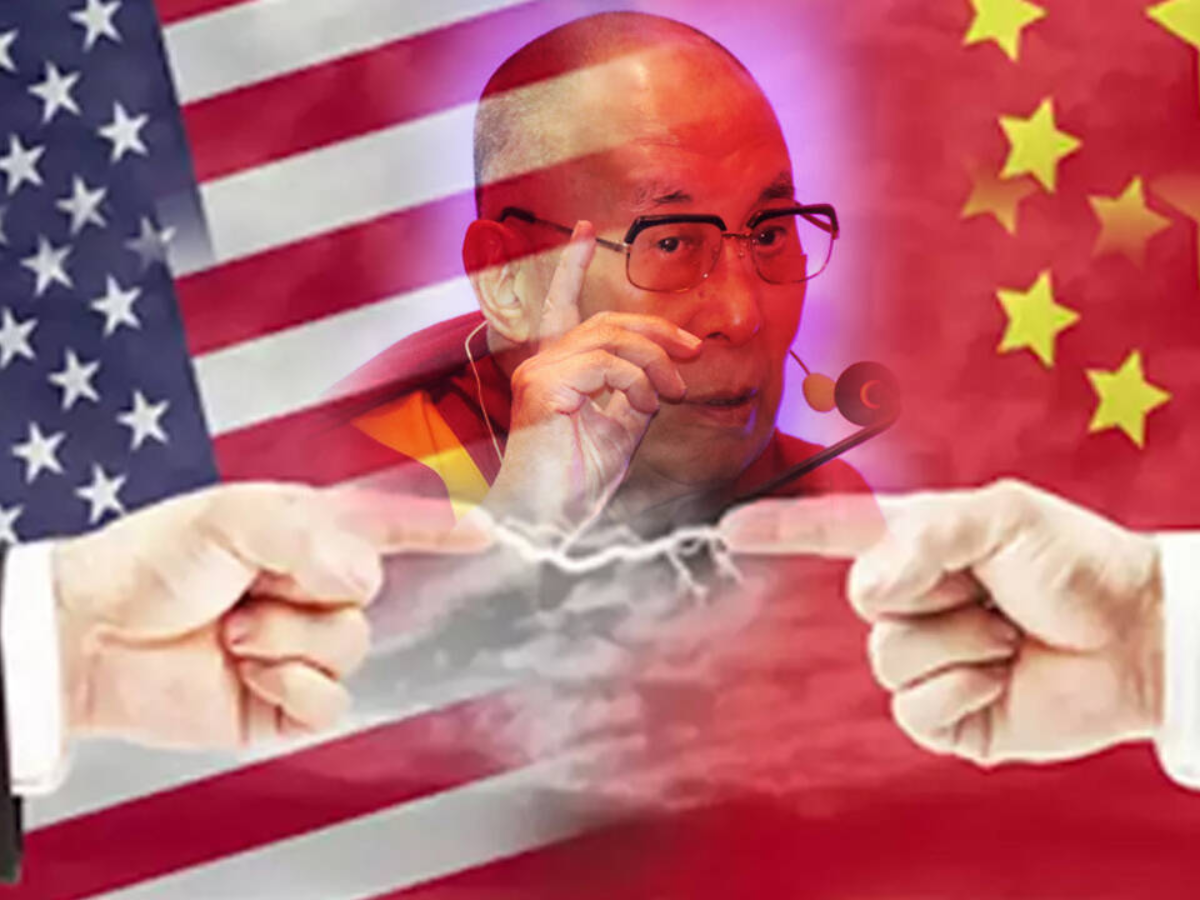
NEW DELHI: Books, especially on geopolitics, and think-tanks occasionally either contribute, or point to, the thinking of a government or growing tensions. In the backdrop of the current tensions between the United States and China, one of the leading US think-tanks, the Washington-based Hudson Institute, released a report in July titled “China Post Communism: Preparing for a PostCommunist China”. Edited by Miles Yu, who served as China Advisor to US President Donald Trump during his first term, the book comprises 10 chapters, four of which are by contributors who have chosen to remain anonymous.
Quite apart from the provocative title of the report, the various chapters too deal with specific subjects centring on replacing the Chinese Communist Party (CCP) and China’s current government and military establishments with alternate structures. It is almost like a guide to the dismantling of the CCP and the reshaping of present-day China. The report and its editor, Miles Yu, who has earlier exhibited some penetrating insights into the Chinese leadership and is no stranger to criticism by China, can be expected to attract Beijing’s ire.
The titles of the chapters reveal the broad scope of the authors’ vision for the future China. The chapters are titled: OSS in China Again: The Role of US Special Operations Forces after CCP Collapse; Targeting Bioweapons Facilities with Precision after a CCP Regime Collapse: Key Assets and Locations, Mission Options, and Strategic Execution Plan; Restructuring the Chinese Financial System after CCP Collapse: Recapitalization, Repudiation, Privatization, and Decentralization; Securing China’s Assets in America; Securing and Restructuring the PLA, PAP, and People’s Militia; Spy Versus Spy Versus Spy: The CCP’s Security and Espionage Apparatus in the Absence of Central Authority; China’s Autonomous Regions and Human Rights; How to Initiate a Truth and Reconciliation Process in China; and A Constitutional Convention Plan. Of special relevance to Tibetans, and to India in the context of the XIVth Dalai Lama’s reincarnation in the future, is the chapter on China’s ethnic minorities.
The chapter states that: “The plan depends on US leadership and cooperation with partners in existing international alliances that focus on China. While no single international or regional political infrastructure is available to serve this purpose, US partners could include the countries in the trilateral security pact for the Indo-Pacific region, AUKUS (a security pact that includes Australia, the UK, and the US).
In addition, they could include New Zealand and Canada, which are part of the Five Eyes intelligence-sharing alliance already in place, and regional allies Taiwan, Japan, South Korea, India, and the Philippines. Some of these nations are part of the Quadrilateral Security Dialogue, or Quad, which focuses on Indo-Pacific security and which some observers are already viewing as a potential Pacific NATO.”Captioned “China’s Autonomous Regions and Human Rights”, the chapter’s author Nina Shea, whose professional background is that of a Christian activist and human rights lawyer, has regrettably glossed over the fundamental problems of China’s ethnic minorities. Specifically, she has prioritised Hong Kong and the Falun Gong over China’s ethnic minorities, who, after being subjugated, suffered Chinese oppression for over 80 long years.
The aspirations of China’s three largest ethnic minorities, namely the Tibetans, Uyghurs and Mongols, for self-determination or independence have largely been ignored. Tibet and the XinjiangUyghur Autonomous Regions together also account for nearly 60% of the total land area of the present-day People’s Republic of China. The main concerns of the Tibetan, Uyghur and Mongol peoples is the preservation of their language, culture and history, all of which are being systematically and progressively erased by the Chinese Communist authorities.
These, they feel, cannot be preserved unless they become independent. Their real demand, therefore, is for independence. However, the report hedges US support and ambiguously says “American support for independence should depend on the will of the people of the province, various regional factors, and conditions that Washington defines in a set of guidelines reflecting US government interests. The US government should adopt principles to determine which autonomous provinces aiming to separate from China merit American support.” The report thus appears to leave an unaddressed open wound in the imagined new, non-communist China that the report seeks to portray.
Additionally, Nina Shea states quite definitely that the XIVth Dalai Lama decided on greater autonomy instead of independence. It is probable, however, that the XIVth Dalai Lama opted for greater autonomy in order to avoid the shedding of Tibetan blood in case the people rose against the better armed Communist Chinese State. She has also underplayed the fears of the Chinese leadership that the estimated 7 million Tibetans—their number is incorrectly mentioned as 3.4 million—in China could turn violent like the Uyghurs.
That has been one of the reasons for the Chinese negotiating with the Dalai Lama’s special envoys. Considering that the report seeks to outline the contours of a proposed new, non-communist Chinese state, China’s ethnic minorities and particularly the Tibetans, Uyghurs and Mongols will probably feel let down that their cause hasn’t received the attention and support it deserves. The report has also come when the new US Administration is yet to appoint a Special Coordinator for Tibet. It additionally seems to fall short of the support advocated in the “Promoting a Resolution to Tibet-China Dispute Act”, better known as the Resolve Tibet Act, passed by the US Congress in June 2024.
The author is President of the Centre for China Analysis and Strategy
