
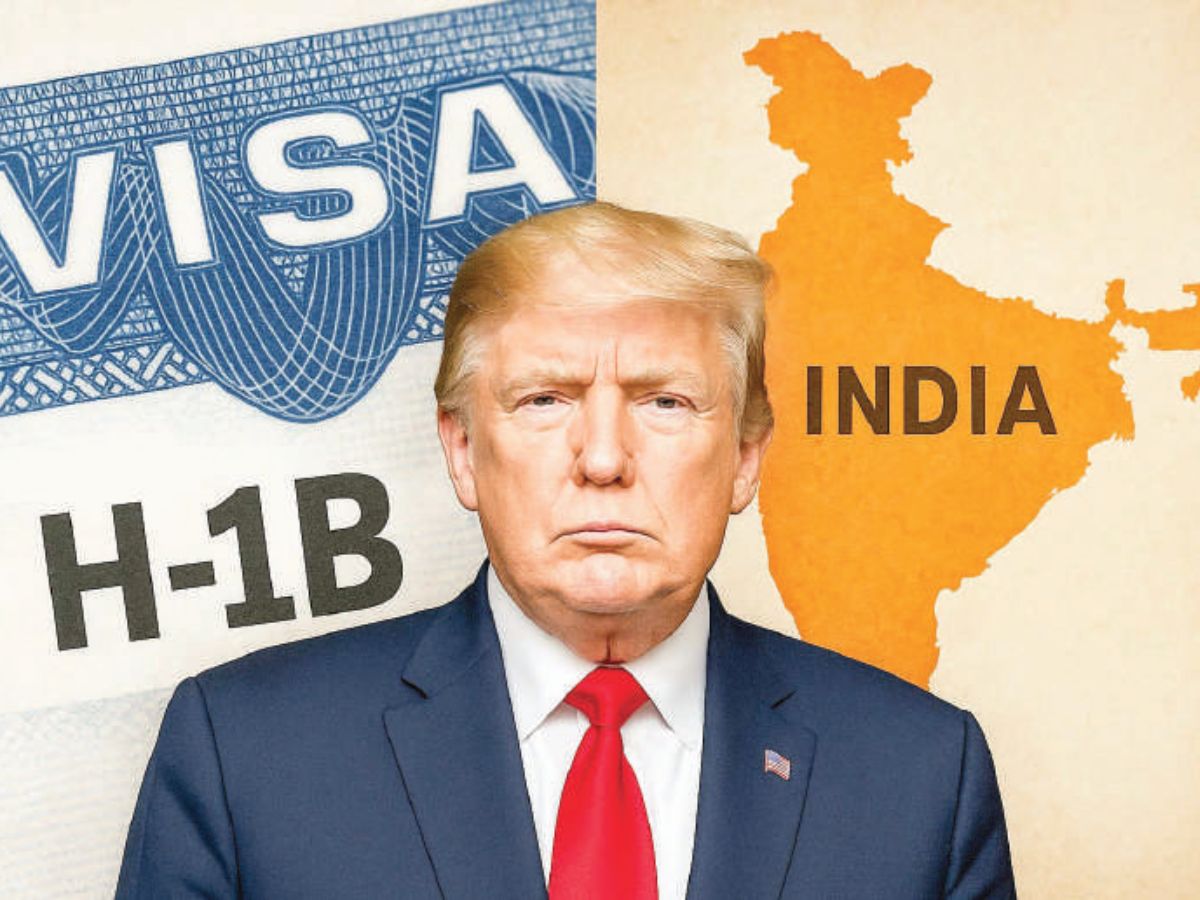
Mumbai: It began with a signature. On a brisk September day in 2025, President Trump’s administration enacted a sweeping new rule: any U.S. company hoping to employ a high-skilled worker on the H1B visa would have to pay a staggering $100,000 fee for every new application. With one stroke, the world’s most sought-after employment pass became an elite ticket beset with unprecedented costs. And as the new reality settles in, it’s clear that this was not just an American policy change—it is a global turning point, sending ripples from San Francisco to Shenzhen, Bengaluru to Berlin, and igniting what many now describe as the age of “visa wars.”
AMERICA’S POLICY SHOCK: REWIRING GLOBAL AMBITION
For decades, the United States held an unmatched allure for the world’s best and brightest. For engineers in India, PhDs in China, and IT professionals in Eastern Europe, the H1B visa represented a launchpad to international careers, significant earnings, and a pathway to eventual citizenship. Multinationals—from Silicon Valley giants to Wall Street investment banks—relied on this channel to power innovation and maintain global competitiveness.
But the new six-figure H1B fee fundamentally rewires that equation. Employers who once pursued every smart graduate regardless of nationality now must ask: is this person $100,000-a-year valuable, or should the job stay home? According to U.S. Commerce Secretary Howard Lutnick, the move is justified: “If you’re that valuable, you’re worth it. If not, train Americans instead.” Yet for global recruiters, the calculus is suddenly more complex—and for many, the game has already moved elsewhere.
CHAOS AND CONFUSION: WHO PAYS, WHO STAYS?
Almost overnight, the policy sparked panic and uncertainty among visa holders and applicants worldwide. In the days after the order, passengers on international flights scrambled to clarify their legal status, with some deciding to abandon travel plans entirely. U.S. Citizenship and Immigration Services rushed to clarify: the $100,000 fee applies only to new H1B applicants after September 21, sparing current visa holders and renewals for now. But the damage was done. Anxiety swept through companies and campuses, and the tech industry in particular began recalibrating its global hiring model.
Amazon, which received nearly 10,000 H1B approvals in the last fiscal year, now faces an eye-watering potential cost of $1 billion annually under the new system. Indian IT giants like TCS and Infosys, with their heavy reliance on the H1B route, would need to radically rethink their U.S. presence, or pass soaring costs to clients and customers. Analysts predict further pivots: more offshoring, accelerated automation, and “nearshoring” to friendlier policy environments like Canada and Mexico.
BIGGER PICTURE: AMERICA’S LOSS, WORLD’S GAIN?
What is truly transformational about the H1B fee spike is not just the barrier it creates—but the global opportunity vacuum it opens. Canada, already a magnet for international graduates, has redoubled efforts to attract disillusioned H1B hopefuls. Economic planners in Ottawa now describe every new arrival from the U.S. as a $100,000 “negative recruitment fee captured with no Canadian expense.” Toronto and Vancouver rapidly expanded visa quotas and PR programs, boasting of stability and transparent rules—a stark contrast to the sudden policy whiplash south of the border.
Not to be outdone, Germany and the UK are unleashing their own “talent offensives.” The British government is actively considering scrapping visa fees for certain skilled workers, part of its bid to become the world’s premier tech and research hub post-Brexit. Germany’s Blue Card, long seen as a bureaucratic alternative to the U.S., is being rebranded as a passport to long-term security and access to the EU’s vast single market.
ENTER THE NEW PLAYERS: CHINA AND THE RACE FOR INNOVATORS
Perhaps most dramatically, China has seized the moment with an unprecedented policy tilt. On October 1, Beijing launches the K-Visa, a new migration pathway designed to attract global talent in STEM—no prior job offer or research placement required. The message is clear: if America won’t have you, come write your future here. The Chinese government also promises career support, competitive pay, and access to world-class research infrastructure.
South Korea, too, is entering the fray. Following the U.S. move, Seoul’s “talent task force” is now crafting special incentives to lure scientists, AI engineers, and innovative startups. Across the Middle East, countries like Dubai are piloting rapid work permit systems aimed at attracting “digital nomads” and remote tech teams displaced by American restrictions. Singapore and Australia, leveraging their Asia-Pacific connections, continue to fast-track citizenship and incentives for in-demand professionals.
GLOBAL BRAIN DRAIN OR TALENT SHUFFLE?
The outcome is a historic “talent shuffle,” one that no single government can fully control. For young engineers and researchers, weighing global options is suddenly more natural than ever. No longer tethered to one “dream destination,” early professionals now scan the world for countries offering not just salaries, but regulatory certainty, transparent rules, and future pathways for their families. For India and China, whose citizens represent the overwhelming majority of past H1B recipients, the landscape has flipped. Traditional migration maps are fragmenting, and parents counsel children to diversify—apply to Canada, Germany, and even China, not just to the U.S.
For multinational firms, the response is strategic. “Insurance payrolls” in Toronto and Berlin, “policy surcharges” built into global HR budgets, and remote workforces that follow opportunity rather than geography have become the norm. The largest tech companies, like Amazon, Google, and Apple, though better placed to swallow new fees, are now reassessing whether future research hubs or data centres should reside on U.S. soil or move to more welcoming environments.
UNIVERSITIES AND THE REPUTATIONAL RECALIBRATION
America’s universities, historically reliant on international students and scholars to fuel research and tuition coffers, face their own reckoning. With new obstacles to postgraduation work, competitors in Canada, Germany, and even China are enjoying higher application volumes and rising tuition revenue. For academic leaders, reputational damage—once slow to accrue, now accelerated by viral messaging and WhatsApp forwards—has become a strategic risk.
A NEW ERA FOR MIGRATION POLICY
America’s dramatic hike in the H1B visa fee is a watershed moment for global talent mobility—forcing India to confront both risks and opportunities. This is more than a cautionary tale; it is a chance for India to assert itself in the geopolitics of human capital. To thrive, India must rethink its entire approach: build resilience at home, expand pathways abroad, and transform its global reputation.
First, India needs urgent investment in domestic innovation. Boosting research, streamlining education, and nurturing start-ups will help retain top minds and encourage global breakthroughs to start at home. Fast-tracked reforms in higher education and incentives for world-class labs and collaborative projects will lay the foundation for an innovation-driven economy.
Second, proactive international engagement is vital. India should negotiate mobility partnerships with countries like Canada, Germany, and the UK, securing work and residency rights for both professionals and students. Making Indian credentials globally valid and fostering bilateral research and industry exchanges will expand attractive options for India’s workforce.
Third, smart business strategy matters. Indian companies should build “capability hubs” in nations with favourable visa regimes and tap remote work models to hedge policy risks. Diversification of global footprints and embracing hybrid talent models will protect growth in uncertain times.
Fourth, youth must prioritize competency over destination. Building global portfolios—patents, competitions, remote collaborations—will unlock elite visa pathways and bypass restrictive quotas. Internships and digital skill-building will reshape success strategies.
Finally, easing re-entry for returnee talent is essential. Speedy recognition of foreign degrees and incentives for repatriating startups will help India reclaim and reintegrate skilled professionals.
If India moves decisively—aligning innovation, policy, and ambition—it will convert disruption into historic opportunity and secure its role as a global talent powerhouse.
Brijesh Singh is a senior IPS officer and an author (@brijeshbsingh on X). His latest book on ancient India, “The Cloud Chariot” (Penguin) is out on stands. Views are personal.




