
New Delhi: The Bihar elections opened with opposition parties confident that Nitish Kumar’s long incumbency and public fatigue courtesy his 20 years of rule would translate into a difficult contest for the NDA. In the early phase of campaigning, this seemed plausible. The same feeling was also shared by top National Democratic Alliance leaders while interacting with journalists privately, including by two senior BJP Union Ministers, who spoke to this correspondent before and after the poll schedule was announced.
In interviews with voters across rural and semiurban regions in Patna, Darbhanga, Muzaffarpur, and Samastipur districts, residents expressed a familiar sentiment: 20 years is a long time under the same leadership. The high-decibel sustained campaign of Jan Suraaj Party led by Prashant Kishor too was described as a factor that would hurt the NDA, given the fact that forward community voters, upset with BJP’s backward caste appeasement, were reportedly weighing the option to vote for Jan Suraaj in this election.
But the ground began to shift quietly in October. The one-time Rs 10,000 livelihood assistance released under the Mukhyamantri Nari Shakti Yojana under the Rs 2 lakh per beneficiary scheme, routed through JEEViKA self-help groups, landed directly into women’s bank accounts. These were not promises. They were transactions already completed, confirmed through account messages, passbooks, and group meetings. By early October, an estimated 1.21 crore women had received this tranche; the second disbursal happened on Friday after the first phase had happened. Independent analysis confirmed that this assistance went to every eligible woman, even in seats considered “non-NDA.”
Because women in Bihar vote in large numbers and share political judgement through tightly knit SHG (self-help group) networks, the transfer appears to have created a stabilizing effect for the ruling coalition, according to campaign tracking by both NDA and opposition strategists. The conversation in many homes, according to focus group assessments conducted by political outfits, moved from whether change was needed to whether continuity would guarantee the continuation of such direct support.
It is pertinent to mention that before this “rewadi” of Rs 10,000, as critics have termed it, the Nitish Kumar government took a series of decisions to raise honorariums and service payments for ASHA and Anganwadi workers, contractual teachers, Vikas Mitras and panchayat-level workers. These workers are the state’s everyday presence in households and neighbourhoods. Political analysts say their sentiment often shapes the electoral mood more effectively than rallies or slogans. In previous elections, their dissatisfaction contributed to anti-incumbency waves. This time, according to NDA campaign managers, that anger did not materialize. The opposition did not get the wave of dissatisfaction it expected to ride.
Similarly, the sudden announcement of Prashant Kishor that he won’t contest the elections created an anti-Jan Suraaj mahol (environment) among those who wanted to vote for the new party—it was seen as an indirect admission by the former political strategist that he was not sure of winning the elections. On 5 November, a prominent Jan Suraaj candidate told this correspondent that Kishor’s decision had severely impacted his campaign and even if he wins, it would be because of his personal rapport and respect in the seat from where he is contesting.
These three developments started moulding the election away from the topic of anti-incumbency and towards the practical implications of governance continuity.
On this recalibrated ground, Prime Minister Narendra Modi’s campaign entered with full intensity. In Phase 1 alone, the Prime Minister conducted eight rallies and one major roadshow, and addressed three virtual outreach programmes targeted at booth workers, youth, and women. The Sunday Guardian spoke to voters across multiple constituencies who cast their ballots on 6 November. Many said that while they were dissatisfied with aspects of the NDA’s governance in Bihar, they nevertheless voted for its candidates out of what they described as a sense of “attachment” and “respect” for Prime Minister Narendra Modi—underscoring the continued centrality of the “Modi factor” in the NDA’s electoral performance.
Similarly, Home Minister Amit Shah held 24 rallies across more than 86 constituencies, framing the contest as a choice between stable governance and a return to what he repeatedly called “jungle raj.” The Grand Alliance led by RJD’s Tejashwi Yadav has not been able to shake off the deep-seated fear of the “jungle raj” that remains synonymous with the tenures of his parents, Lalu Prasad and Rabri Devi. Across districts, many voters said that despite poor infrastructure and patchy local development, they preferred voting for the NDA purely to prevent what they described as the “return of lawlessness.”
While the NDA raised the issue of jungle raj prominently throughout the campaign, the fault also lies with Tejashwi and his political advisors, who in the past five years made little effort to challenge or even acknowledge that image. At no stage did Tejashwi clearly promise that the criminalized governance of the past would not repeat under his leadership—an omission that cost him among undecided and middle-class voters, particularly in urban and semi-urban belts.
Meanwhile, the Mahagathbandhan struggled to project cohesion. The Gaura Bauram seat made the cracks visible. Both RJD and VIP (Vikassheel Insaan Party) initially announced candidates. The RJD later ceded the seat to VIP, which fielded Santosh Sahani, brother of VIP chief Mukesh Sahani. But the RJD’s original candidate Afzal Ali refused to withdraw and was expelled from the party for six years. He filed his nomination as an independent anyway. Then, on 4 November, Santosh Sahani abruptly announced support for Afzal Ali instead of contesting himself.
The comparison surfaced immediately in political circles: Tejashwi marginalizing Tej Pratap, and Mukesh Sahani now sidelining his own brother—a coalition arguing for change but unable to maintain unity within its own ranks.
Into this already complicated picture, the Congress arrived late in the election that covers 31 constituencies across 11 districts in the first phase. Rahul Gandhi—the party’s most visible national face and a key Mahagathbandhan ally—entered the campaign only at the final stage, holding nine public meetings over four days, beginning on 29 October, just six days before the campaign for the first phase ended on 4 November.
Two senior opposition strategists, speaking on condition of anonymity, said Gandhi’s involvement should have come much earlier, at least in the constituencies where Congress candidates are in direct competition. By the time he arrived, the early narrative window had already closed, and the NDA’s messaging had settled. His speeches attempted to revive the anti-incumbency argument, but the anchor of that argument had already been weakened by the women’s transfer programme and the salary revisions that had reached government-linked workers.
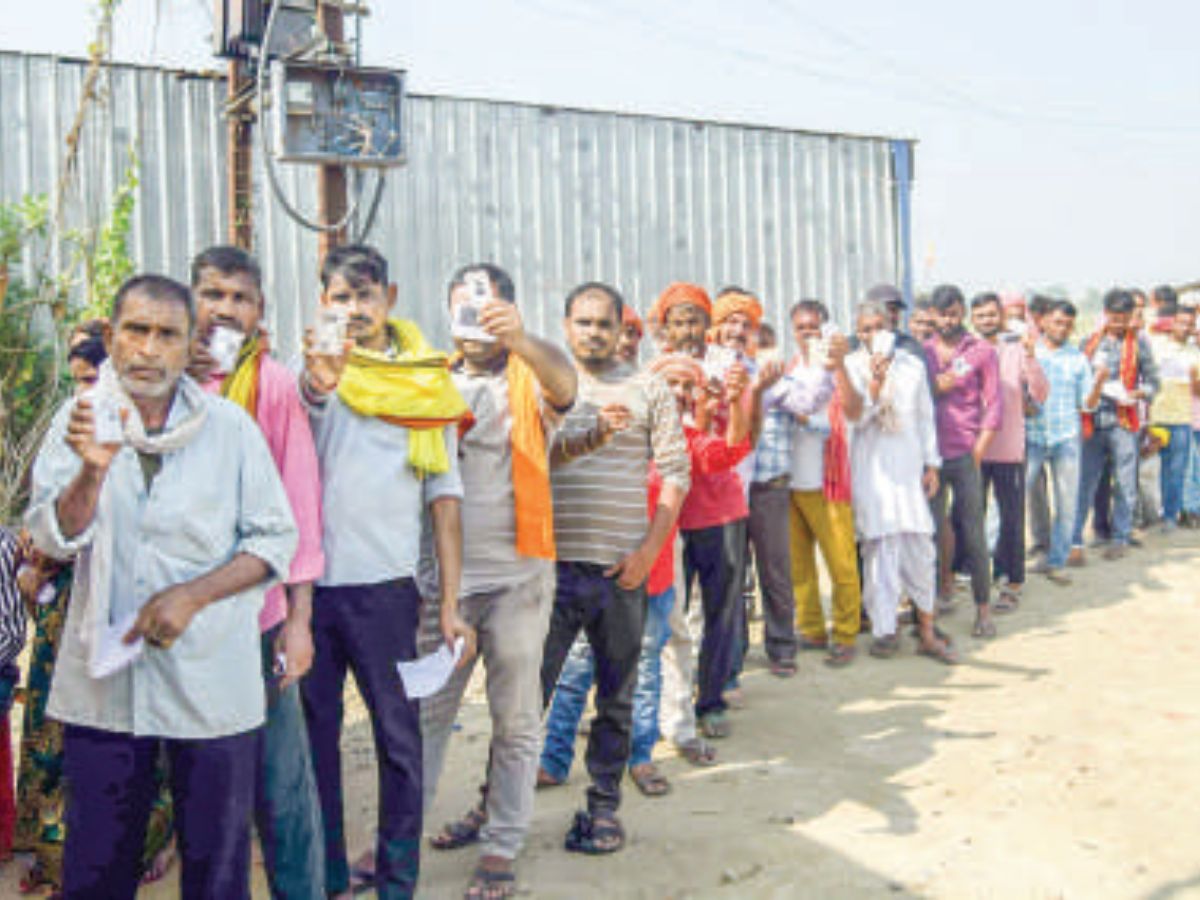
By the close of Phase 1—which recorded around 65% voter turnout, the highest ever in Bihar’s polling history—the contest no longer resembled the tight race it had seemed at the outset. Opposition campaign managers privately concede that the NDA’s timing and execution, combined with Mahagathbandhan’s internal divisions, shifted the narrative momentum.
The record turnout, often seen as a sign of anti-incumbency, appeared this time to have favoured the NDA. Field reports from multiple districts suggested that women beneficiaries of JEEViKA transfers and voters mobilised through BJP’s booth outreach were key contributors to the surge. Rather than signalling anger against the government, the higher participation reflected organised mobilisation around welfare delivery and the Modi factor.
The Rs 10,000 JEEViKA transfer tempered household-level dissatisfaction, the honorarium hikes neutralized institutional resentment, Modi’s campaign set the terms of political interpretation, and the Mahagathbandhan displayed visible internal fractures. The disarray in candidate management—such as the Gaura Bauram episode—became emblematic of a wider pattern across several seats, where coordination between alliance partners broke down over nominations and local leadership rivalries.
While the subsequent phase may bring new shifts, early evidence suggests that the NDA regained control of the narrative in the opening round—not through spectacle, but through timing, execution, and an opposition that failed to mount a disciplined challenge.




