
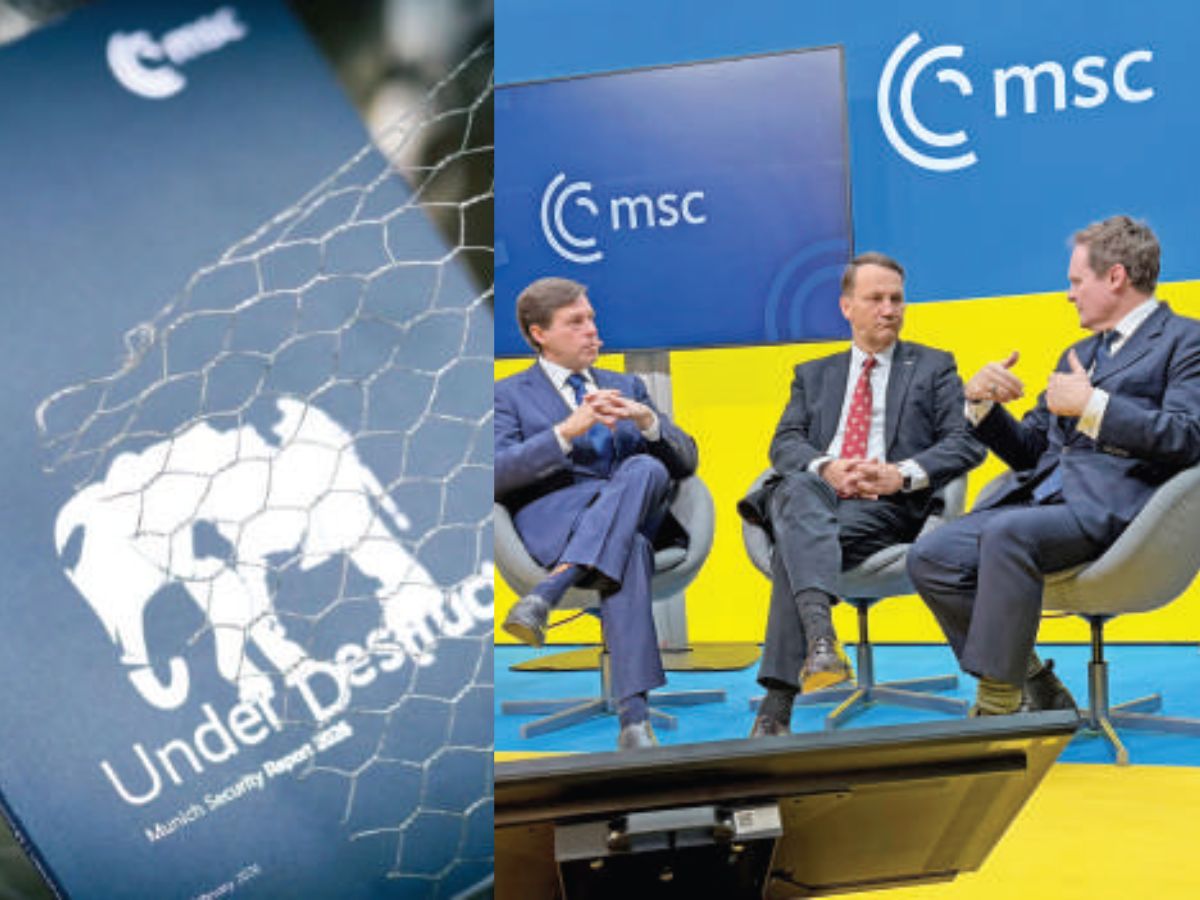
This author has been watching Munich long enough to recognise the mood before the speeches even begin. The chandeliers glow, the coffee is strong, the delegations circulate with rehearsed gravity and somewhere between the first bilateral and the second panel, the word “crisis” may be whispered with increasing conviction. Well, this year it can be said that there was a fear amongst some of the delegates as they assembled for one of the side events of which there are countless throughout the four days of MSC.
Last year, this author had written that the penny had finally dropped in the Bayerischer Hof. Washington had changed the script. The Trump-Vance administration was no longer prepared to subsidise Europe’s strategic comfort blanket, and Vice President J.D. Vance made that abundantly clear. His speech—sharp, unapologetic, culturally confrontational—landed like a thunderclap in a room accustomed to carefully ironed platitudes and a kinder, gentler world, which Europeans still believe could be the order of the day. In the end, America was signalling a recalibration of the New World Order where American dominance and leadership in global institutions that shaped it was about to take a 180-degree turn.
The line that travelled farthest was not about tanks or battalions. It was about priorities—about voters in Ohio mattering more than abstractions in Odessa. Whether one applauded or winced, the message was unmistakable: U.S. foreign policy would henceforth be measured against domestic legitimacy first, transatlantic sentiment second.
Some of the corporate elite this author met with in the side events understood the message and knew it was time for Europe to grow a new spine and get on with defending itself. But these words were not to be uttered publicly—and yet they were.
Twelve months on, the Munich Security Report 2026 arrives bearing a dramatic title: “Under Destruction”. Its organising metaphor is “wrecking-ball politics.” According to the report’s authors, the world has entered an era in which established institutions, norms, and alliances are being smashed—sometimes recklessly, sometimes deliberately.
Then U.S. Secretary of State Marco Rubio took the stage. If Vance’s intervention was a hammer blow, Rubio’s was a recalibration of tone without retreat from substance. He did not repudiate the premise that Europe must shoulder more responsibility. Nor did he signal a return to the comfortable asymmetry of past decades. What he offered instead was conditional solidarity: the United States and Europe belong together—but belonging requires reciprocity.
Rubio’s message was clear to those listening carefully. The alliance endures, but sentimentality is over. Burden-sharing is not a talking point; it is a precondition. Strategic clarity on borders, energy security, and defence spending is not optional; it is foundational.
In Munich, omissions are never accidental. Every word is weighed; every paragraph calibrated. To exclude Russia from a speech delivered in the epicentre of Western security discourse is, in itself, a signal.
Russia remains the primary conventional military threat to NATO member states. It is the reason Germany has reversed decades of defence underinvestment. It is why Poland is rearming at unprecedented speed. It is why Scandinavian neutrality is now history. The war in Ukraine is not peripheral to European security; it is central. And yet, Washington chose not to foreground it.
Equally striking was the absence of NATO as a named anchor. Since 2022, NATO has reasserted its relevance with renewed purpose—expansion, integrated force posture, and industrial mobilisation. For an American Secretary of State to speak in Munich without explicitly invoking the alliance is not rhetorical oversight. It is strategic choreography.
What does it mean? By declining to centre Russia rhetorically, Washington subtly shifts ownership of the European theatre back to Europe. If Russia is not the headline in the American speech at Munich, perhaps that is precisely the point. Europe must treat its own neighbourhood as its primary responsibility—not as a subsidiary file in Washington.
For European leaders, the implication was unmistakable. The United States has not withdrawn. But it is redefining expectations. Strategic autonomy long debated in Brussels salons may now be a less philosophical ambition and more operational requirement.
Washington has not abandoned Europe, but it has abandoned illusions. The transatlantic relationship is moving from dependency toward transaction, from assumption towards accountability. The wrecking ball, it turns out, may not be aimed at the alliance itself—but at the complacency that once underpinned it.
If Europe wishes to avoid the swing of the wrecking ball, it must build something sturdier than indignation. It must invest, consolidate, and decide what autonomy actually means in steel, energy, and political will, not merely in conference communiqués. It means modifying its Green Procurement regime as articulated in a number of panels by business and military leaders because our enemies are not playing by the same rules nor will they.
Munich has always been a barometer of elite anxiety. This year, it may also be a test of elite adaptability.
Rubio’s address was not a rupture with the transatlantic alliance as many were expecting. It was a recalibration. The United States signalled continued partnership but under a model that is more transactional, more reciprocal, and less sentimental. The wrecking ball is not the whole story and for now European leaders can breathe, a sigh of relief that America understands that strategic partnerships with allies are a must, not optional, but it in the age of transactionalism and the emergence of a new world order, it comes with a price.




