
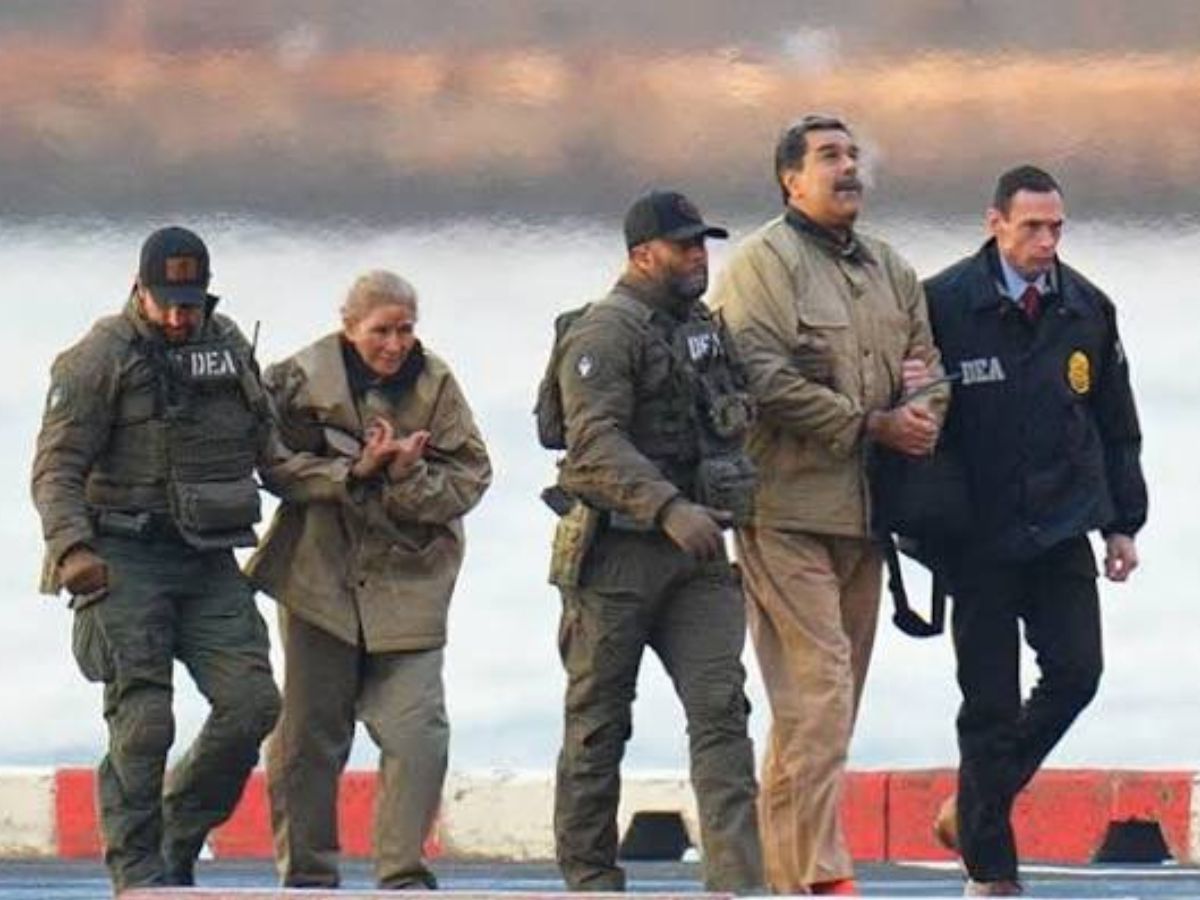
The detention of Venezuelan president Nicolás Maduro is not merely a geopolitical shock or an episode of American power projection. It is a structural warning for intelligence and counterintelligence agencies worldwide including in India, particularly those tasked with protecting state leadership. The central lesson is blunt: awareness of being targeted by foreign intelligence agencies does not, by itself, constitute protection.
Maduro and his inner circle were not operating under illusions. For years, they publicly acknowledged that U.S. agencies were seeking his removal, capture, or prosecution. Among those agencies, the Central Intelligence Agency (CIA) was the central pole.
Venezuela responded by hardening its security posture, restricting movement, rotating locations, enforcing layered protection, and maintaining a siege mentality within the state. Yet these measures failed.
That failure is analytically significant.
No head of state operating inside a heavily securitised environment can be located, isolated, and detained purely through satellites or intercepted communications. Such outcomes require accurate, time-sensitive, continuously refreshed intelligence. That intelligence is almost always human and almost always internal.
The decisive factor that led to the capture of Maduro was not external surveillance or technological superiority alone, but penetration from within.
This inference is reinforced by post-capture media reporting. Several U.S. media outlets and analysts with close access to intelligence and defence officials reported after Maduro’s detention that the CIA and other U.S. agencies had been running a sustained operation aimed at tracking, mapping, and ultimately neutralising him. These accounts described the effort as the culmination of months of focused intelligence work rather than a last-minute improvisation. Human intelligence cultivation, pattern-of-life analysis, and detailed mapping of Maduro’s security ecosystem were cited as core elements.
From a counterintelligence standpoint, the implication is uncomfortable but clear. If a foreign intelligence service can assemble actionable intelligence over months inside a hostile country whose leadership is fully aware that it is being targeted, the vulnerability is not tactical. It is structural.
The most parsimonious explanation is not a single spectacular betrayal, but cumulative leakage across administrative, logistical, political, and security chains. Partial inputs from multiple individuals, fused over time, are sufficient to generate a coherent operational picture. Modern intelligence success is incremental. It relies on accumulation, not shock.
Once a foreign intelligence service achieves penetration across layers of a state, awareness at the top loses much of its defensive value. Leaders may know they are targets, but they cannot comprehensively audit loyalty across thousands of officials, guards, drivers, planners, aides, and intermediaries.
This lesson carries direct relevance for India.
While the activities of the CIA inside India are not publicly dissected in detail, they are well known within professional intelligence circles. There is little evidence to suggest that U.S. intelligence engagement with India has diminished in recent years. If anything, it has adapted and acquired renewed salience.
There has been at least one instance in recent years where the CIA has been alleged to have been involved in interactions later described by Indian authorities and political actors as anti-government in nature. These allegations have not been subjected to full public disclosure or judicial adjudication. That absence does not make them irrelevant. Intelligence activity rarely enters public discourse unless it crosses a threshold of political sensitivity.
According to assessments shared privately by security professionals, U.S. intelligence attention towards India intensified after New Delhi declined to align with Washington’s position on the Ukraine war. India’s refusal to side unequivocally with the U.S.-led bloc represented a strategic divergence on a core global issue.
The urgency of reassessment becomes sharper when viewed through India’s immediate neighbourhood.
Over the past decade, U.S. intelligence and diplomatic activity has been widely assessed as influential in political churn and elite realignments in countries such as Bangladesh and Nepal. Whatever one’s interpretation of those developments, they demonstrate the scale, persistence, and resource depth with which U.S. agencies operate in South Asia. For Indian planners, this is not a theoretical concern but a proximate strategic environment.
In this context, Indian institutions would be well advised to treat the Venezuelan episode as a prompt for introspection rather than reassurance.
Relevant agencies and offices, including the Prime Minister’s Office, may need to consider a comprehensive audit and revamp of existing counterintelligence mechanisms. Such an exercise does not imply institutional failure, it reflects institutional realism.
A rigorous reassessment of background vetting processes, particularly for officials in sensitive positions whose immediate family members or close relatives are based outside India, would be a logical component of such an effort. This is not a comment on loyalty, but a recognition of vulnerability. Family exposure abroad has historically been one of the most effective pressure points used by foreign intelligence services across regimes and continents.
One of the most persistent and under-discussed sources of weakness within intelligence and security agencies is stagnation in postings, and this is deeply prevalent in the Indian intelligence system.
When individuals remain in the same sensitive position, desk, or functional role for extended periods, vulnerability accumulates. Familiarity breeds predictability. Over time, a long-stationed official becomes identifiable, approachable, and accessible to hostile intelligence services. This is a structural flaw rather than a personal one. Regular rotation across roles, geographies, and functions is not a human resources formality but a defensive tool. Movement disrupts profiling, breaks continuity for hostile collectors, and forces adversarial agencies to restart the costly process of identification and targeting.
Equally important is the information ecosystem.
Media organisations and influential individuals occupy a central position in modern intelligence collection. Media is not merely a channel for narratives; it is a source of access, informal disclosure, perception mapping, and influence building. Foreign intelligence agencies, especially the CIA, have long treated media ecosystems as both collection platforms and force multipliers. This reality warrants attention rather than denial.
This does not mean countries should panic or close themselves off. Important countries will always have foreign intelligence agencies operating around them. That is normal, not unusual. The key is to manage this reality carefully, not pretend it does not exist.The Venezuelan case demonstrates that once an intelligence agency becomes embedded inside a country’s administrative, political, or informational ecosystem, leadership awareness alone does not translate into leadership safety.
The strategic takeaway is unforgiving. The real battleground is not public diplomacy or official assurances. It lies inside institutions: in the resilience of counterintelligence, the integrity of human networks, and the capacity to detect and disrupt slow, methodical penetration before it translates into leverage.
The Venezuelan episode demonstrates that leadership security does not collapse because of foreign technological superiority, but because of cumulative, low-level internal penetration that no single agency is tasked with auditing in its entirety. That structural vulnerability exists in every state, including those that believe themselves to be insulated.
Venezuela demonstrates a simple but devastating truth. Knowing that you are being targeted is not protection. Preventing penetration is.




