
NEW DELHI: The launch of the Atal Canteen scheme by the BJP-led Delhi government, which provides meals at Rs 5 to the urban poor, has sparked an intense political debate, with both the Congress and the Aam Aadmi Party (AAP) questioning the scheme’s intent, reach and execution.
Opposition leaders contend that subsidised food cannot serve as a substitute for stable jobs and assured incomes for urban workers and daily-wage labourers. They argue that the poor need dignified employment opportunities rather than long-term dependence on government-run canteens.
Delhi Congress president Devender Yadav said the urban poor require guaranteed employment with a minimum daily wage of Rs 500, not “charity” in the form of low-cost meals. He asserted that hunger in a city like Delhi cannot be addressed through subsidised food alone and called for the implementation of an urban employment guarantee programme to ensure income security and dignity.
Yadav claimed such a programme could be rolled out at a cost of around Rs 10,000 crore and questioned the government’s decision to earmark nearly Rs 7,104 crore annually for the Atal Canteen scheme instead of prioritising job creation. He also flagged the lack of clear nutritional benchmarks, transparent beneficiary selection and adequate coverage, pointing out that while Delhi has 675 JJ clusters, the government has proposed only 100 canteen locations.
The Congress leader further expressed concern over the use of rented facilities for centralised kitchens, alleging that this could increase the risk of corruption. He also sought clarity on food safety protocols, including the availability of safe drinking water and strict action in cases of contamination.
Launching the scheme on former Prime Minister Atal Bihari Vajpayee’s birth anniversary, Yadav said it raised a broader question on whether subsidised meals alone could address hunger among crores in the capital.
AAP accused the BJP government of “farziwada” (fraud) in implementing the scheme. AAP leaders claimed that although the government announced plans to open 100 Atal Canteens, its official list includes only 45, with several existing merely on paper.
AAP Delhi unit president Saurabh Bharadwaj alleged that the canteen listed at Bhanwar Singh Camp was shown as inaugurated in official records, despite no facility being present on the ground. Sharing a video from the site on social media platform X, Bharadwaj accused the government of misleading the public, stating that fraud had been committed even in the name of Atal Bihari Vajpayee.
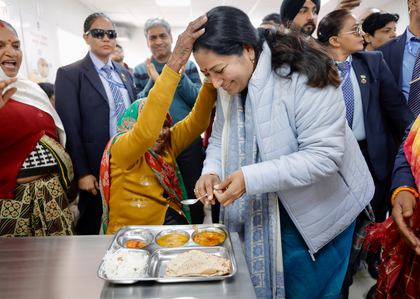
The BJP-led Delhi government has rejected the allegations and defended the scheme, stating that 45 Atal Canteens were launched earlier this week, in line with its election commitments. On Saturday, Chief Minister Rekha Gupta inaugurated an Atal Canteen in Pitampura and interacted with beneficiaries, sharing a meal with them as a symbolic gesture. Residents welcomed the initiative, saying they were surprised to receive a wholesome and good-quality meal for Rs 5, comprising dal, rice, vegetables, roti and pickle.
Delhi Home Minister Ashish Sood said the government’s primary objective is to ensure that no resident of the capital goes hungry. He added that while 45 canteens are currently operational, the scheme will soon be expanded to more than 100 locations across Delhi.
According to the government, all Atal Canteens will serve meals twice a day following a standardised, nutritious menu. The canteens are equipped with modern kitchens, LPG-based cooking systems and industrial RO water plants.
To ensure transparency and quality, the government has introduced digital token systems, CCTV surveillance and periodic audits, while food samples and raw materials will be regularly tested by FSSAI and NABL-accredited laboratories.
With sharp exchanges continuing between the ruling party and the Opposition, the Atal Canteen scheme has become a major flashpoint in Delhi’s welfare discourse, highlighting the larger debate between immediate food relief and long-term employment-based solutions to urban poverty.




