Appointment comes at a time when Centre is reviewing the security situation in Seemanchal region.
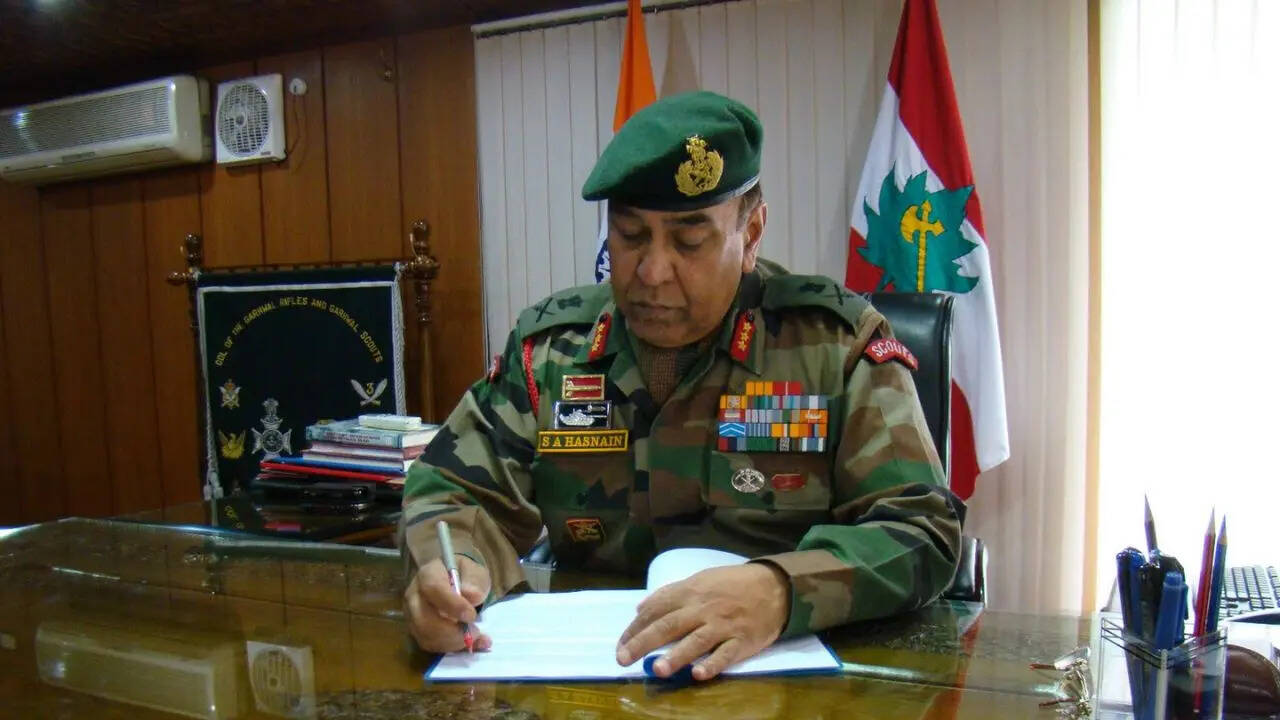
Lt Gen (Retd) Syed Ata Hasnain
NEW DELHI: The appointment of Lt Gen (Retd) Syed Ata Hasnain as the new governor of Bihar has drawn attention in security circles because of his professional background and the timing of the decision, which comes amid heightened focus on the sensitive Seemanchal belt of the state.
Hasnain is a former senior officer of the Indian Army with extensive operational experience in counter-insurgency and cross-border security operations. During his military career he commanded the Srinagar-based XV Corps (Chinar Corps), the formation responsible for overseeing counter-insurgency and counter-terrorism operations across the Kashmir Valley. The corps is one of the Army’s most operationally active commands, tasked with monitoring infiltration across the Line of Control and managing internal security challenges in the Valley. Hasnain’s tenure in the formation placed him at the centre of the Army’s efforts to contain terrorist infiltration and cross-border terror networks operating in the region.
Over a career spanning more than four decades, he served in several operational theatres including high-altitude deployments and insurgency-affected areas. Within the Army he developed a reputation as a counter-insurgency commander and later emerged as a strategic commentator on security issues after retirement.
His appointment to the Raj Bhavan in Patna comes at a time when the Union government has been closely reviewing the security situation in the Seemanchal region of Bihar, a belt that has increasingly featured in internal security discussions because of its geography and migration routes. Seemanchal comprises the northeastern districts of Kishanganj, Araria, Purnia and Katihar. The region sits at a junction connecting Bihar with North Bengal and lies close to the strategic Siliguri corridor that links mainland India with the northeastern states.
While Bihar does not share a border with Bangladesh, the Seemanchal belt forms part of a migration corridor that connects the Bangladesh-West Bengal frontier with eastern Bihar. Individuals who cross into India through the Bangladesh border in North Bengal can move into Bihar through the open internal boundary between West Bengal and Bihar. Security agencies have for years monitored this corridor because of concerns related to illegal migration networks, document fraud rackets and smuggling routes operating across the Bihar-West Bengal boundary.
The focus on the region intensified recently when Union Home Minister Amit Shah undertook a three-day visit to Bihar and spent considerable time in the Seemanchal belt. During the visit he stayed in the region and held meetings with security and administrative officials to review the situation in the border districts. Officials familiar with the meetings said the discussions focused on migration concerns, border management and the broader security dynamics of the area. The inputs gathered during the visit highlighted the strategic importance of the belt, particularly because of its proximity to the Siliguri corridor and its links with migration routes running through North Bengal.
The political developments in Bihar have also been cited by officials as a factor that could influence how security agencies approach the issue of illegal migration in the region. With the exit of Nitish Kumar from the chief minister’s post, some officials believe central agencies may now face fewer political constraints while pursuing investigations related to illegal migration networks operating in the Seemanchal belt. Officials who have participated in past security reviews at the Ministry of Home Affairs said concerns about undocumented migrants and forged identity documents in the region had been raised in internal meetings over the past decade.
According to officials familiar with those discussions, some central agencies had flagged that enforcement actions in parts of the belt were difficult because of local political sensitivities and the complex demographic profile of the region. The issue has remained politically sensitive as Seemanchal has a large Muslim population and has historically been an important electoral base for the Janata Dal (United).
Security officials have argued in internal discussions that illegal migration networks, if present, often become intertwined with local political and economic structures, making enforcement actions difficult without strong political backing. Against this backdrop, the appointment of a former counter-insurgency commander with long experience dealing with infiltration and internal security is being viewed in some quarters as significant. Although the governor’s role is constitutionally limited, officials say the presence of a security professional with experience in counter-insurgency and cross-border infiltration management could strengthen coordination between the state administration and central security agencies as the government focuses on developments in Bihar’s eastern districts.
