IAF cites incompatibility, sovereignty concerns, and cost in shunning the American stealth fighter.
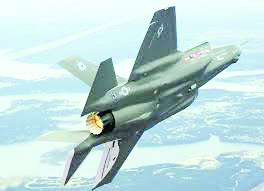
New Delhi: Amidst renewed trade friction and sharp rhetoric by U.S. President Donald Trump, some in New Delhi view Washington’s pressure tactics—including tariffs and strategic arm-twisting—as partly stemming from India’s reluctance to acquire the F-35 Lightning II stealth fighter jet for its air force.
Despite intensive lobbying by U.S. officials and defence contractors, the Indian Air Force (IAF) has shown little interest in the fifth-generation fighter. While the F-35 underpins NATO air dominance, senior Indian defence officials—both serving and retired—consider the aircraft incompatible with India’s strategic priorities, operational needs, and technological ecosystem.
“The F-35 is more than a fighter; it’s a flying computer system embedded in the U.S. defence infrastructure. That raises a major red flag,” said a retired IAF official on condition of anonymity. “It could compromise our operational independence in a full-scale conflict, especially as technology rapidly evolves.”
A key hurdle is the aircraft’s incompatibility with India’s existing fleet, dominated by Russian Su-30MKIs, MiG-29s (soon to be retired), French Rafales and Mirages, and British Jaguars—all using the probe-and-drogue aerial refueling system. In contrast, the F-35A requires boom-type refueling, demanding costly overhauls to India’s tankers or the jet itself.
“You can’t refuel an F-35 with our current tankers,” explained a senior IAF officer. “That structural incompatibility would impose huge financial burdens.”
Integration issues extend further: the F-35 currently cannot mesh with India’s Integrated Air Command and Control System (IACCS). A Defence Research and Development Organisation (DRDO) official involved in network warfare said accommodating the F-35 would require overhauling secure communication networks, encrypted data links, and radar interfaces—a massive undertaking for a single platform.
Data sovereignty is another major concern. The F-35 uses the U.S.-controlled Operational Data Integrated Network (ODIN) to send mission and maintenance data back to American servers. “Even if not real-time, letting another country access operational data is unacceptable,” the retired IAF official stressed. “It jeopardizes mission secrecy.”
Indian planners also worry Washington could weaponize this access by delaying spare parts, restricting software updates, or limiting performance, citing the 2019 expulsion of Turkey from the F-35 program after it procured Russian S-400 systems. “The precedent is clear,” said the official. “Washington can and will use its leverage.”
Lockheed Martin, manufacturer of the F-35, responded that foreign military sales are government-to-government matters best handled diplomatically by the U.S. and India.
Cost considerations weigh heavily as well. The F-35A costs around $80 million per unit with operating costs exceeding $36,000 per flight hour. The 2024 U.S. Pentagon report noted only about 30% of F-35s were fully mission-capable at any time, with repairs averaging over 140 days.
“We need jets capable of rapid takeoff, refuel, rearm, and scramble cycles in 30 minutes from high-altitude bases like Leh,” said a defence officer formerly posted in the Eastern Sector. “The F-35 is designed for long-range missions from secure NATO bases, not quick reactions in Himalayan sectors.”
India’s indigenous missile arsenal—including Astra BVR, BrahMos cruise missile, and Spice-2000 precision bombs—cannot currently be integrated with the F-35 without significant redesign or U.S. approval.
“You’re buying an entire weapons ecosystem tied to U.S. regulations, including end-use monitoring, deployment restrictions, inspections, and upgrade controls,” said the IAF official. “India has long resisted such vendor lock-in for frontline combat assets.”
The Ministry of Defence highlighted past sanctions, such as those following the 1998 Pokhran nuclear tests and CAATSA threats over the S-400 deal, as factors shaping cautious procurement decisions.
Instead, India is investing in its indigenous Advanced Medium Combat Aircraft (AMCA), with a first prototype expected by 2028, while upgrading its Su-30MKI fleet and considering additional Rafale jets.
“AMCA will deliver fifth-generation capabilities, but tying our weapons, software, and data to the F-35 now could fatally undermine AMCA’s political and budgetary momentum,” the DRDO official said.
“It’s a great platform for countries willing to operate inside the U.S. strategic framework,” concluded the retired IAF official. “But India has never flown under anyone else’s radar.”
