Winter Solstice 2025 occurs Dec 21. It's the shortest day & longest night. Learn the science, global traditions, and how Indigenous communities observe it. Official guide.
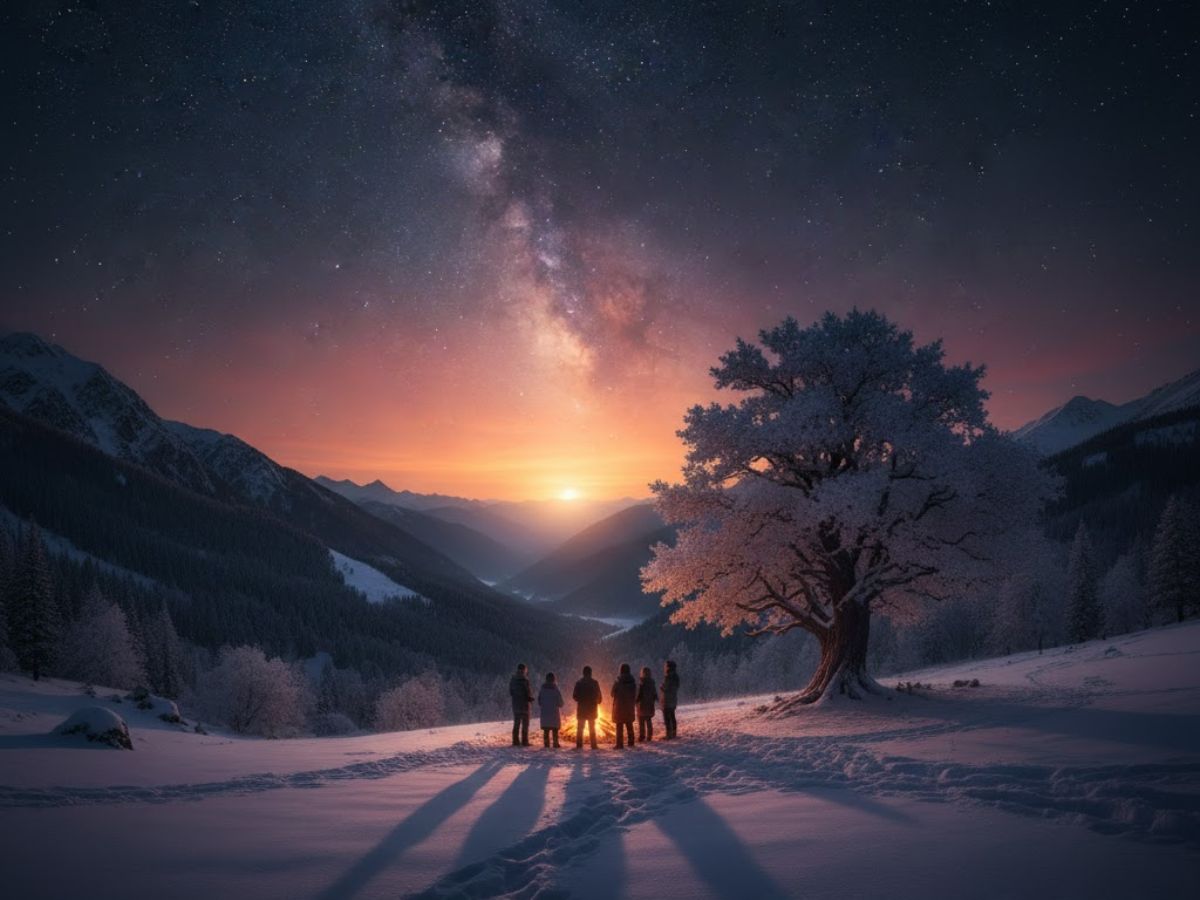
Winter Solstice 2025 Arrives: Shortest Day, Longest Night Explained (Image: File)
This Sunday marks a pivotal moment in our planet's annual journey. On December 21, 2025, at precisely 10:03 a.m. EST, the Northern Hemisphere will experience the winter solstice—the astronomical event that brings us the shortest day and longest night of the year.
The solstice is a worldwide axis point when ancient astronomy, contemporary science, and several spiritual traditions come together at a single, quantifiable instant in time. It is more than just a calendar footnote.
The Winter Solstice marks the precise astronomical time when Earth’s North Pole is tilted about 23.5 degrees away from the Sun. The Sun appears at its southernmost point in our sky, positioned above the Tropic of Capricorn, because of Earth’s axial alignment.
The Result: The Sun crosses the horizon in its shortest, lowest arc. This shortened route significantly shortens the amount of time spent in direct sunshine, resulting in the longest night and shortest day of the year. Additionally, it creates the longest midday shadows of the year.
The impact of the solstice on daylight is wholly determined by latitude. The farther north you are, the more pronounced the effect.
Equator (0° latitude): Maintains close to 12 hours of daylight year-round, with very little solstice change.
Mid-Latitudes (~40°N): Cities like New York, Madrid, or Beijing receive about 9 hours of daylight.
High Latitudes (~60°N): Locations such as Oslo or Anchorage get under 6 hours of weak, low-angled sun.
Arctic Circle (66.5°N and above): Experiences the “Polar Night,” with nonstop darkness as the Sun does not rise above the horizon.
This solstice highlights two distinct frameworks for defining winter's arrival.
Astronomical Winter: This method is based on Earth's position in orbit around the Sun. The December solstice (Dec. 21, 2025) marks the start of winter, which concludes on the March equinox in 2026. Every year, it varies by one or two days.
Winter begins on the December solstice (Dec. 21, 2025) and ends on the March equinox in 2026. It changes by one or two days annually. It defines winter as the three coldest months: December 1, 2025, through February 28, 2026. This fixed schedule allows for cleaner statistical comparison of seasonal weather data.
Many Indigenous peoples, such as the Ojibwe (Anishinaabe), view the solstice as a holy period of spiritual rejuvenation that is closely linked to ecological knowledge and oral history.
Historically known as “Midwinter,” the solstice has shaped human celebrations for thousands of years, symbolising the rebirth of the sun and the steady return of light.
Ancient Monuments: Designed to align with solstice sunrise or sunset, sites like Stonehenge in the United Kingdom and Newgrange in Ireland served as ancient calendars.
Yule (Norse/Germanic): The source of many contemporary "Christmas" customs, such as feasting, decorating with evergreens to commemorate the sun's rebirth, and burning a Yule log.
Shab-e Yalda (Iran): Families gather for this Persian celebration on the longest night to recite poetry and eat watermelons and pomegranates, which represent daybreak.
Dongzhi (East Asia): Tangyuan, or sweet rice balls, are typically consumed during this celebration of the return of longer days and the harmony of yin and yang.
Uttarayana (India): Initiates a six-month cycle considered very favorable for meditation, rituals, and spiritual pursuits.
Modern celebrations now blend introspection with a conscious connection to the natural world.
The 2025 Winter Solstice serves as a universal reminder of the planet's regular orbit around the Sun, a cosmic truth that continues to influence science, culture, and our intrinsic connection to the cycles of light and dark.
