BJP strategically lowered its leadership’s average age while broadening social and regional representation.
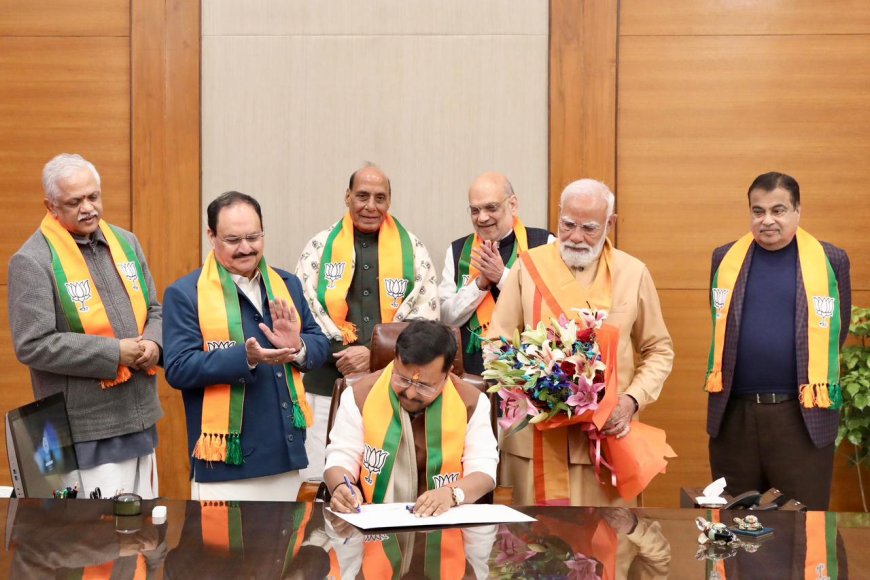
Nitin Nabin takes charge as BJP president, signalling a new phase in the party’s generational and organisational transition (Photo: X)
NEW DELHI: The election of Nitin Nabin, 48, as president of the Bharatiya Janata Party on 20 January marks the culmination of a long-running organisational transition. That transition, initiated after the BJP’s return to power at the Centre in 2024 under the impact of the “Modi wave,” involved a deliberate generational restructuring of the party’s national leadership, executed in phases across successive presidencies.
Nabin’s elevation represents the latest stage in a succession arc that began under Amit Shah and was consolidated during the tenure of J.P. Nadda. Across these phases, the BJP systematically reduced the average age of its leadership while expanding its social and regional representation, reshaping the party’s command structure in both composition and operating style.
When Amit Shah assumed the BJP presidency in July 2014, succeeding Rajnath Singh, the party leadership broke decisively with the veteran-heavy, consensus-driven committee characteristic of the Vajpayee-Advani era.
The emphasis shifted from internal accommodation to operational efficiency and electoral execution. Shah’s first national team, announced in August 2014, functioned as an operational war cabinet, optimised for electoral conquest rather than internal balance, according to party insiders. Nearly 80 percent of office-bearers were under the age of 60; roughly 60 percent were under 50, and the average age fell within the 55-58 range. By BJP historical standards, this constituted a marked demographic shift.
Decision-making was sharply centralised, with authority concentrated between Shah and Prime Minister Narendra Modi, effectively ending the earlier culture of collective leadership.
A defining feature of this period was the direct integration of the Rashtriya Swayamsevak Sangh into the party’s operational tier. Ram Madhav, then around 50, was inducted directly from the RSS as national general secretary and emerged as a central figure in the BJP’s Northeast expansion and in brokering the PDP-BJP alliance in Jammu and Kashmir.
The vice-president lineup included B.S. Yediyurappa, whose induction signaled a renewed push in southern India, along with Mukhtar Abbas Naqvi and Satyapal Malik. Younger leaders such as Poonam Mahajan, then 34, were elevated as national secretaries, while Anurag Thakur was retained as president of the Bharatiya Janata Yuva Morcha.
Equally important were the exclusions. High-profile omissions, most notably Varun Gandhi, signaled that dynastic autonomy and parallel power centers would not be accommodated within the new structure. Ever since then, for multiple reasons, he has been kept away from the party's activities.
The configuration delivered rapid territorial expansion, including the BJP’s capture of Tripura, consolidation across the Northeast, and sustained growth in West Bengal and eastern India.
By the end of the second Modi government, party leadership concluded that a permanent state of expansion was unsustainable without greater institutional depth and a younger second line of leaders. This strategic reassessment culminated in September 2020, when J.P. Nadda, nearly eight months into his presidency, announced a sweeping reconstitution of the national team.
The average age of the leadership dropped to the 45-50 range, making it the youngest BJP national leadership cohort up to that point. The new team comprised 70 members, included 14 women—the highest representation in the party’s history—and significantly increased participation from South India and the Northeast, countering the perception of the BJP as a predominantly North Indian party.
The generational signal was most explicit in the appointment of Tejasvi Surya, then 29, as president of the Bharatiya Janata Yuva Morcha, replacing Poonam Mahajan. Among the eight national general secretaries, five were new appointments. Figures such as C.T. Ravi from Karnataka, Tarun Chugh from Punjab, and Dilip Saikia from Assam, the first general secretary from the Northeast, symbolised the party’s regional recalibration. Senior general secretaries including Kailash Vijayvargiya, Arun Singh, and Bhupender Yadav were retained, all under 55 at the time, ensuring continuity alongside generational change. The vice-presidential roster brought in Radha Mohan Singh, Mukul Roy, and Baijayant Panda. Minority outreach was emphasised through the appointment of Abdullakutty as vice president, alongside Shahnawaz Hussain and Syed Zafar Islam. Rajesh Agarwal replaced Piyush Goyal as national treasurer, marking a shift toward a full-time, non-Cabinet organisational finance role.
Equally significant were the omissions that reshaped the party’s operational core. Four powerful general secretaries from the Shah era were removed simultaneously. Ram Madhav exited the national command structure, reflecting a move away from the expansion-first model that had defined the previous phase. P. Muralidhar Rao, Anil Jain, and Saroj Pandey were also dropped, creating space for leaders in their forties to assume decisive roles.
Among vice presidents, veterans such as Uma Bharti, the late Prabhat Jha, Vinay Sahasrabuddhe, and O.P. Mathur were omitted. At the state-coordination level, Rahul Sinha was dropped as national secretary ahead of the 2021 West Bengal elections. Internally, these changes were justified through a tenure and rotation philosophy, involving cabinet migration, state redeployment, and deliberate generational clearance rather than disciplinary action. However, organisational continuity during this transition was maintained by B.L. Santhosh, who was appointed general secretary (organisation) in July 2019 in place of Ram Lal and continues to hold the post.
Following the collapse of the PDP alliance in Jammu and Kashmir and adverse internal assessments related to the Northeast, Ram Madhav remained outside the central command structure for an extended period. Earlier this week, he was assigned responsibility for overseeing the upcoming civic elections in Bengaluru. This limited organisational role has revived speculation among his supporters about a possible return to prominence, though no indication has emerged that this represents a broader rehabilitation.
Party sources indicate that Nabin’s forthcoming national team is likely to push the average age down further, toward the 40-45 range, drawing primarily from leaders groomed during the Nadda years rather than lateral entrants. It is understood that several senior general secretaries and central office-bearers appointed by Nadda, some of whom have recently sought to signal proximity to the new president, are unlikely to be accommodated.
Similarly, a small number of influential senior leaders, whose covert internal maneuvering is believed to have prompted Prime Minister Narendra Modi’s public assertion that Nabin, as party president, was “his boss,” may also find themselves excluded from the new configuration.
The BJP has executed a phased elite rotation. Initially, it prioritised expansion through centralised authority and battle-hardened organisers with an average age in the mid-to-late 50s. Then the party institutionalised those gains by lowering the age profile into the late 40s, broadening women’s and regional representation, and building a deep bench of mid-career leaders. The new era completes this transition by transferring control to a leadership cohort expected to remain politically viable for the next two decades.
The result is a party that has shifted from charisma-driven dominance to system-driven organisation, positioning itself to manage future successions without internal rupture.
