
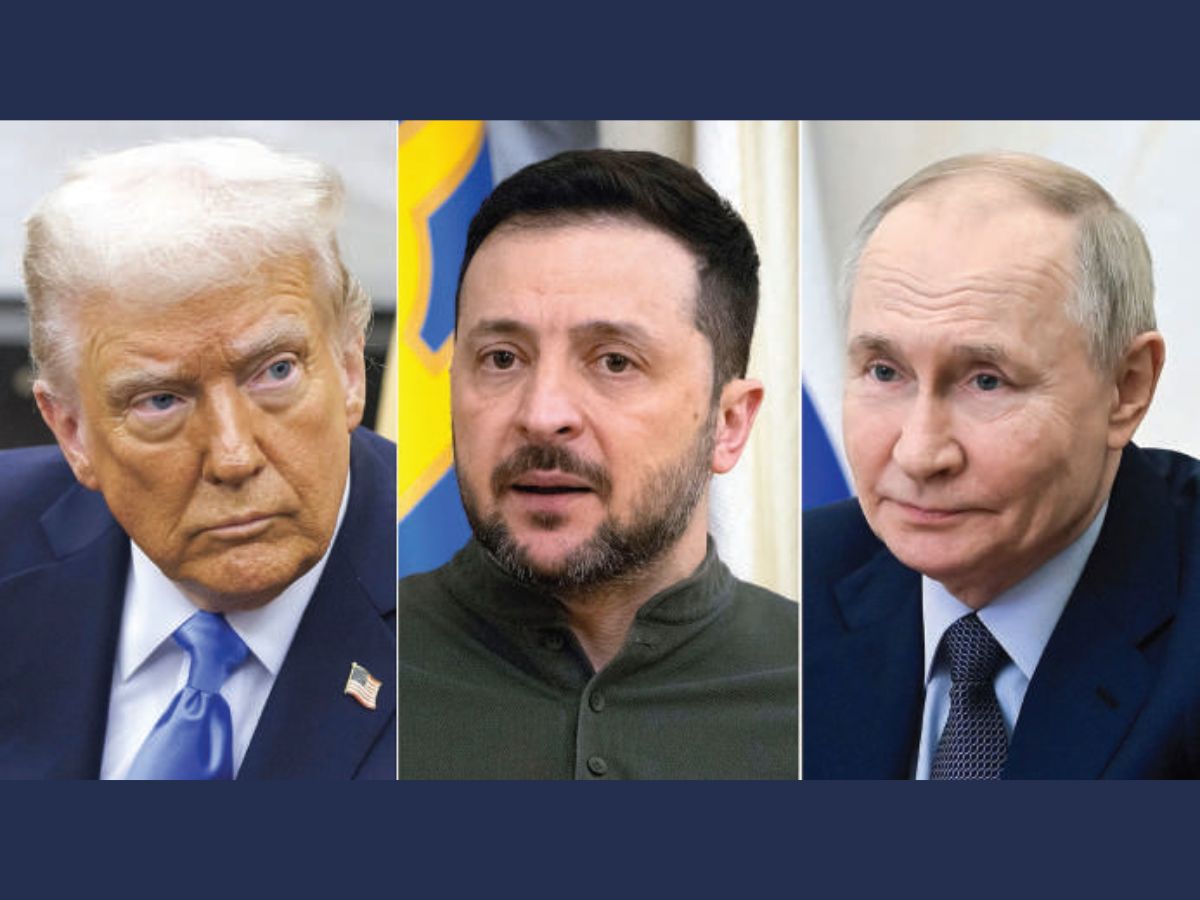
Notwithstanding the spirited assertions by the Global South of its increasing relevance and significance and animated reiteration by world leaders of pursuing multi-alignment, flexi-alignment, need-based alignment or tactical and ad hoc transactional arrangements, the world was impacted in 2025 as never before, by one individual—whether you loved him or hated him—called Donald J. Trump. He entered the White House for his second inning, after registering landslide victory, contrary to most predictions. Whether you believed in his claims of having ushered in the golden age in the US—booming economy, lowest unemployment, lowest inflation, trillions of dollars pouring in from tariffs, thousands of aliens deported and no entry from scores of countries—the impact of his tariffs was felt by his friends and foes alike including India. Many leaders scrambled to the White House with offers of lower duties on American products and allowing market access in new areas. India, faced with the highest duty of 50% including a punitive duty of 25% for importing discounted Russian oil, is still negotiating for a favourable BTA.
Trump might have missed the Nobel Peace Prize in spite of nominations from Pakistan and Israel and notwithstanding his claims of having stopped eight wars including clashes between India and Pakistan in May 2025, his presence was felt even when he was absent in all attempts to address the Israel-Hamas conflict or the Russia-Ukraine conflict and a full-blown Israel-Iran warfare with missiles and drones. Trump bombed three Iranian nuclear facilities at Fordow, Natanz and Esfahan and claimed to have obliterated them; acted as the MC, host and the Chief Guest at Sharm el Sheikh Gaza Peace Summit; is putting in place an International Transitional Security Force and an International Board of Peace to administer Gaza sans the PLA and Hamas headed by himself; welcomed in the Oval Office the new President of Syria, Al Sharaa, who once carried a booty of US$10 million on his head; gave an unprecedented dressing down to Ukrainian President Zelenskyy in the Oval Office in front of the media; pressed Ukraine to sign a deal on rare earth and mineral and is urging her to make concessions to Russia whose President Vladimir Putin he met in Anchorage, Alaska in August, but failed to persuade him to sign on a ceasefire; blasted the NATO and EU leaders as weak, decaying and incapable of handling challenges; failed to bring China to her knees with tariffs and denial of technology; met Xi Jinping in Busan and dangled the carrot of G-20; showed no interest in COP30 in Belem, Brazil or the WTO; mocked the UN that it couldn’t even fix its escalators; announced that South Africa won’t be invited to G-20 Summit in Florida next year; imposed an oil blockade on Venezuela; approved billions of dollars’ worth arms to Taiwan; feted Pakistani Field Marshal Asim Munir in the Oval Office; and claimed great achievements in the National Security Strategy; flagged Europe as a civilisational ally but mentioned India only in the context of the Indo-Pacific. So, the most unpredictable and unparalleled disruptor, the father of MAGA who is unconcerned about the repercussions of his policies on others, the 47th President of the US was the obvious man of the year 2025. The “Trump tempest 2025” will continue to impact developments in the US and abroad in 2026.
It has been a challenging year for India to manage relations with Trump 2.0, with 25-year-long bipartisan support for closer relations with India thrown to the wind. India has wisely refrained from announcing any retaliatory tariffs, nor succumbed to maximum US pressure. She hasn’t admitted Trump’s role in brokering the ceasefire with Pakistan notwithstanding his claims for over 20 times. In trade negotiation, India has stuck to her red lines and subtly conveyed her strategic autonomy. The optics of the triumvirate of Putin, Xi and Modi cosying up at the SCO Summit in Tianjin in China, Modi and Putin car ride and Putin’s recent visit to Delhi, and Modi claiming to stand on the side of peace but not condemning Russian invasion of Ukraine must have conveyed unmistakable message to Washington and her western allies.
While US tariffs have cost a loss of jobs and impacted the export of gems and jewellery, shrimps, textiles, leather goods, handicrafts and automobile parts to the tune of US $30 billion, India has intensified her efforts and signed the CETA with UK; CEPA with Oman; TFA with New Zealand. The EFTA and TEPA with Switzerland, Norway, Iceland and Liechtenstein became operational in October; TFAs with EU and UAE and other countries might follow. The relative peace on the LAC with patrolling with prior intimation, resumption of Kailash Mansarovar yatras, direct flights, limited border trade and supply of rare minerals and batteries from China and prospects of Chinese investment reflect a degree of thaw in relations with China, although the underlying distrust remains, especially with regards to the LAC, China’s support to Pakistan and concerns about the idea of G-2.
PM Modi attended the AI Summit in Paris, BRICS Summit in Brazil, G-20 Summit in South Africa and SCO summit in China. His interventions on AI, international terrorism, UNSC reforms, salience of the Global South, 1 million trainers for Africa drew international appreciation.
Through visits and talks, relations were nurtured and broadened with the UK, France, Germany, Italy, Japan, South Korea, Australia, Canada, New Zealand, ASEAN and South East Asia, Central Asian Republics, Latin America’s Brazil, Argentina and Mexico, and Middle East’s Egypt, Saudi Arabia, Iran, Israel, UAE, Qatar and Oman.
Though Operation Sindoor inflicted substantial damage to the terrorist infrastructure in Pakistan and the Pakistan Air Force, Chief of the Army Staff, Gen Asim Munir sold the narrative to the Pakistani people of having succeeded against India and promoted himself to the rank of Field Marshal and rose to the post of Chief of the Defence Staff. He got invited to the White House, strengthened relations with the US, China, Saudi Arabia and UAE and continued with his anti-India tirade.
With Sheikh Hasina in India, demands for her extradition and attacks on Hindus and minorities and Indian missions and posts on the rise, relations with Bangladesh have touched the nadir. Musical chairs of PMs in Nepal and territorial claims against India haven’t made relations hunky dory with that country. But strong ties with Bhutan and a positive turnaround in relations with Maldives, Sri Lanka and Afghanistan are a feather in the cap of Indian diplomacy.
2025 saw a brazen display of might is right: USA bombed Iran, Russia continued aggression against Ukraine, Israel invaded Lebanon, Syria, Gaza and West Bank, but still didn’t achieve security. The Pope reminded of Palestinians living hellish life in Gaza in biting cold and rain. Journalist Seema Sirohi wrote in her column, the “new year will bring new insults, new anger and new ways to hate.” Wish, she is proved wrong.
-
Surendra Kumar is a retired Indian ambassador.




