Wars have a life of their own, the only certainty of a war is plenty of unintended consequences.
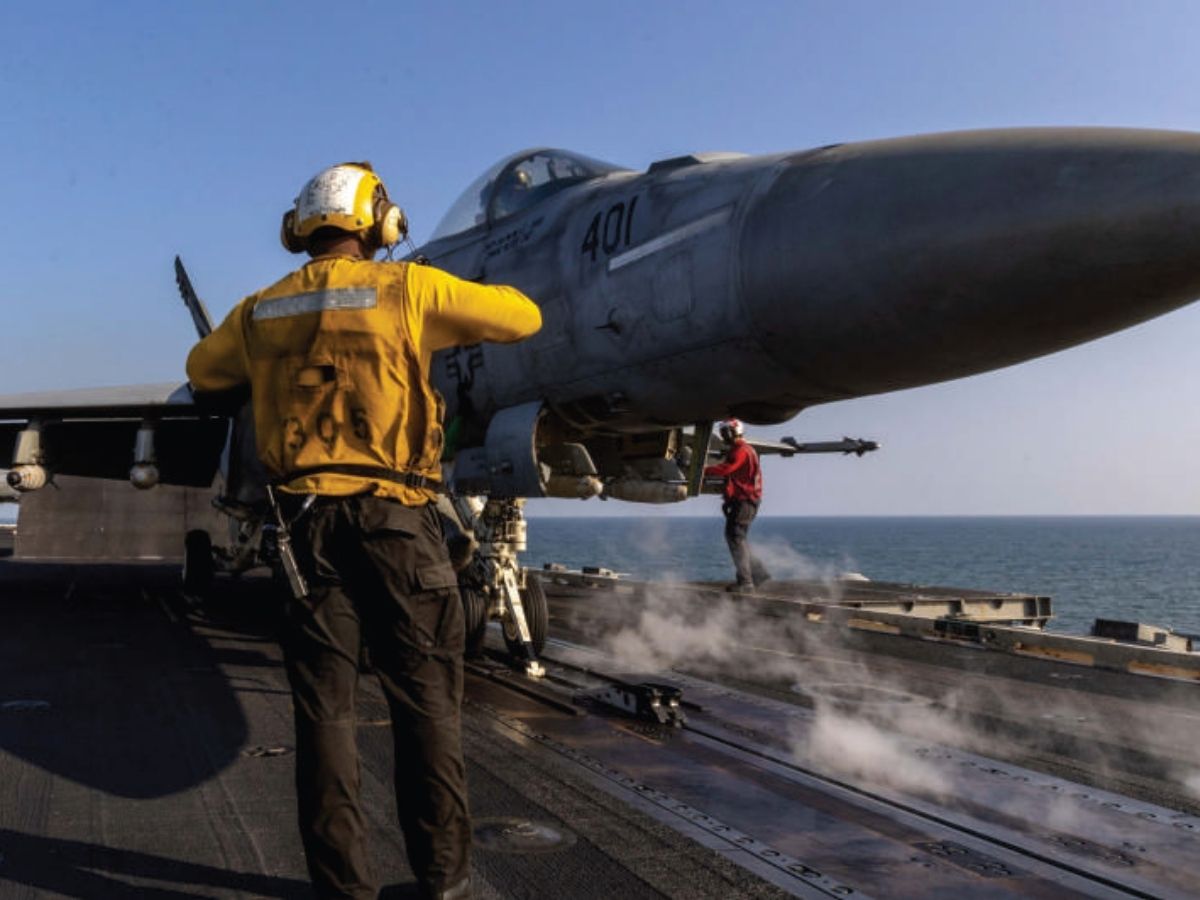
A US fighter jet is being readied to take off from USS Abraham Lincoln on Saturday. Photo courtesy: X handle of US Central Command.
Beit Rahbari, the wellknown House of the Leadership is the secure compound in central Tehran, official residence, bureaucratic office and principal workplace of the Supreme Leader of Iran Ayatollah Ali Khamenei. On Saturday, 28 February 2026, around 8:10 am local time in Tehran, in Beit Rahbari, the Supreme Leader was conferring with about 40 of his top leaders, including Mohammad Pakpour, Commander of the IRGC, Azis Nasirzadeh, the Defence Minister, Ali Shamkani, Head of the National Defence Council and Abdolrahim Mousavi, Chief of Staff of the Iranian Armed Forces. This was directly targeted by 30 odd missiles, assassinating the tiers of Iranian hierarchy, in the most obvious place in Iran where the “most senior forum” would meet consequent to commencement of war. Calling it “Decapitation Strike”, or cutting the head off, is creating a coinage that will haunt military theorists in times to follow.
There ought to be clear motivation to commence a war. Israel Prime Benjamin Netanyahu had stated that “do what I have long aspired to do for 40 years: to strike Iran decisively”. The public rationale of PM Netanyahu for waging war against Iran, in June 2025 “Operation Rising Lion” or the latest “Operation Lion’s Roar,” is based on the existential threat to Israel’s survival or Tehran’s determination to follow covert nuclear program and the imminence of the threat. For Israel, the war can be stated indeed of choice and necessity both.
The stated objectives of US Operation Epic Fury are to “eliminate Iran’s ballistic missile threat, destroy their naval capability, disrupt missile and drone production infrastructure and sever their pathway and end their pathway to nuclear weapons.” The questions of Iran being an existential threat, the imminence of that threat, the state of Iranian nuclear programme and being a “mothership” to Hamas and Hezbollah, and the harshness of the regime to Iranian peoples are important, and will best be analysed by future historians. Pre-emption, that a state cannot attack another because it believes it will be attacked in future, are not justifiable in international law! In any case, legal justifications under the UN Charter are non-debateable for obvious reasons.
Much has been stated or alluded to is regime change in Iran as a motivation to commencement of war, though it has been of late downplayed. The US had promised the Iranian people that “the hour of your freedom is at hand”. In beseeching Iranians to “take over your government” towards a “prosperous and glorious future”, it was presumed that oncoming regimes will be different. Conventional wisdom shows that attempts at regime change have ended in even more calamity, like in Afghanistan, Iraq, Libya and Syria. There is a global aversion to regime change militarily, that even Pakistan, which is known to be an interventionist state in Afghanistan, had to hasten to clarify recently that it is not seeking any change of government in Afghanistan, calling it an internal choice of the Afghan people.
In any case, Iran has a welldeveloped layered system of selecting and anointing the next rung. Though in this particular time, it is likely the later rungs have also been killed at Beit Rahbari. The Islamic Republic has a highly motivated security apparatus that is intent on its own survival, and its people have not demonstrated any great large mass-based desire for change. Hence it is apparent Iran will be able to create a seamless continuation of regime albeit with new leadership.
Wars have a life of their own, the only certainty of a war is plenty of unintended consequences. First is the major difficulty in envisioning the end-state, the time frame for it, discerning when in the opportune time to undertake it, and what will follow thereafter. With Iran having relied on the talks that were continuing prior to Operation Epic Fury, where in Omani mediators in Geneva were on the verge of announcing a potential breakthrough, intimating that Iran had accepted major demands of the US. The next round was scheduled in Muscat on 9 March 2026.
It is a critical moment for the US Administration which had taken office over a year ago with a promise to end “forever wars” like in Afghanistan and Iraq, ground invasion for which the US has no political appetite, especially the MAGA constituency. President Donald Trump is also slated to visit China in April 2026 for crucial talks, on which this war will cast a shadow as China-Iran have very close relationship. It does seem that the war termination and war aims have not been deeply thought through, hoping for lack of resistance as in the 12-day war of June 2025 and the abduction of President Maduro of Venezuela. The response of Iran has also been in all likelihood a war larger than what was appreciated, making the situation as if in a cul de sac. To find mediation to facilitate war cessation, though China has offered its services, and getting Iran and Israel to accept will not be easy.
Second, what has opened out in this war is not simply a battlefield conflict; it is a historical geopolitical rupture. It has intensified existing cleavages within the US and among Western allies regarding foreign policy, and the effectiveness of military force over diplomacy. Countries like the UK and Spain pulled away from the war, at least initially. It is obvious that the global rules-based order was disintegrating under its own weight, this war will hasten its collapse. The rupture as it was called by the Canadian PM at Davos, will become unbridgeable, and hard power concerns and nationalism will overtake, till sane counsel prevails over many years or even decades. There may never be status quo ante in West Asia.
Third, wars would invariably lead to mass destruction and civilian deaths—demeaningly called collateral damage. The population of Iran exceeds 90 million and the country’s terrain is extremely difficult to penetrate. Iran is like a mountainous fortress with strategic depth, a population that has survived decades of sanctions, and a Shia martyrdom culture, and is a civilisational state with well-honed nationalism. Iran sits astride the all-important Strait of Hormuz, 33 km wide, with 20% of global oil passing through annually.
Indeed, the Iranian military is greatly outmatched and outclassed, in all domains of warfare by the US. However, the war coming to its shores on 28 February, it did become for Iran as one of necessity. To that can be cumulated are the substantial resources of Israel. Typically, it is the asymmetric warfare undertaken by nations which are outclassed in war by powerful adversaries is in evidence, where it is not necessary to match firepower. As an example, the imbalance of military power is being attempted to be offset by Shahed drones costing around $35k-$50k each, which Iran can produce 500 daily, and will have a very large estimated stockpile. The US/Israeli response has been using expensive interceptors each costing $1-3 million Patriot/THAAD missiles, used 2-3 needed per drone/missile. The paucity of interceptors can be an issue itself for early ceasefire.
Israel and the US militaries have been seeking out about 400 Iran’s missile launchers, and destroying them. While Iran may have a large number of missiles, probably 300 have been destroyed. The US/Israeli military campaign, including cyber and space, has been exemplary.
In response to the war, the Iranian forces launched missiles and armed drones against Israel and US military facilities in all six Gulf Cooperation Council countries. In Israel, Iranian missiles caused serious damage, killing and injuring scores of people. The GCC are petro/gas rich-states, however 80% of all food is imported and 60% of all fresh water comes from energy-intensive desalination plants. The target list of Iran is varied with desalination plants, oil terminals, power grids, airports and US bases. Iran also struck civilian infrastructure in the Gulf, including ports and airports.
The hostilities effectively forced the closure of the strategic Strait of Hormuz, through which no less than 20% of the world’s oil supply passes. While devastation in Iran is immense and very widely dispersed, the reciprocal strikes over 14 countries from Cyprus and Turkey to Oman have been devastating. Regionalization of the conflict that was sought to be avoided, has been become a very major concern and consequence.
The presence of strong American forces has not prevented escalation. Iran has hence used its capacity and the willingness to disrupt the entire region, and create chaos in the West Asia, once pushed to the brink.
The war also reached closer to Indian shores, with the torpedoing of an Iranian Naval Ship by a US submarine, while circuiting Indian peninsula, on its way back from Vishakhapatnam, having attended Indian Milan exercise. The sequence has been intensively debated in India, naturally as it happened generally in Indian area of interest and influence. India and Sri Lanka did provide safe berths to one each of Iranian Naval ships.
Fourth is the very large economic costs of the war. It is premature to forecast costs of war at this juncture, with limited formal release of data. Israel struck Iranian military and nuclear sites on 13 June 2025 in Operation Rising Lion, with Iran retaliating with over 550 missiles and 1,000 drones over 12 days. US forces expended more than 92 THAAD interceptors at $12.7M each, 14% of the total US stockpile, with total US air defence costs reaching $2.7-4.7 billion. Restocking is projected to take 3-8 years.
In the current ongoing war, it has been estimated that expenditure by Israel from the air war with Iran could reach more than 9 billion shekels ($2.93 billion) a week. US forces used more than 2,000 munitions of all types in the first 100 hours of war, estimating to US $3.7 billion, followed by over $890 million daily. Meanwhile, three F-15Es were shot down by Kuwaiti air defence in a friendly fire incident. An original F-15E costs $31Million (FY1998), while F-15EX replacement over $94Million.
The conflict led to immediate surges in oil and gas prices, widespread disruptions in aviation and tourism, declines in stock markets, and heightened volatility in financial markets, leading to global inflation.
The Brent crude oil prices surged to 10-13% to around $80-82 per barrel by 02 March 2026, and the Qatari Oil Minister has projected an astronomical increase to $150 per barrel.
Exports from the region are typically going to Asian countries, with China, India, Japan and South Korea accounting for 75% of oil and 59% of LNG exports. Wars are expensive business for the participating belligerents, though in the ongoing war, the effect will inevitably be global.
Fifth is application of mosaic war. Mosaic warfare has been spoken of earlier as a US developed military strategy that connects numerous, low-cost, and diverse platforms (sensors, shooters) across air, land, sea, space, and cyber domains, similar to tiles in a mosaic, to overwhelm opponents through complexity, agility, and decentralized command.
In the ongoing war in Iran, mosaic war has been spoken of in some local innovations. Iran’s foreign minister, Abbas Araghchi, recently spoke of “decentralised mosaic defence” meant to keep the system fighting even if senior leadership, communications, or major hubs are hit. Seemingly, Iranian Revolutionary Guards had delegated authority far down the ranks and units and built a systemic so units can keep operating if commanders are killed (decapacitated). Mosaic defence attempts that loss of no single headquarters, city, or leader could collapse the fight. Obviously, the aim is to survive the initial shock and keep retaliating through multiple channels, and raise the costs of a prolonged campaign.
Naturally, the mosaic warfare, with greatly decentralised command and control, can lead to major follies. There have been questions on Iran targeting Oman, Turkey and Azerbaijan, all that could well have been follow up of non-availability of command-and-control hierarchy, with decentralised operations undertaken with previously issued broad guidelines. This of course is open to verifications, consequent to war termination.
In sum, the Iran war, from the Iranian side has witnessed a marked drop in missiles firing, giving rise to apprehensions of major losses.
While the US had spoken of willingness to continuing (four to five weeks) the war, it is of grave concern to US allies in the Middle East, and around the world. The possibility of an “unconditional surrender” by Iran, presently, seems distant. Geopolitical (and geoeconomic) considerations alone could well push for an early cessation of hostilities.
Lt Gen Rakesh Sharma (Retd) was formerly with the Indian Army.
