
THE STAGE IS SET, AND THE WORLD ARRIVES
The air in Mumbai hums—not with the usual chaos of a metropolis at full throttle, but with something quieter, more deliberate: the weight of history shifting. The arrival of British Prime Minister Sir Keir Starmer, accompanied by a delegation of 125 officials, business leaders, technocrats, and academics, was never meant to be merely ceremonial. It was a pilgrimage. Not of obligation, but of recognition. The world had come to witness what India had quietly become: no longer a footnote in the ledger of global power, but a central node in the new architecture of the 21st century. And at the centre of this transformation stood Prime Minister Narendra Modi—not as a populist figure, but as the architect of a strategic reorientation so precise, so patient, that its culmination now unfolds with the inevitability of tides.
A DECADE OF DESIGN DELIVERS
This was not an accident of timing. It was the product of a decade-long design: deliberate, unyielding, and deeply rooted in the principle of strategic autonomy. The Comprehensive Economic & Trade Agreement signed months prior was not a last-minute concession—it was the culmination of negotiations conducted with the calm certainty that India’s market, its scale, and its resilience were non-negotiable assets. The Vision 2035 framework, unveiled quietly in a New Delhi boardroom years ago, now serves as the blueprint for global partnerships. What once was dismissed by Western analysts as idealism—India refusing to choose between Washington and Beijing—is now the gold standard of multipolar diplomacy. Starmer did not come to negotiate terms; he came to align himself with a reality that had already been forged.
ATMANIRBHAR IN ACTION: A NEW GUARD RISES
Nowhere was this reversal more vivid than in the defence sector. The £350 million missile procurement deal made headlines, but it was the quiet announcement that followed—Indian Air Force instructors will now train Royal Air Force pilots—that sent ripples through defence establishments from London to Washington. This is not an anomaly. It is the logical endpoint of Atmanirbhar Bharat, a policy that began as rhetoric but hardened into institutional reality through years of investment in indigenous R&D, manufacturing infrastructure, and human capital. The nation that once imported training manuals now exports instructors. That which was once a recipient of technology is now its source. The guard has changed—not with fanfare, but with the quiet authority of competence proven.
CODING THE FUTURE, THE INDIAN WAY
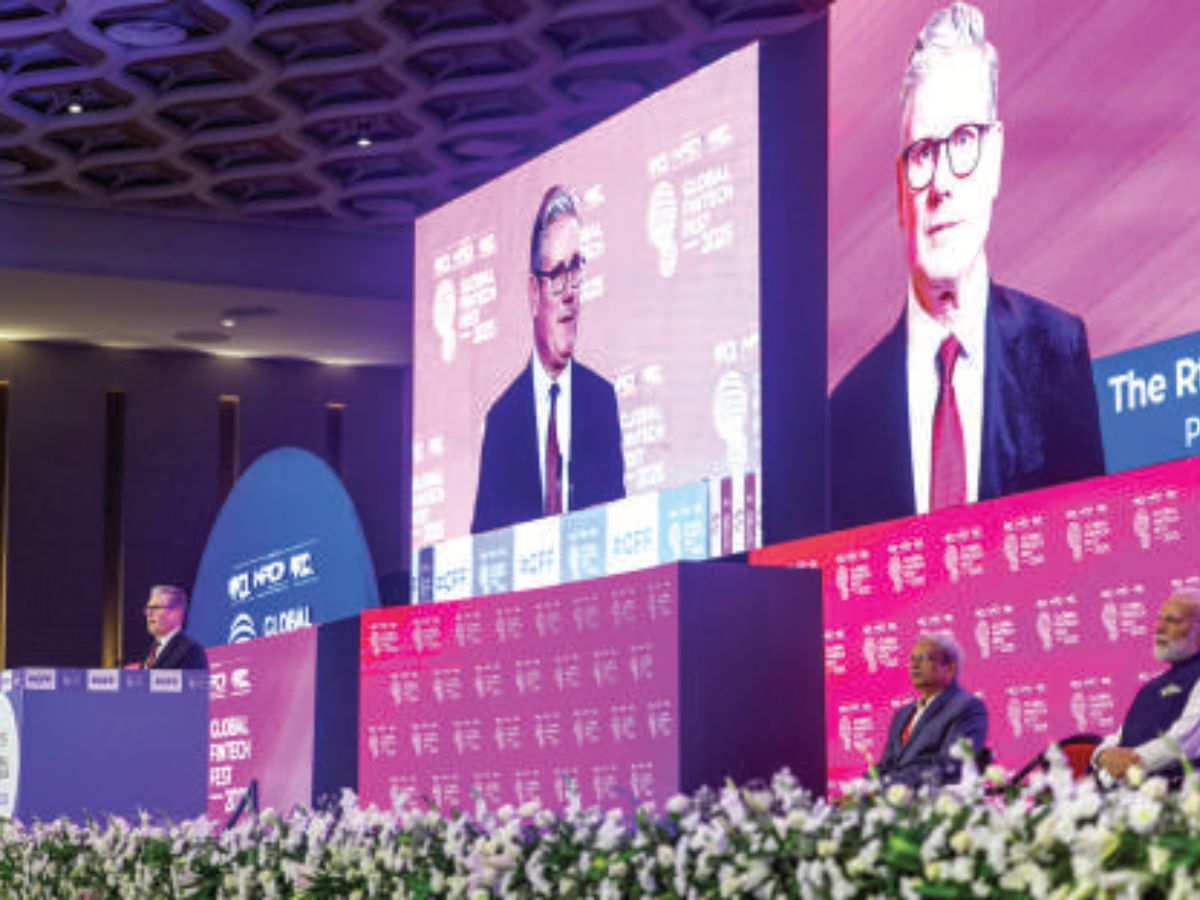
Beyond hardware, the partnership now runs on code. At the Global Fintech Fest, where Sir Starmer stood beside PM Modi showcasing a live UPI transaction dashboard processing 12 million payments per minute, the message was unmistakable: India no longer aspires to be digital—it is the standard. The Unified Payments Interface, born of public-sector innovation and private-sector agility, has become the global template for financial inclusion. No longer do nations look to Sweden or Singapore for digital infrastructure models—they look to India, where a farmer in Bihar can receive direct subsidies via smartphone, and a street vendor in Jodhpur can accept payments without a bank account. The new Climate-Tech Start-up Fund, backed by British capital and Indian scalability, is not charity. It is a commercial bet on India’s capacity to deploy green technology at the scale of 1.4 billion people—something no Western economy has ever achieved. Britain brings finance; India brings execution. And in that asymmetry lies the new balance of power.
THE NEW GLOBAL GURUKUL
The most profound shift, however, may be cultural—and it is happening in classrooms. The announcement that nine of Britain’s most prestigious universities—Oxford, Cambridge, Imperial, UCL, King’s College, Edinburgh, Manchester, Warwick, and LSE—will establish full-scale campuses in India is not merely symbolic. It reverses a century of brain drain into the West. For decades, India’s brightest minds fled to London or Boston, seeking opportunity elsewhere. Now, the reverse flow is underway: British academics are relocating to Bengaluru and Hyderabad, drawn not by charity or aid, but by the magnetic pull of a nation that has redefined higher education through the National Education Policy. This is not colonization by another name—it is the modern gurukul, where knowledge flows from East to West. India is no longer a student of the world; it has become its teacher.
A MASTERCLASS IN STRATEGIC AUTONOMY
The diplomacy on display was not performative—it was structural. The joint commitment to a “rules-based order” was standard diplomatic language. But the creation of the Critical-Minerals Supply-Chain Observatory? That was a masterstroke. In an era where lithium, cobalt, and rare earths are weaponized through export controls and sanctions, India has built not a fortress, but a hub—a neutral, transparent platform for secure, diversified sourcing. It invites partners not to submit, but to collaborate on resilience. This is leadership without arrogance: confident enough to offer solutions, not because it seeks dominance, but because it understands that global stability cannot be sustained without Indian participation.
CONFIDENCE OF A RISING POWER
There was no plea for visa concessions. No public lament over the lack of work permits for Indian IT professionals. The British side offered none—and India did not demand them. Not because it was indifferent, but because it no longer needed to be. The market is so vast, the talent pool so deep, the innovation ecosystem so dynamic that Britain’s tech firms are now competing to establish operations in India—not because they were invited, but because they have no choice. The calculus has flipped: it is no longer India seeking access to Western markets; it is the West scrambling for access to Indian talent, infrastructure, and scale.
FROM RECIPIENT TO ROLE MODEL
The most telling moment came during a closed-door session on digital identity. Sir Starmer, flanked by his chief data officer and home affairs secretary, asked detailed questions about Aadhaar—the world’s largest biometric ID system. Not as a curiosity, but as a potential model for Britain’s own fragmented welfare and immigration systems. For decades, India was the recipient of Western governance templates: e-governance manuals, audit frameworks, civil service reforms—all imported, all adapted. Now, the reverse is true. A British minister sits across from an Indian technocrat and asks: “How did you do this?” The answer is not technical—it is political. It is the will to implement against entrenched resistance, to prioritize scale over perfection, and to trust data over bureaucracy.
THE HELMSMAN OF A NEW INDIA
This visit occurred in the Amrit Kaal—the 25-year window between India’s 75th and 100th anniversaries of Independence, a time designated not for celebration alone, but for transformation. Starmer’s presence is an acknowledgment of India’s transformation, the nation that once begged for recognition now commands it. It does not shout its rise; it demonstrates it—in the code, in the classrooms, in the missile silos, in the digital payments that reach every corner of its geography. The West no longer sees India as a future power. It sees it as the present one. And it is adjusting—not out of deference, but necessity.
This is not the story of a bilateral agreement. It is the story of a nation that refused to be defined by its past, and instead chose to write its future—one line of code, one trained pilot, one university campus, one biometric ID at a time. The sun did not rise in the East because it had to. It rose because India made sure it would.
Brijesh Singh is a senior IPS officer and an author (@brijeshbsingh on X). His latest book on ancient India, “The Cloud Chariot” (Penguin) is out on stands. Views are personal.




