
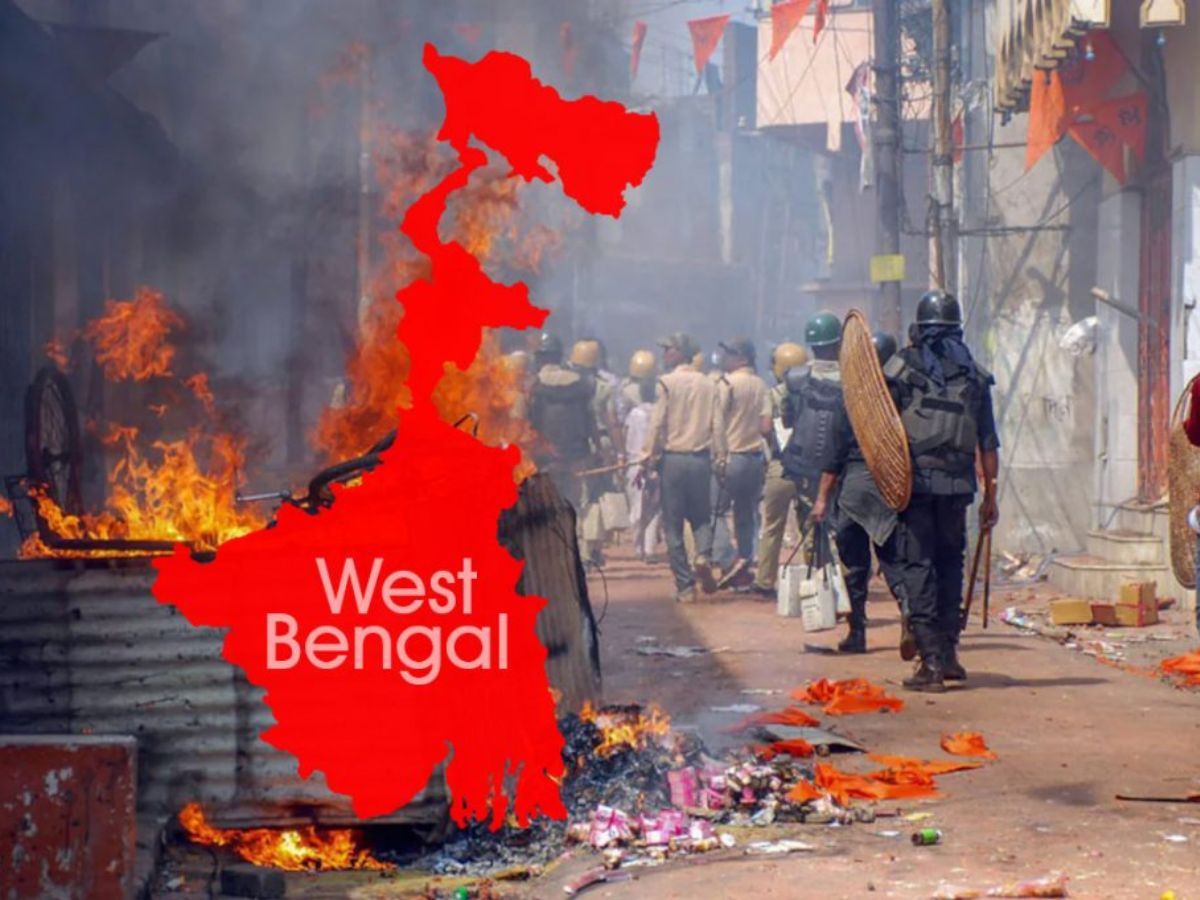
Border states like Manipur, Punjab, Jammu and Kashmir, Bengal and now Ladakh are facing divisive politics, violence based on narrow identities and a crisis in democratic governance. Is it a larger pattern to stall India’s independent ecomomic growth, and development? These are through internal differences exploited by external powers and global NGOs who have exploited this. The work done on Bengal polls, instigated violence and illegal immigration being legitimised to win elections is extremely dangerous to India’s secular democracy and our Constitution. In Bengal, the border has moved by 20 km, where non-Muslims cannot even buy property. This brilliant study was done by Prof Vidhu Shekhar [SPJIMR, Mumbai] and Prof Milan Kumar [IIM, Vishakapatnam] through fieldwork and data collection.
IDENTITY POLITICS AS A CRUTCH
For over a decade, Mamata Banerjee and her Trinamool Congress (TMC) have sought legitimacy not only through governance claims but also by invoking a nativist brand of Bengali identity. Pride in language and culture is natural, but when it becomes the primary lens of politics, it risks degenerating into exclusion, and at times, a tool to legitimise violence. Campaign speeches, controversies around migration, and repeated “Bengal versus outsiders” narrative have created an “us” versus “them” dynamic. The consequence of this is immense, as moving forward, the democratic competition becomes less about development or governance, but more about “identity” and “belongingness.” This narrowing of politics weakens the inclusive idea of Bharat, where regional pride should complement, not compete with national solidarity.
NORMALIZATION OF VIOLENCE
The cost of this identity-obsessed and alliance-driven politics is borne most brutally by ordinary citizens and party workers. Bengal has long carried a reputation for electoral violence, but recent years have shown a disturbing trend. The 2023 panchayat elections were a bloody reminder: scores killed, hundreds injured, and booths captured in broad daylight. For too many citizens, an election in Bengal still means the possibility of armed clashes and intimidation at the polling station. These are not isolated accidents but signs of a political culture where violence is accepted and normalized as a legitimate electoral tool. As such, law and order cannot be reduced to partisan slogans. Reports of political murders, clashes between party cadres, and attacks on law enforcement undermine confidence that the state can protect its citizens. When investigations drag or appear compromised, the message is clear: violence pays, and perpetrators escape justice. That message eats into the foundations of democracy more surely than fraudulent ballots ever could.
The human cost of this toxic politics is far more tragic. As the data shows, BJP workers, in particular, have been repeatedly targeted and even brutally killed. Such deaths are not just party-specific matters but must be viewed as national failures. Every political murder, regardless of affiliation, signals that the democratic contest has collapsed into gang warfare. The brutal murder of BJP worker Abhijit Sarkar in 2021 and the protracted investigations that followed underline how party workers (working for their political beliefs) can become victims of violence with little consequences to perpetrators.
Yet, even more disturbing has been the pattern of violence against women in Bengal in recent years. Rather than being isolated crimes, such violence appears to become a part of the political environment where power shields perpetrators and the political system seems slow, or worse, unwilling to respond. The 2022 Hanskhali case, in which a minor was allegedly gang-raped and died soon after, was not only horrifying in itself but doubly damaging because of the political commentary that appeared to trivialise the tragedy. The initial response was less about empathy and more about managing fallout. Not to mention the shocking rape and murder of a young doctor at RG Kar Medical College last year that triggered nationwide protests. Doctors went on strike, demanding accountability. The episode demonstrated how vulnerable even educated professionals in urban spaces remain, and how political interference in investigations only deepens public anger.
As if these were not enough, fresh allegations of gang-rape at a Kolkata law college in 2025 have again shaken public confidence. What troubles people most is not only the brutality of these incidents, but also the perception that influential networks can subvert justice. And that FIRs are delayed or not even registered, while the suspects remain protected, and women’s safety remains subordinate to political expediency.
Such episodes, taken together, tell a sad story of a great state in India, where countless leaders and innovations emerged. It’s a story of erosion of institutional trust in Bengal to the point that crimes against ordinary citizens and even women are seen less as matters of justice and more as collateral damage in the sustenance of power.
WHAT NEEDS TO CHANGE
When violence against women is trivialised and political murders are brushed aside, what becomes obvious is that a culture of impunity and unaccountability is in place. Indeed, culture is crucial to people, and identity is integral to politics, but that does not mean that political leaders get to trivialize violence. When leaders themselves normalise or minimise brutality and manipulate investigations, it reinforces the miserable message: power trumps principle.
This cannot be allowed to continue. This is not Bhartiya culture. A democratic republic, especially ours that goes back millennia, must abandon this cycle where violence is routine and where women live in fear, even in their workplaces and on campuses. The way forward is not a mysterious fact. It only requires the political will of the Mamta government, the opposition, and all other stakeholders in the process, including the great people of Bengal.
Moving ahead, first and foremost, every party must make a public, enforceable commitment to non-violence, backed by demonstrable action on the ground. Second, law enforcement must be given institutional independence to conduct impartial policing with swift prosecution as a non-negotiable solution to any violence, political or otherwise. Third, the Election Commission must strengthen its monitoring capacity in Bengal, ensuring that booth capturing and intimidation are dealt with swiftly and transparently. With the experience of previous elections at different levels, the EC would be remiss in its duties if it failed to ensure a fair and transparent electoral process in Bengal. Fifth, the media and political commentators, as much as they enjoy the electoral season, bear a great responsibility to speak truth to power and reflect reality, not their ideology. Finally, the political discourse must shift from “identity politics” and “alliance” arithmetic to focus on questions of governance, employment, and dignity.
The elections in Bengal have always been passionate. But such passion is an asset only when it is channelled into creativity and civic energy. Once it treads the path of tribalism and vendetta, it becomes a liability. The upcoming election will be a test not only of Bengal’s parties but also of India’s democratic promise. In all senses of the meaning, Bengal is at the crossroads. And the choice now seems very clear: will Bengal politics remain tethered to violence, appeasement, and identity-driven exclusion, or will it be able to rise to the promise of inclusive, peaceful, and accountable democracy?
For the sake of its people, its workers, its women, and even ordinary voters alike, Bengal must choose the latter. As a border state with Bangladesh where an illegal dispensation, an anti-India and extremist government has taken over power with the help of the global deep state is in itself even more destabilising to the Indian constitutional secular democracy.
Prof Santishree Dhulipudi Pandit is the Vice Chancellor of JNU.*




