
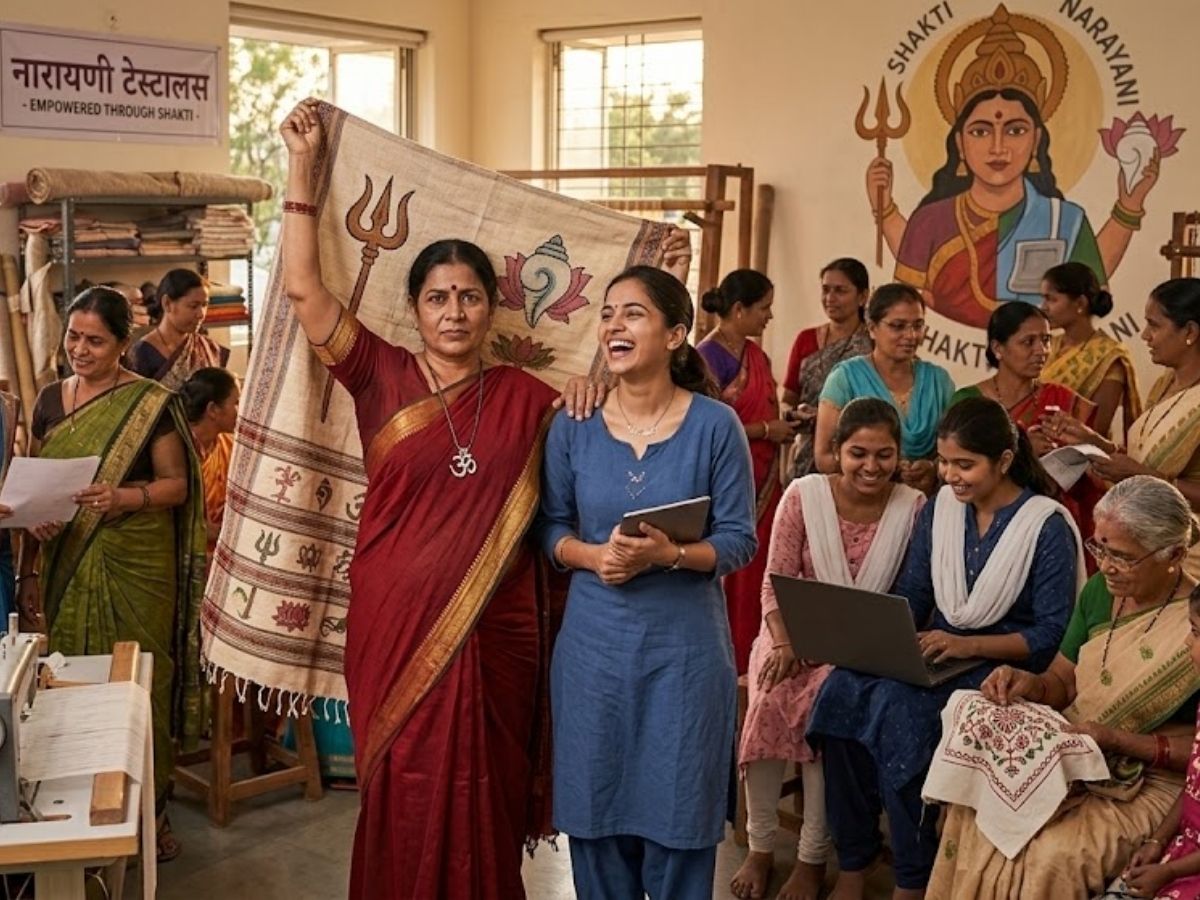
Every society frames the question of women’s agency through the experiences that shaped it. In Europe, the modern feminist vocabulary grew out of a long battle with the church, property, and the modern state. It is therefore structured around opposition, illustrated in binaries: the individual versus authority, rights versus exclusion, body versus control. That history produced powerful tools, and they travelled across the world because they worked.
But when this adversarial language becomes the only way we are able to think about women and power, conflicts and confusion emerge. In the case of Bharatiya culture, such binaries are nonsensical and frankly meaningless. But then what are our views and vocabulary? The sad reality is that our own ideas and thoughts on this fundamental subject, although vast, remain untranslated and underdiscussed.
For us, the starting point was never the absence of feminine power. It was its overwhelming presence. The most casual walk through India’s sacred geography makes this clear. Cities are mapped through goddesses. Rivers are mothers. Hills, groves, and even boundaries between villages are guarded by female deities who are neither gentle nor accommodating. They demand, they punish, they protect. They are not waiting to be granted legitimacy. They already possess it.
For instance, take Kali. When colonial writers first described her, they saw a grotesque figure, blood, skulls, and a dark body standing on her husband. What they were really encountering was a metaphysics they could not read. In the theological imagination that produced her, Kali is time itself, the force before which everything dissolves. Shiva beneath her is not a defeated male; he is pure consciousness without energy. The image says, quite simply, that power is feminine.
Move away from the well-lit temples and into the world of local goddess traditions, and the argument becomes even harder to ignore. In large parts of Tamil Nadu, the festivals of Mariamman, known in some regions as Karmariamman, are not conducted by a distant priesthood. They are organised by the community itself. Women carry fire pots, walk on embers, enter trance, speak as the goddess. The deity is approached not through Sanskritic liturgy but through heat, song, possession, and negotiation. Such are not symbolic gestures.
Anthropologists have long noted that village goddesses function as authorities in their own right, settling disputes, marking territorial limits, and protecting the moral economy of agrarian life. Their shrines often stand outside the formal temple complex, which is another way of saying that their power does not depend on classical structures of control.
Indeed, it is difficult to fit this into the familiar argument that goddess worship is merely a cultural compensation for women’s subordination. But that critique works in certain contexts, especially when the divine feminine is reduced to the ever-giving mother who quietly sanctifies domestic labour. Furthermore, it becomes inadequate in front of deities who are unmarried, entirely sovereign, or even frankly terrifying.
The Meenakshi of Madurai rules as a warrior-queen before her marriage is ritually staged. The goddesses of many Adivasi traditions accept offerings that orthodox temples would reject. Yellamma’s cult in parts of Karnataka and Maharashtra carries the complex histories of marginalised women who negotiate stigma and sacred authority, which was later stigmatised heavily by colonial-era morality laws. None of these figures fit the mould of the obedient consort.
What emerges instead is a different understanding of empowerment. In the liberal framework, empowerment is about access to education, to employment, to representation. All of these are necessary. But in the Bharati imagination, power is also something more elemental. Knowledge itself is feminine in the form of Saraswati. Prosperity is Lakshmi. Protection in times of crisis is Durga. These are not decorative metaphors; they are ways in which society has historically organised its ethical and ritual life.
This is why the Bhakti movement matters so much to any conversation about Indian feminism, even if we do not always call it that. When Akka Mahadevi walked out of a royal marriage in the twelfth century and declared that she had only one true beloved, the divine, she was not asking for reform. She was refusing the entire structure of mediation that defined her place in society. When Mirabai sang in public spaces, ignoring royal and familial authority, she transformed devotion into a form of spiritual sovereignty that transcended temporal power.
There is also an ecological intelligence built into this worldview. The goddess is not only in the sanctum. She is the river, the forest, the mountain. To pollute a river is not an environmental violation but instead must be viewed as an act against a sacred presence. Long before eco-feminism became an academic term, the connection between the exploitation of nature and the imbalance of social life had been ritualised.
None of this erases the very real inequalities that women continue to face. The language of the devi has often been used to demand impossible standards of sacrifice and purity. Symbolic reverence does not automatically translate into social freedom. Bharati feminism, if it is to mean anything, has to be unsentimental about this. It has to separate those strands of tradition that immobilise women from those that give them agency.
Meanwhile, it also has to resist the temptation to read its own archive only through borrowed categories. Because there are spaces in this civilisation where the feminine was never passive, the shrine where the oracle is a woman whose words settle conflicts, the annual festival where caste hierarchies are briefly suspended in collective possession, the oral epics where the heroine fights, avenges, and rules. These are not marginal curiosities. They are parallel institutions of authority that modern India has not yet fully learned how to interpret.
In recent years, when political language invokes Nari Shakti or when women lead massive ritual processions, as they do during Bonalu in Telangana, carrying the goddess through the streets on their heads, something of this older grammar reappears in public life. The female body becomes, at once, the bearer of the sacred and the agent of the civic. It is not a performance of vulnerability but a performance of power.
What Bharati feminism offers, then, is not a rejection of Western feminism but rather a reminder that there are other ways of imagining liberation. This does not always need to be a war against structures, but as a recovery of energies that were never entirely lost.
As such, the challenge is translation: bringing the sovereignty of the goddess into conversation with the citizenship of the woman, without romanticising the past or dismissing it. If that translation begins in earnest, the question will slowly change. It will no longer be only about how women gain power within existing systems. It will also be about how a society that has always known the feminine as power learns can finally organise itself accordingly. And such would not be based on a borrowed future but a return to a memory we have not yet fully read and recognised.
-
Prof Santishree Dhulipudi Pandit is the Vice Chancellor of JNU.




