The diplomatic crisis between Beijing and Tokyo has exposed enduring structural fault lines in their relationship and the East Asian security order.
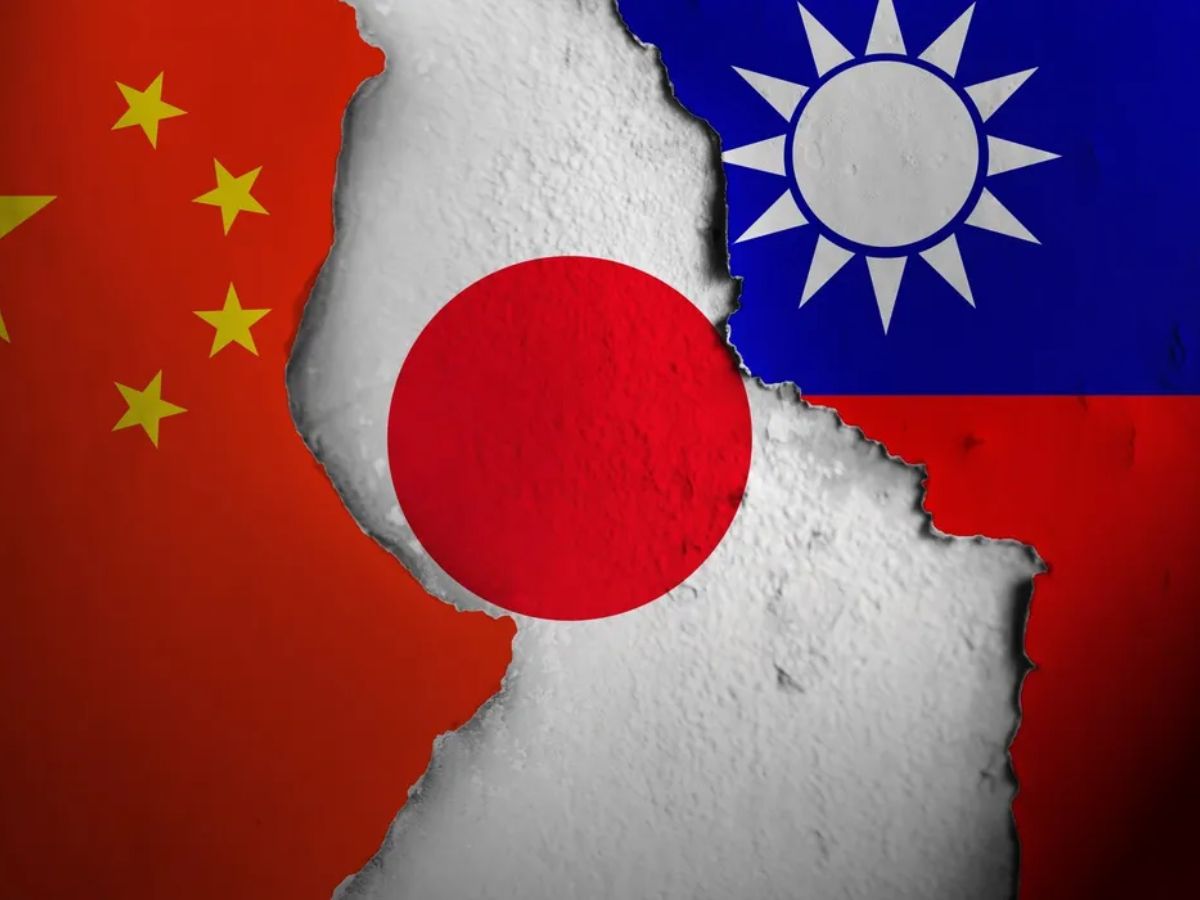
China, Japan and the Taiwan flashpoint
On November 7, 2025, while responding to a question about a statement she had made in 2024, Japanese Prime Minister Sanae Takaichi told the Lower House Budget Committee that “If it involves the use of force by China against Taiwan, it could be considered a survival-threatening situation for Japan.” Her remarks implied that Tokyo might respond militarily under the post-2015 collective self-defence framework. The statement drew strong criticism from Beijing, and the next day, China’s Consul-General in Osaka, Xue Jian, posted on X: “If you go sticking that filthy neck where it doesn’t belong, it’s gonna get sliced right off. You ready for that?”
Japan’s Foreign Ministry and the Japanese Embassy in China lodged a protest with Beijing on November 9 and demanded the immediate removal of the post, but China reacted sharply. On November 13, 2025, Vice Foreign Minister Sun Weidong, “under instruction,” summoned Japanese Ambassador to China, Kenji Kanasugi to issue stern representations regarding Takaichi’s “erroneous remarks.” Seeking to calm tensions, Tokyo sent Masaaki Kanai, Director-General of the Foreign Ministry’s Asian and Oceanian Affairs Bureau, to Beijing for talks with Liu Jinsong, his counterpart in China’s Ministry of Foreign Affairs.
However, a widely circulated social media clip showed Liu speaking to Kanai with his hands in his pockets, a gesture that, according to a November 20 Japan Times editorial, “constitutes nothing less than malicious impression management meant to demonstrate that China holds the upper hand.” No public retraction by either side, but hardening of the rhetoric. On November 18, in an article Jiu Taiping, a commentator wrote in the China Jilin Net that “the status of Ryukyu remains an unresolved issue left over from World War II, and it is legitimate to continue examining and debating this issue under international law today.” And if Japan continues to touch China’s red line, the Ryukyu Issue deserves to be put on the table.
The diplomatic crisis between Beijing and Tokyo has exposed enduring structural fault lines in their relationship and the East Asian security order. While not the start of a conflict, it marks a decisive inflection point—stripping away ambiguity about intent, sharpening strategic signalling, and complicating future restraint. Takaichi echoed former Prime Minister Shinzo Abe’s 2022 line that “a Taiwan contingency is a Japan contingency,” but she did so officially in the Diet. China responded with heightened coast guard patrols near the Senkaku/Diaoyu Islands, travel advisories for Japan, suspension of Japanese film screenings, restrictions on beef and seafood imports, and postponement of a trilateral culture ministers’ meeting. Beijing also signalled that Premier Li Qiang would not meet Takaichi at the G20 summit in South Africa. The following are the major takeaways from the current spat:
First, for decades Tokyo practised strategic ambiguity about Taiwan. What makes Takaichi’s Diet statement different is that it by placing Taiwan within the language of “survival” and collective self-defence, she moved the discussion from the hedged language of deterrence to something closer to declaratory policy. That reduction of ambiguity matters because signalling, whether to allies, adversaries or domestic audiences is consequential. Beijing read it as a durable shift; Tokyo and Washington may regard it as calibrating deterrence. Either way, the ambiguity that allowed both sides to manage the status quo has been narrowed.
Second, China’s response, from diplomatic summons and coast guard “rights enforcement” patrols to tougher regulatory standards on Japanese imports and public travel warnings, follows its familiar playbook of coercive diplomacy, while still leaving space for continued engagement. These actions also serve domestic political needs. Taiwan is a deeply emotive and foundational issue in China’s political narrative, tied closely to the Party’s legitimacy in the “new era,” where reunification is framed as essential to national rejuvenation. Domestic nationalist audiences expect visible toughness. This helps explain why Beijing’s moves were forceful yet calibrated: strong enough to signal resolve at home and deter external intervention, but cautious enough to avoid crossing thresholds that could trigger uncontrollable escalation.
Third, historical memory acts as an accelerant. Disputes between China and Japan are rarely confined to territory or a single incident; they rest on a deep historical ledger shaped by invasion, occupation, and wartime atrocities in the first half of the 20th century. These memories are politically instrumentalized by both sides. In China, narratives of a “century of humiliation” and Japanese militarism provide powerful domestic framing for foreign policy assertiveness.
As Peking University historian Huang Bowen has written, authoritative post-war treaties, including the Cairo Declaration, the Potsdam Proclamation, and the UN Charter place obligations on Japan as a defeated nation: to reflect on its history of aggression, eradicate militarism, return seized territories, respect sovereignty, uphold a pacifist constitution, and renounce offensive military capabilities. China interprets Japanese leaders’ visits to the Yasukuni Shrine through this same historical narrative.
Fourth, the strategic consequences for Tokyo are structural rather than immediate. This crisis will not trigger a sudden Japanese military intervention in Taiwan, but it will accelerate ongoing policy shifts: faster defence modernization, clearer deterrence messaging, deeper operational alignment with the United States and other partners, and a more permissive legislative environment for forward deterrent measures. Recent initiatives such as expanded security partnerships, the Reciprocal Access Agreement with the Philippines (in force since September 11, 2025), and investments in sea-control and anti-access/area-denial capabilities, will now carry even stronger political justification, reinforcing Japan’s trajectory toward a more proactive security posture.
Fifth, economic interdependence constrains escalation, for now. China and Japan remain deeply intertwined: substantial bilateral trade (US$292.6 billion in 2024), tens of thousands of Japanese business entities in China (31,060 in 2023), and a large Chinese community in Japan (870,000 in 2024) accounting for 27% of all foreigners in Japan. These connections raise the costs—political, economic, and social—of a rupture. Beijing’s reliance on non-military coercion seeks to punish without breaking the relationship, while Tokyo understands the severe economic and societal damage that an open confrontation would entail. Mutual dependence therefore acts as a brake on escalation, albeit a fragile one when viewed through a hard security lens.
Sixth, the incident will strengthen alliance dynamics. Washington benefits from a more explicit Japanese security posture that enhances burden-sharing credibility, while Seoul, Canberra, and Manila are likely to take cues from Tokyo in their own strategic calculations. This will drive closer operational coordination among U.S. allies and partners in the Indo-Pacific and incentivize faster capability development. China’s opposition will remain firm.
As Cai Liang of the Shanghai Institutes for International Studies recently argued, strong countermeasures should make the Japanese public aware of the risks of provocation, warn the United States against being drawn into confrontation, and signal to Japan’s ruling camp that such actions raise political costs. Beijing’s move to condemn Takaichi’s remarks at the United Nations reflects this strategy of signalling not only to Japan, but also to other states watching the regional balance.
Seventh, there is a latent risk: misperception and unintended escalation. The same reduction of ambiguity that clarifies policy also raises the salience of mistakes. Coast guard encounters, air intercepts and maritime shadowing, routine in East Asian waters are now more likely to be read through a security lens that assumes higher stakes. In that environment, a small tactical incident could be politicised into a strategic crisis.
Finally, the most likely near-term outcome is neither war nor reconciliation but a more contested equilibrium: higher rhetoric, deeper alliance-level coordination, more frequent maritime and air encounters, and intermittent coercive diplomacy calibrated to avoid all-out war, nonetheless, the very encounters increases the probability that a small spark becomes a large fire. That equilibrium is stable only if political leaders on both sides value economic ties enough to accept persistent friction and if diplomatic channels remain open and functional.
In short, the Takaichi episode has not created a new reality; it has made an existing one sharper and less forgiving. For the region and the world, the task now is to manage that sharper reality without letting it harden into a permanent strategic rupture.
* B.R. Deepak is Professor, Center of Chinese and Southeast Asian Studies, Jawaharlal Nehru University, New Delhi.
