The fragmentation of the western spirit is now visible. It must wake up to alternative civilizational systems that exist and to a world that is not anti-western but post-western.
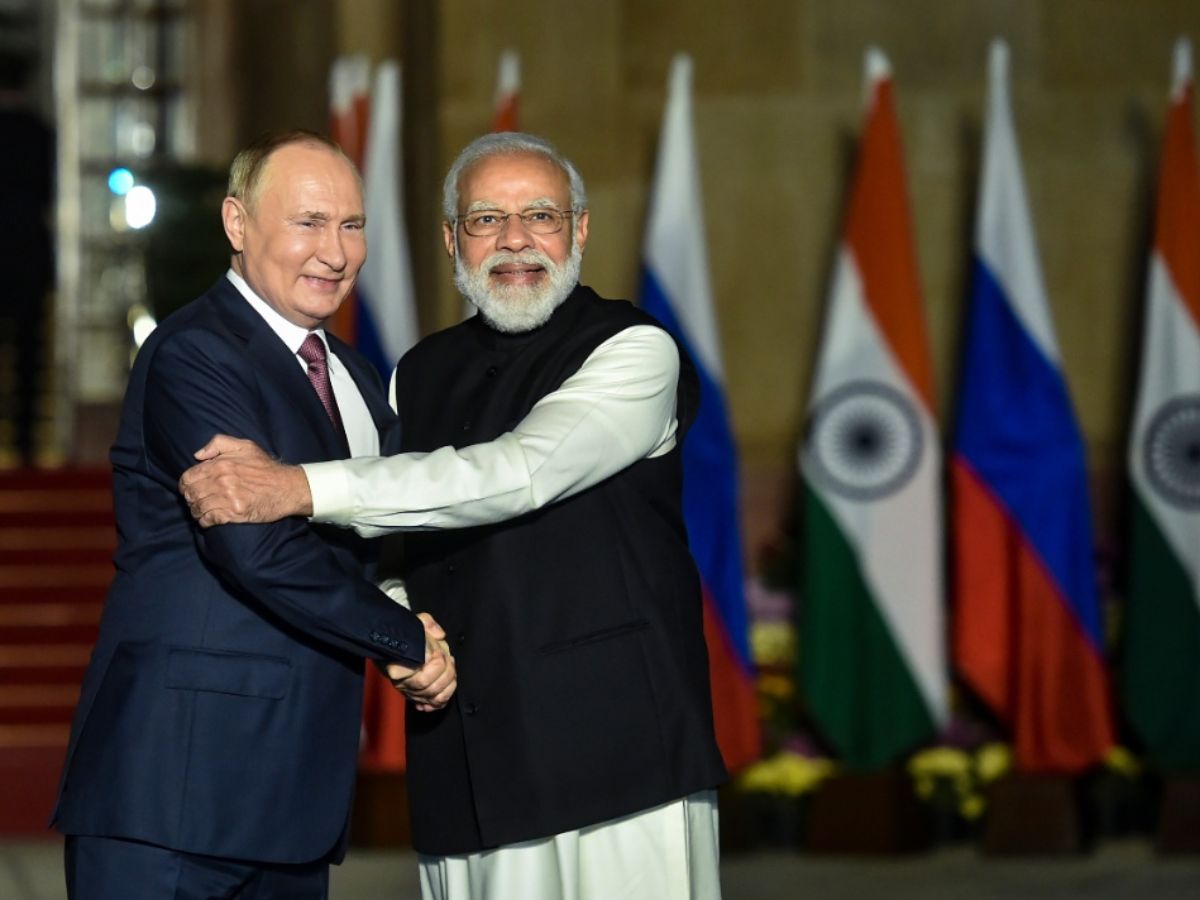
President Putin and PM Modi (Image:X)
On the eve of the visit of President Vladamir Putin to India, it is essential to understand the post western order of not unipolarity, or bipolarity, but multipolarity and changing multi-alignments. On 21 October, Vladimir Putin called the shot in the global balance of power by testing the Burevestnik nuclear-powered long-range cruise missile. The test meant far more than its technological capabilities. It was a message wrapped in aerospace engineering. It loudly declared that the era of unilateral coercion, which has dominated global politics since the end of the Cold War, is ending. Not because someone wishes it to end, but because the illusion of permanent western dominance has cracked. The test reminded us that writing off great powers is not only arrogant but historically foolish. Those who do not learn from history are condemned to repeat its worst mistakes. And history has a cruel way of punishing those who mistake dominance for invincibility.
For decades, the West comforted itself with two convenient narratives: that Russia is a declining relic whose power had become redundant, and that China’s rise can be contained. These assumptions were not a strategy but self-congratulation disguised as farsightedness. Meanwhile, the West convinced itself that its so-called rules-based order would endure simply because it said so. However, somewhere, the West laid the groundwork for its own failure by undermining itself from within. The system became self-referential, believing its own proclamations while failing to understand that rules, like empires, collapse when one side starts acting with impunity as if there are no consequences. Critics and loyal defenders alike overlooked the central reality that any order founded on unilateral power ultimately faces resistance. Today, the world is experiencing the re-emergence of deterrence, albeit in a new form: what we can call deterrence 2.0, where fear of consequences has returned. And it has returned precisely because the West stopped fearing consequences for itself.
NATO expansion is a prime example of how intentions and outcomes diverge. For years, western analysts insisted that expanding NATO eastward was harmless, abstract, even noble. But for Russia, it was not abstract. It was a strategic encirclement, a military infrastructure creeping closer to its borders under the pretext of moral virtue. European leaders repeated that NATO was defensive. Yet, for Russia, a nuclear state with a long historical memory of invasions, defensive infrastructures look offensive when placed at its front door. Peace rests not on declarations of good intentions but on the equal fear of what the other is capable of doing. The West offered narratives and spoke of partnership, but for Russia, assuming this as containment is not unfounded, but rather a recognition of reality.
Similarly, arming Ukraine did not remain a benevolent gesture of solidarity on the part of the West. Instead, it has evolved into a coercive strategy aimed at pushing Russia into submission, using Ukraine’s territory and its military as instruments to exhaust and isolate Moscow. Ukraine was not strengthened into a secure democracy, but into a frontline. It became a pawn, trapped between moral rhetoric and geopolitical utility. Western support did not empower Ukraine to negotiate from a position of strength but encouraged Ukraine to reject negotiations entirely, believing that foreign weapons could compensate for geographical reality. In the process, Ukraine misinterpreted foreign backing as a sign of sovereignty. At the same time, Russia was bound to view the entire arrangement as a preparation for regime change in Moscow itself, given the previous examples of the last century, where the West had done this repeatedly. Regardless, as its history repeatedly shows, Russia will not be coerced into submission.
Europe, meanwhile, has built a technocratic empire of values, institutions, and bureaucratic virtue, applauding NATO expansion as a project of collective security. Yet this collective security has left Europe more vulnerable than ever. If NATO expansion was really about cooperation, why did the West so bluntly deny Russia a partnership? Why is Europe’s sovereignty outsourced to Washington? Why does a continent that claims strategic autonomy require US consent for every major security decision? The myth of European strategic autonomy evaporates quickly when confronted with the reality that Europe cannot protect itself without American troops, cannot heat its homes without imported gas, and cannot maintain industrial growth without sacrificing its independence to external suppliers. Europe traded actual sovereignty for a moral narrative about values. Values do not power factories or deter adversaries.
Sanctions that were presented as economic precision weapons were expected to cripple Moscow. Yet, the global economy did not obey Washington’s imagination. Russia adapted, built alternative networks, strengthened ties with Asian powers, and scraped the rust off its industrial base under the pressure of necessity. Europe, not Russia, found itself entering winter with energy anxiety, industrial stagnation, and price shocks. The sanctions intended to isolate Russia ultimately isolated Europe from cheap energy and exposed its lack of strategic foresight. China closely monitored developments and reinforced its own self-sufficiency by diversifying its trade, technology, and energy routes. The more the West weaponised economic networks, the faster the non-western world pursued alternatives. As a result, the myth of western strategic invincibility quietly collapsed, without ceremony, while the West was busy congratulating itself on its moral unity.
The post-Cold War world was built on three illusions: that the ideological victory of western liberalism was irreversible, that markets would tether nations into political submission, and that western strategic dominance had no expiration date. All three illusions are now dissolving. A single hegemon may feel invincible for a moment. Its followers may feel the same. But forcing countries to your will, whether they are tiny islands or great civilisational states like Russia, does not lead to peace. It leads to blowback. Nations have self-esteem. They fight back. Moral binaries cannot secure interests; they only justify pressure. But pressure without limits invites confrontation without resolution. We are entering a phase of dangerous instability, not one of chaos, but a balance built on mistrust. This stability is built on deterrence, not morality. Every shield can be pierced. Every defence can be penetrated. No state can guarantee another’s security permanently, no matter how righteous it imagines itself to be. Liberal democracies in the West are mistaking subordination for submission.
Meanwhile, Europe continues to speak loudly of sovereignty while its security policy is written in Washington. It criticises Russia while purchasing its energy through intermediaries. It speaks to strategic autonomy, yet its militaries remain dependent on American hardware. The EU blames others for moral relativism while practising selectivity in its own values. Where are the Bismarcks, the De Gaulles, the Adenauers? Where are the statesmen who understood balance rather than sermonising it?
This visit symbolises a call for realism, not hysteria. The return of nuclear deterrence, strategic competition, and the logic of fear is not a threat to civilisation. Invoking democracy for dominance does not build peace. Moral crusades do not produce stability. Proxy wars and regime-change ambitions have repeatedly failed. The fragmentation of the western spirit is now visible. It must wake up to alternative civilisational systems that exist and to a world that is not anti-western but post-western. It must accept that it is no longer the sole arbiter of morality, security, or order.
Prof Santishree Dhulipudi Pandit is the Vice Chancellor of JNU.
