
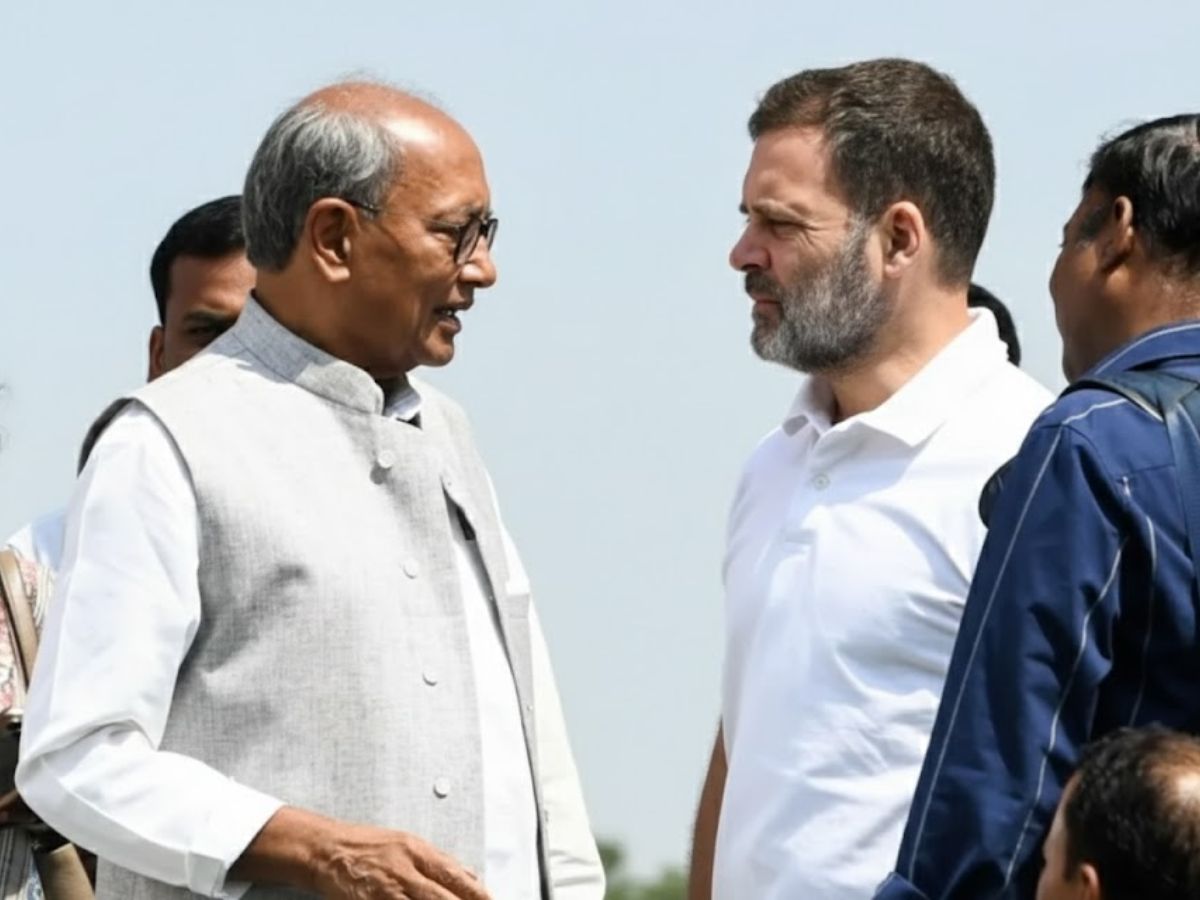
The Rashtriya Swayamsevak Sangh has received praise from completely unexpected quarters, with several Congress leaders, former Madhya Pradesh Chief Minister, Digvijaya Singh, notably, lauding its organizational strength. Digvijaya, who in the past has been extremely critical of the RSS, often referring to it as a fascist outfit and accusing it of unleashing “Hindu terror”, particularly after the Malegaon blasts, complimented the Sangh for its discipline and organizational prowess.
Significantly, the statement followed by weak attempts to elaborate it, was issued on the eve of the Congress Foundation Day and when the Working Committee was meeting at Indira Bhawan to finalize the agitation programme against the Centre on the MNREGA issue.
The veteran leader released an old photograph of the Prime Minister sitting at the feet of BJP stalwart, L.K. Advani during the swearing in ceremony of Keshubhai Patel, 30 years ago, with a comment that it was the Sangh alone which could make an ordinary worker first the CM and subsequently the PM.
Political analysts were quick to point out that the views expressed by the former CM were aimed at the coterie around Rahul Gandhi and also highlighted both the inaccessibility of the leadership and its inability to address important organizational issues. Incidentally, Digvijaya’s Rajya Sabha term ends in a few months as also of those who appeared to concur with him amongst the elected members.
The entire issue has generated a huge controversy, but there is nothing new in what he has said. The only difference is that while admitting that the Congress had lost in 2014 Parliamentary polls, the then president and now UPA chairperson, Sonia Gandhi had observed that poor organization had played a role in the defeat. The problem was that at the time, no one questioned her and asked as to whose job except that of the Congress president was it to strengthen the Congress.
The fact remains that all issues such as “vote chori” can be linked to the poor state of affairs of the Congress. In majority of places, the party has no structured form and in places where state presidents have been appointed, there is nobody. The high command is only concerned with raising issues, some of them very important, but pays little heed to the organizational aspects.
The Congress has failed to regain its original vote bank of Brahmins, Dalits and Muslims. Its leadership has helped the BJP by its inactivity and to strengthen the perception that it was anti-Hindu, and pro minorities. It has alienated itself from the masses and the result is that it has been losing in polls in one state after the other. There can be some truth in the allegations of “vote chori”, but these have to be substantiated by evidence presented before the courts.
Digvijaya has merely pointed out the failings in the set-up, not out of concern, but because he is unsure on whether he shall be able to retain the Rajya Sabha seat from Madhya Pradesh. The same is the case with Rajni Patil from Maharashtra. In MP, the party may be able to win one seat, and in all probability, it would go to someone who is chosen by the Gandhis. Former CM and nine-time Lok Sabha MP, Kamal Nath could also be a contender and though he has all the credentials to make it to the Upper House, no one knows what would happen.
The issue which has once again come to the fore after Digvijaya’s statement is that there is no frontal wing of the Congress that has the heft and capacity to counter the RSS. The Youth Congress, except for a brief period when B.V. Srinivas was the chief, has been defunct and the Seva Dal does not receive the attention it should.
It may be recalled that the fightback in the late 1970s after Indira Gandhi’s defeat had started with the Youth activists taking it upon themselves to give the party a new lease of life. Soon after taking over as the president of the Congress, K. Brahmananda Reddy had disbanded the Youth Congress, but determined activists Prem Swarup Nayyar, the late Lalit Maken, and some others, after being encouraged by the late Sanjay Gandhi, floated the Congress Youth Forum.
The development took place after Lalit, Prem and Geetanjali Maken, while returning from Mata Vaishno Devi shrine halted in Chandigarh at the house of upcoming leader Venod Sharma. During the deliberations, a decision to float the Youth Forum was taken, and Ram Chander Rath, who had been elected to the Lok Sabha from Odisha, was appointed the president even though Sanjay was not in his favour, but because he was a Member of Parliament during those difficult times.
The Youth Forum led by Prem and Lalit, held the first demonstration outside the All India Radio, which paved the way for the fightback by the Congress. The office bearers of the Forum at that point included Ghulam Nabi Azad, Lalit and Venod. Prem was the Delhi unit president.
The Youth Forum would plan its strategy at the South Avenue residence of Rath where Azad, Panicker and Madan Mohan stayed in the barsaati. Sanjay would monitor all activities and Maken and Prem led the agitations by mobilizing new activists who later helped in strengthening the Congress, following the second split in 1978.
The short point is that the Congress needs an overhaul, and leaders, who can deliver or have expertise in micromanagement should be given responsibility, regardless of their age. Between us.




