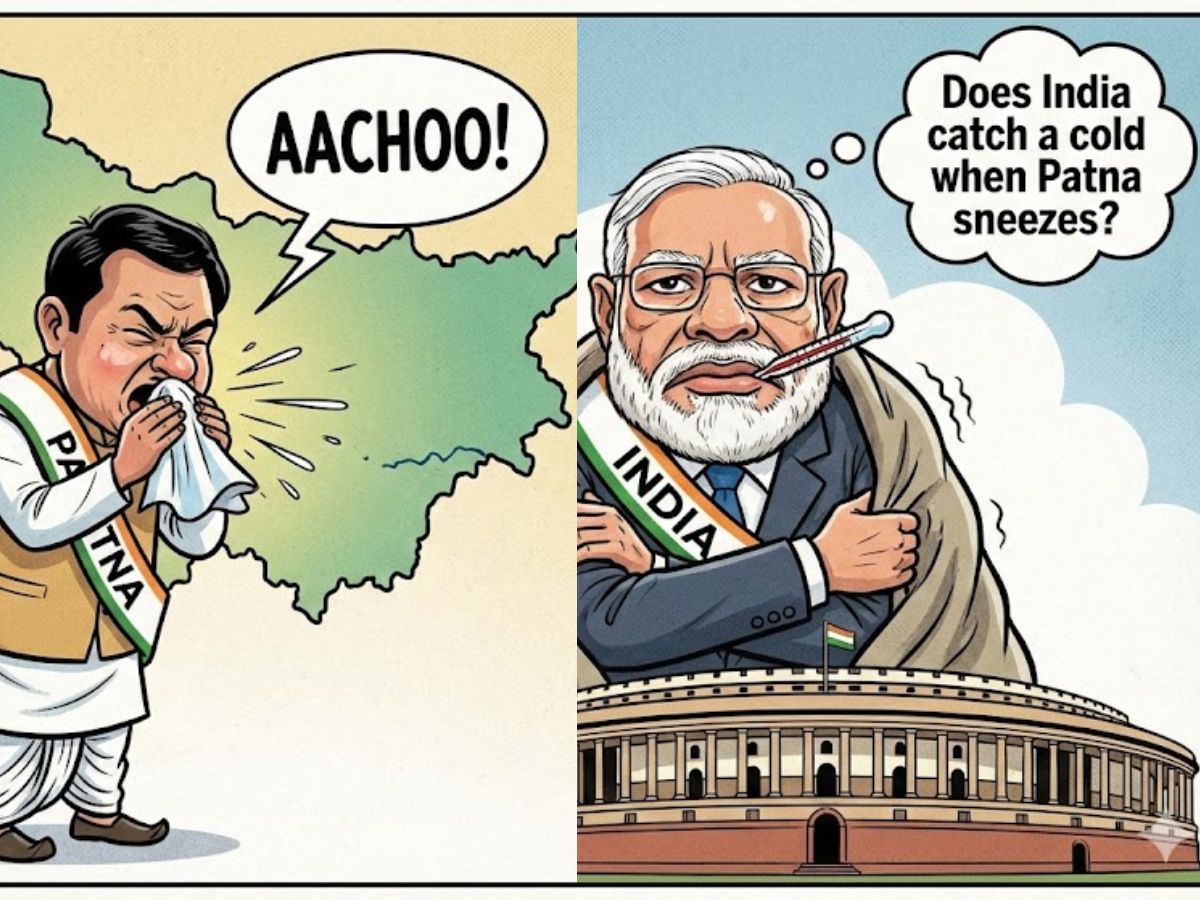
Does India catch a cold when Patna sneezes?
Bihar is a paradox: Unless he migrates from Bihar, an average Bihari earns only Rs 66,208 a year—less than a third of what an average Indian earns (Rs 205,324, currently). Even so, political trends in Bihar—the fight against the Emergency for instance—are often a harbinger of what follows later in other states.
And so it seems may be the case in the recently concluded assembly elections in Bihar: the NDA overcame a 20-year anti- incumbency to win an overwhelming mandate—202 out of 243 seats (BJP 89 seats; JDU 85, LJP 19). What was even more significant than the margin of this win were certain force multipliers that enabled this runaway victory.
It was not as if people did not vote for the Opposition. The decline in Opposition vote shares was insignificant—from 23.11% to 23% in the case of the RJD and from 9.48% to 8.71% in the case of the Congress. What then explains the decline in their seats—from 75 to 25 in the case of the RJD, and 19 to 6 in the case of the Congress? One factor was surely the increase in the overall turnout. This jumped from 57.29% to 67.13%, thanks largely to the increase in the number of women voters. This figure increased from 59.61% in 2020 to 71.60% in 2025.
Rs 10,000 was transferred to 1 crore women, just before the Model Code of Conduct came into force. Contrary to what critics claim, this did not violate the Model Code of Conduct, because the latter came into force only on 6 October, ten days after the initial announcement. By itself, this welfare measure may not have gained much traction, but it proved to be the perfect topping on Nitish Kumar’s cake.
Women empowerment schemes in Bihar under Nitish Kumar are inter-generational, going back to 2005. When some of the beneficiaries were interviewed, they emotionally recalled the first bicycle they received when they were little girls. These enabled them to go to school. These women are now housewives. Many of them claimed they would now use this money to start small business ventures. Others would be utilizing it for better nutrition, healthcare or education. There were other measures too which proved popular—the supply of piped water, gas and electricity to homes, for instance. The female vote for Nitish Kumar was thus a final hurrah to a father figure before he finally demits office.
Critics have claimed that this is nothing but sophisticated bribery and a race to the bottom, upsetting the fragile fiscal discipline of the states. Critics forget that this measure was not at the cost of economic development. Between 2013-14 and 2022-23, 3.77 crore people were lifted out of multi-dimensional poverty. In 2024-25, the rate of economic growth was 8.64% as against UP’s rate of 8.99% and Tamil Nadu’s rate of 11.19%.
Women empowerment measures are a powerful corrective to female discrimination and an important means to build up human capital. Ultimately, all such measures spur further economic growth and are a good preparation for the implementation of the Women’s Reservation Act, 2023 by 2033.
The other real winner of the recent elections was the Election Commission. Whether in sports or politics, the role of the umpire is thankless. When a highly contentious election passes off incident-free much of the credit must go the referee: Bihar recorded its highest ever turnout since 1951. Yet there were no complaints and no call for repolls. There were also no appeals against wrongful inclusion or exclusion of voters after the Special Intensive Revision of electoral rolls. The highly politically conscious electorate of Bihar realised all this instinctively and rejected the accusations of vote chori summarily.
Even in other states, this accusation is unlikely to cut much ice, simply because manuals, procedures and instructions of the Election Commission are totally impartial and apolitical. As someone who has acted as the Commission’s Election Observer in the past on a number of occasions, I can vouch for this fact and endorse the sentiments expressed by 272 eminent citizens in an open letter to Rahul Gandhi, the Leader of the Opposition in Lok Sabha.
“When Paris sneezes, Europe catches a cold” said Austrian Chancellor Metternich in an obvious reference to the influence this city had in European affairs. Does India catch a cold when Patna sneezes? Is Bihar once again the harbinger of new trends in Indian politics? It would seem so.
The writer was Chief Commissioner of Income-Tax and is the author of the Moral Compass: Finding Balance and Purpose in an Imperfect World, Harper Collins India, 2022.
