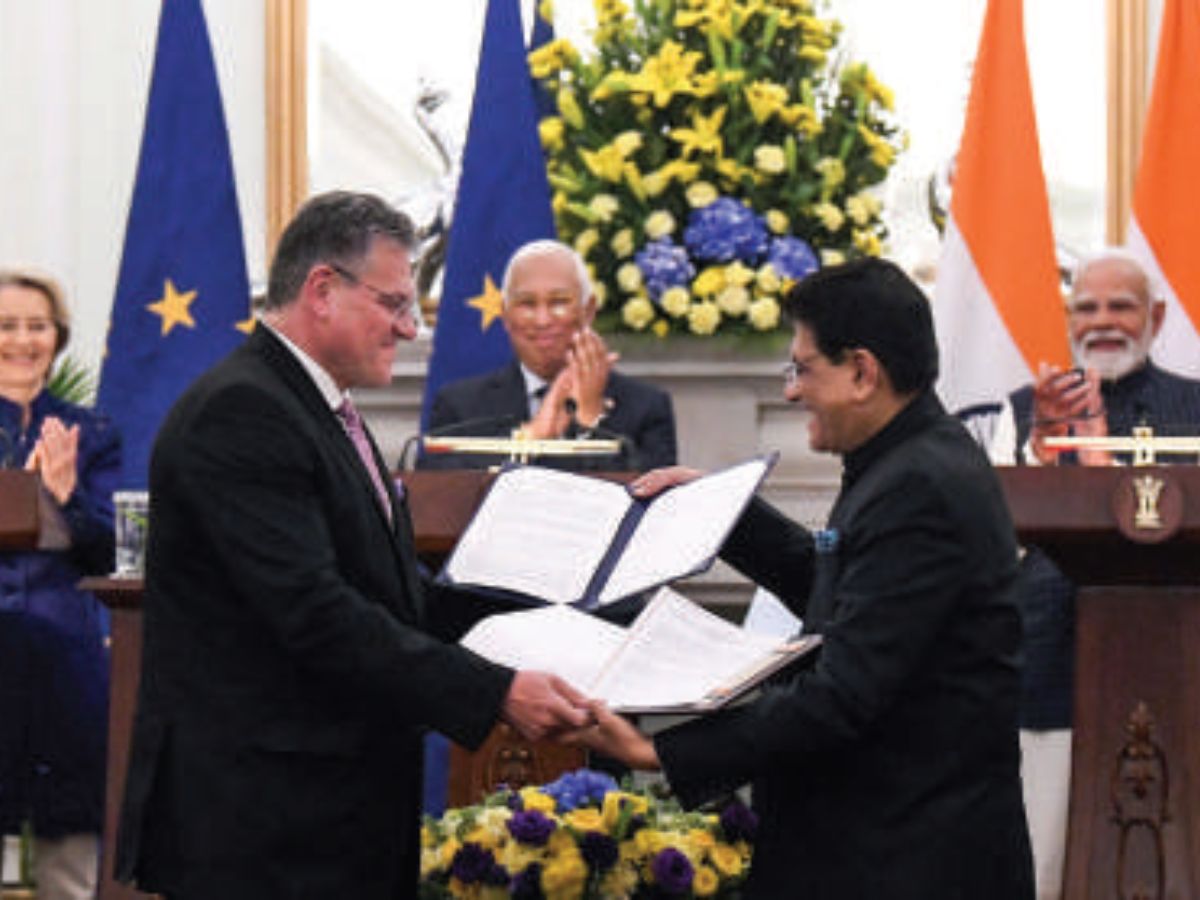
The FTA MoU signing ceremony in New Delhi on Tuesday. ANI
One of the quickest conclusions to prolonged deliberations between two parties, both of which believe as much in process as in outcomes, came with a joint announcement in New Delhi on the day following India’s 77th Republic Day on the 26th January. The heads of the European Union (EU) Council and the Commission, who were the two chief guests at the customary Republic Day Parade, jointly declared along with the Indian Prime Minister Narendra Modi, that they had successfully concluded their laborious negotiations to enter into a bilateral comprehensive trade and economic partnership. Alongside this, their representatives signed an agreement on promoting defence and security cooperation, and entered into a mutual arrangement to facilitate the mobility of students and workforce to the European member-states.
Such landmark understandings between the two “middle powers” in a fast-fracturing world, hold the promise of meaningfully denting the strengthening hegemonistic trends in both Western and Eastern spheres. The United States of America, hitherto the benign hegemon providing political, economic and military support to Europe, had suddenly changed its attitude and stance, and the transatlantic relationship was falling to its nadir. Beginning with chiding the European nations for not paying enough for their defence through NATO, President Trump’s threats to impose additional tariffs on eight European nations in the context of ownership of Greenland, and his contemptuous comments on the role of allied soldiers in the long war vainly fought in Afghanistan, had begun to visibly irk the European leaders.
Even the far-right leaders in Europe stand antagonized. President Emmanuel Macron of France, otherwise a friend, was publicly mocked at a business forum in Switzerland. Christine Lagarde, usually the placid head of the European Central Bank, stormed out of a dinner at Davos when the United States Commerce Secretary launched a rather unpleasant attack on alleged European misdeeds. The alliance of decades now appears to be foundering. Jolted by such unexpected arbitrariness and capriciousness by Trump and his aides, the European Union has almost immediately demonstrated remarkable resoluteness in looking for new partners and coworkers. This is much like Canada’s response to similar high handedness and provocations by the United States.
Within days, it concluded new strategic partnerships with China and Qatar. Going forward, both of them, along with several other nations, can be expected to further rebalance away from excessive US dependency, and explore viable alternatives where demands for reciprocity would be less severe and the partners heard as well as respected.
Finalizing trade pacts such as the one with India was seen as desirable to also check the continued breakdown of the global multilateral trading systems assiduously built over the last eight decades. The rule based international order is under unprecedented pressure. Earlier in January, the European Union had signed a pivotal deal with the South American bloc Mercosur, following the pacts last year with Indonesia, Mexico and Switzerland. No doubt while finalizing the trade deal with India, the European Union had to lower its expectations of full access to the vast Indian market. The much-demanded provisions on environmental and labour standards have also not been included and the released summaries of the finalized chapters of the agreement show that the pact will be implemented in phases over a ten-year span, and not in one go.
The European Union, a bloc of relatively well-off 450 million residents across 27 contiguous countries, with an aggregate GDP of $20 trillion has systematically reconstructed itself post the Second World War. By pooling their rich historical experiences and endowments, the member-countries have evolved common ways and means to meet their aspirations and ambitions. The vastness of the acceptance of the commonly applicable rules, regulations and institutions to attain agreed economic and social goals is virtually unprecedented in the history of mankind. Even in matters related to their own defence, for which each member state remains individually responsible, their shared belief in supporting the common alliance under NATO reflects mature prioritization. Such a shared approach and attitude to handling most issues has made the collective European Union a powerful grouping, both geopolitically as well as economically.
India, with its 1.45 billion strong population, is undoubtedly a big market for European merchandise and the diverse technological prowess of EU member nations. No longer a poor society caught up in traditional modes of production, India has expanded its GDP at an average of 6% a year for the last two decades. It is already the fourth largest economy, and its current growth rate of nearly 7% per annum is twice the global average. This places it in line to soon move up another notch in pecking order. Its rising per capita income is leading to the emergence of a rapidly growing middle class with greater purchasing power in its hands. India’s growing and upwardly mobile manpower consists of both highly skilled and lesser trained workers, and should remain available at reasonable compensation-levels in the foreseeable future. This is occurring at a time when populations in developed economies, including the European Union, are shrinking and wage costs are perceptibly on the increase. The diversity of India’s services sector, which now constitutes a lion’s share of its GDP, continues to grow, with rising demand both domestically and overseas. Such positives have catapulted India into the ranks of middle powers, with unique characteristics and clear complementarities with the EU.
The blueprint of the “mother of all deals,” as described by EU Commission President Ursula von der Leyen in an address at the World Economic Forum in Davos, a week before her visit to India, marks a key strategic pivot diversifying their economic reliance on USA and China. Together, the two middle powers represent 1.9 billion people, account for 25% of global GDP, and their total external trade constitutes a third of all world trade. Out of this, EU and India’s bilateral merchandise trade in the fiscal year ending March 2025 was valued at $136.5 billion, in addition to Indian services exports worth $37 billion. Trade in goods between them in 2024 accounted for 2.4% of EU’s trade, compared to EU’s trade with China of 17.6% and with the US at 14.6%.
Once a few remaining details are finalized and legal vetting completed, the proposed pact, after ratification by all the member nations, is expected to come into effect in late 2026 or early 2027. In the five years thereafter, the European Union expects its yearly exports to India to double, while India’s aspiration is to add US$50 billion to its existing level. The strengthened trade ties with the European Union can be expected to be sustainable. In the European Union’s decision-making processes, all member-nations are treated equally, and consensus among members, rather than a majority, is its hallmark. In fact, this very uniqueness could even be a cause of the nine-year hiatus in bilateral negotiations between 2013 and 2022, though India’s reluctance to grant full access to its market was as much a factor.
With the long drawn out negotiations now concluding and the new deal expected to take effect next year, India has agreed to drastically reduce its import duties on European goods from the existing weighted average of 9.4%, while the EU will substantially bring down its average duties of 3.8%. Over seven years, the EU will cut duties on 99.5% of goods traded, with tariffs reduced to zero on Indian marine goods, leather and textile products, chemicals, rubber, iron and steel, as well as gems and jewelry. India has agreed to remove or reduce tariffs on 96.6% of traded goods by value, which in aggregate will result in savings for the European exporters of 4 billion euros (USD $6 billion) in tariffs.
The items on which duties are being reduced by India include alcoholic beverages such as wines, which will see tariffs lowered to 75% immediately upon the pact coming into force from the existing 150%, and then gradually reduced to 25%. Tariffs on spirits will be lowered to 40%, on beer to 50%, and on cars costing over $15,000 euros to 10% (with the overall number capped at 200,000 combustion engine cars and the electric vehicles excluded for the first five years). Tariffs on sausages made from prepared meat will be 15%, and on kiwis and pears 10%. Food items with zero import duties include olive oil, fruit juices, non-alcoholic beer, processed foods, pasta and mutton. Medical equipment, electrical equipment, aircraft and spacecraft have also been put in the tariff-free category.
To quickly sign the trade pact with India, the EU seems to have respected India’s red lines and not insisted on India granting access to its dairy products and most agricultural produce, including genetically modified items. It also agreed to meet India halfway in protecting its automobile and its component-manufacturing industry. In addition, the duties on labour intensive exports from India, such as textiles, leather goods, marine products, and gems and jewelry, will be eliminated immediately upon the deal coming into force. This should help India offset the loss of the US market following the arbitrary 50% levy. To ensure the benefits start flowing as soon as the agreement becomes effective, Indian exporters will, in the interim, need to ramp up their plans to comply with the European Union’s stringent regulations and cope with the non-tariff quality related barriers. Inter alia, these will require stricter quality-compliance and undertaking a host of phytosanitary measures for marine products and other food items.
The trade deal also provides a road map for furthering intellectual property rights (IPRs). The European emphasis on its inclusion is understandable. After the revised Indian patent law was put in place in early 2005, there were rightful demands from Western countries for India to strengthen its machinery for enforcement, as well as establish a more robust dispute resolution arrangement. Acting on these continues to remain a work-in-progress. Alongside this, trademark and copyright regulations need to be updated, especially in light of the increased digitization and the move away from print.
Acting on the agreed roadmap for IPRs, as well as remaining ahead of emerging changes, should help India build itself up as a worthy partner for the establishment of new manufacturing and processing facilities. Given the size of its market and workforce, such bases are more likely to be located in India than in European Union member states. A chapter in the agreement has been exclusively devoted to likely two-way investment flows and the regulatory environment expected to be developed to support them.
The Defence and Security Partnership between the EU and India, announced simultaneously with the trade deal, covers the fields of terrorism, cybersecurity, and maritime security. These are areas of much significance to both sides, which have been victims of cross border terrorism and spreading cybercrime. The EU, a trading monolith, also has a strategic interest in the maintenance of sea routes and passages, especially in the Indo Pacific and the Indian Ocean. Greater cooperation between their navies and scientists, in addition to securing trade routes, can assist in seabed exploration and the conservation of resources. Having such shared strategic interests should bring with it greater stability in mutual relations and more lasting economic and commercial cooperation.
Dr Ajay Dua, a development economist, is a former Union Secretary, Commerce and Industry.
