After J&K’s 2024 elections, Omar Abdullah’s call to revive July 13 Martyrs’ Day sparks debate on history, politics, and unity.
I n August 2019, when the state of Jammu and Kashmir was divided into two union territories and Articles 370 and 35A of the Constitution were abrogated, there was understandable concern about how this significant political move would impact the newly created union territories. The former state of Jammu and Kashmir was under President’s Rule from 19 June 2018 to 30 October 2019, following the fall of the Mehbooba Mufti-led PDPBJP coalition government when the BJP withdrew its support.
President’s Rule was reimposed on the union territory on 31 October, lasting until elections were held in three phases from 18 September to 8 October 2024. The elections demonstrated the strength of Indian democracy and indicated that Jammu and Kashmir was rapidly returning to normal. Five years under President’s Rule brought significant changes to the union territory. The security situation improved considerably, with a notable decline in terrorist attacks and related deaths. Incidents of stone pelting, which were once frequent, along with repeated calls for hartals and bandhs, ceased, signalling a return to normalcy.
The Valley did not report a single incident of stone pelting in 2024. Economic activity revived, and tourism flourished with a record number of visitors to the union territory. Although occasional attacks by terrorist groups continued to be reported, their frequency and severity had lessened. It was hoped that with the installation of a popular government, these incidents would further decrease. The September 2024 elections resulted in a decisive victory for the National Conference, led by Omar Abdullah, who secured a majority of seats in the Kashmir Division.
The BJP won a significant number of seats in the Jammu Division, forming a strong opposition. The government’s focus was rightly on development and good governance, with an emphasis on further improving the security environment. While stone pelting, hartals, and bandhs no longer interfered with people’s lives, terrorist attacks still occurred, albeit at a low level. In four such incidents in the first quarter of 2025, three army personnel and four policemen lost their lives.
However, terrorist groups found it extremely difficult to operate and suffered heavy losses. This was the period when the notorious attack on tourists took place in Pahalgam, on April 22, prompting India to respond firmly to Pakistanbacked terror through the launch of Operation Sindoor in May and other measures, such as suspending the Indus Water Treaty to pressure Pakistan into abandoning its policy of using terrorism as a foreign policy instrument. In this environment, when the focus of the Centre and the Union Territory of J&K was on combating Pakistan-backed terror, Omar Abdullah announced that the union territory would observe 13 July as martyr’s day.
This was a regressive step, as it, besides creating friction along communal lines, has little appeal among the masses. The reason this issue is being raised suggests that Omar Abdullah is facing headwinds in his government. But let us first understand what the problem is about. In 1931, Abdul Qadeer, who hailed from Uttar Pradesh and was serving as a cook for a British officer on leave in Kashmir, issued a call to overthrow the Maharaja. He was arrested on sedition charges and imprisoned in the Central Jail in Srinagar. This was a period when Britain was concerned about Russian expansion and sought to exert control and influence over Gilgit, strategically positioned between Russia, China, and Afghanistan, to serve as a buffer against Russian advances.
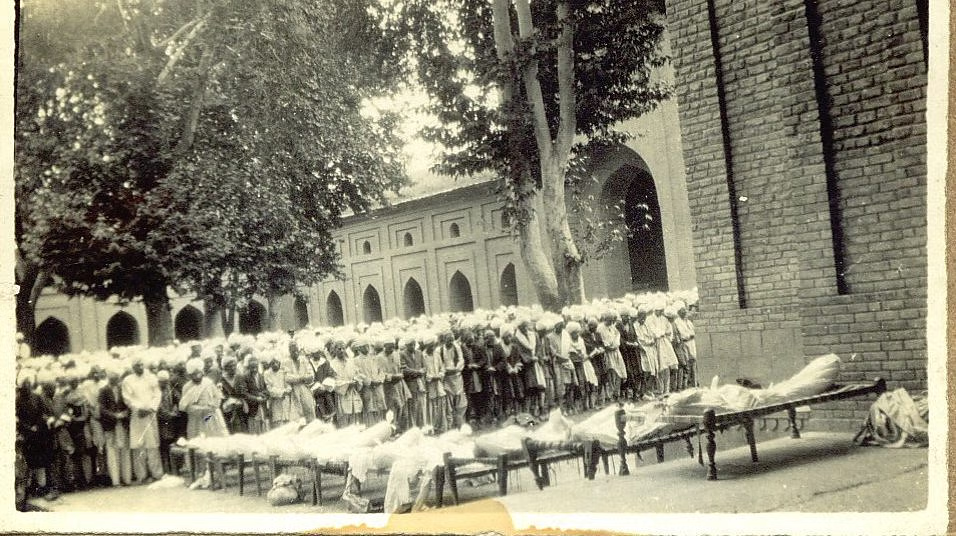
Maharaja Hari Singh, the ruler of Jammu and Kashmir, much to British annoyance, was resisting Britain’s efforts to take control of Gilgit. Britain established the Gilgit Agency in 1877, and a political agent was stationed in Gilgit to gather intelligence on movements in Central Asia, particularly regarding Russian and Chinese activities. Due to their growing strategic concerns, the British sought to take direct control of Gilgit. As the Maharaja of Jammu and Kashmir opposed this move, Qadeer was used as a pawn by the British to foment violence in the state. After Qadeer’s arrest, protests were stage-managed in Srinagar, demanding that the Maharaja release him. On Monday, 13 July 1931, when the protest outside the Central Jail turned violent, with protesters engaging in vandalism and looting, the state police were forced to open fire on the protesters to bring the situation under control.
In the ensuing violence, 22 protesters were killed. This served the interests of the British, who used the incident to compel the Maharaja to lease Gilgit to Britain for a period of 60 years. This lease took effect in 1935, with the British assuming direct administrative control of Gilgit, which was revoked after the partition in 1947. The 1930s were a pivotal moment in history as the Indian Independence Movement gained momentum and tensions between Hindus and Muslims grew sharper. Inside Jammu and Kashmir, some Muslim groups began movements aimed at exploiting these divisions and inciting communal unrest. One such group was the Jammu and Kashmir Muslim Conference, founded in 1932 by Sheikh Abdullah.
Abdullah capitalised on this event to enhance his prominence. In 1939, to expand his party’s appeal beyond sectarian lines, he renamed it the Jammu and Kashmir National Conference. After Maharaja Hari Singh acceded to India in October 1947, he appointed Sheikh Abdullah as the Prime Minister of Jammu and Kashmir on 5 March 1948. That year, Sheikh Abdullah declared 13 July as “Youm-e-Shuhada” (Martyrs’ Day) and made a public holiday to honour those killed. This was a travesty of justice. Qadeer was no freedom fighter, and the people killed were not heroes deserving martyr status. This was a case of political expediency, where Sheikh Abdullah exploited communal sentiments to strengthen his hold over power. It was Abdullah’s declaration of 13 July as Martyrs’ Day, which gave significance to an event that took place 18 years earlier—an event that, until then, had not captured the public’s imagination and would have been but a mere statistic in the records of that time.
Hari Singh’s rule was not one marked with cruelty and suppression. On the contrary, the Dogra rule in Kashmir’s history was a significant period, marking the arrival of the British in the region. Overall, it was also a time of notable prosperity for the state. Regrettably, the travesty of Martyrs’ Day continued till it was done away with after the state became a union territory in August 2019. The violence perpetrated by a section of the population on 13 July 1931 was neither a random act nor a struggle for freedom. It was done at the behest of the British to fulfil their geopolitical aims.
The event was crassly exploited by Sheikh Abdullah, 18 years after the event, to gain political mileage and cement his grip on power. It gives rise to the view that the valley’s politicians have continuously exploited Muslim sentiments to achieve political aims. It appears that Omar Abdullah is once again playing this dangerous game. Considering the tense geo-political environment that presently exists, it is not clear whether Abdullah is simply naive or playing a game at the behest of the Chinese, the Americans or even the Pakistanis.
In any event, this is a red flag which cannot be ignored. If Martyrs’ Day needs to be commemorated, it should be on 19 January. That was the day which marked the beginning of the genocide and mass exodus from the Kashmir Valley of the Kashmiri Hindus in 1990. It was the widespread threats, targeted killings, and Islamist terror that forced the community to flee their homes overnight. This is a blot on the collective psyche of the nation, which must never be forgotten. By commemorating 19 January every year as Martyrs’ Day, we will be honouring the memories of all those who were killed in such mindless communal violence and sending a message that we will never allow such atrocities to occur again.
Maj Gen Dhruv C. Katoch is an Army veteran. He is presently the Director of the India Foundation.
