Can the US, China, Russia and India join hands to address global challenges together?
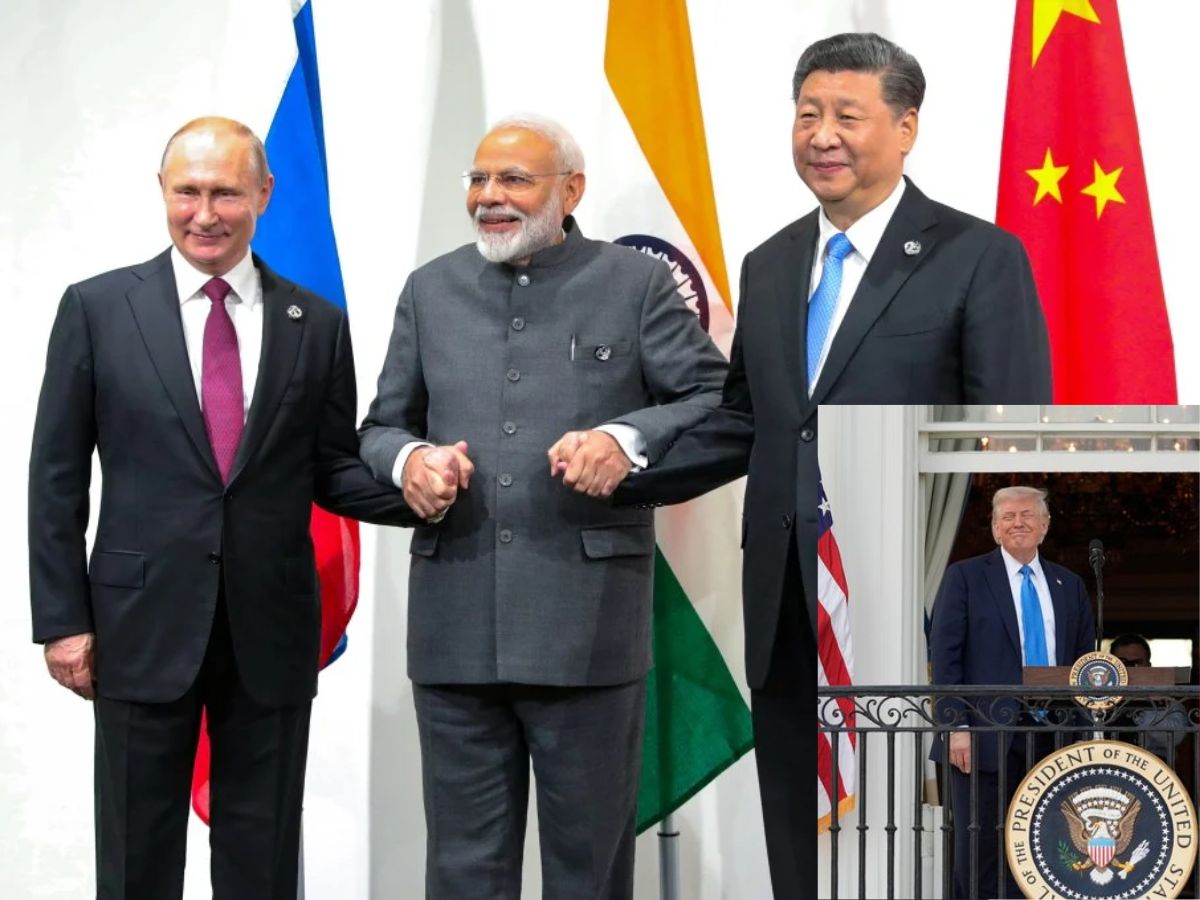
Forming Quadro difficult, but not impossible (Image: X)
The entire globe is currently in a state of political, economic, social and strategic turbulence. If the prevailing ideas and initiatives to bring about normalcy are not working, it is time to muse over an out-of-the-box proposal.
Recently, the CUTS International and Chintan Research Foundation brought together about two dozen thought leaders to deliberate upon the future of the global order, international institutions and probable powerplay among the influential actors in world politics to deliberate upon whether the United States, China, Russia and India could join hands to address global challenges together. Calling it a potential Quadro, the idea was put on the table for brainstorming.
The idea of formation of a Quadro in the backdrop of Russo-American tussle over the Ukraine War, Sino-US economic cold war and underlying tension in India-China relations was promptly rejected by some as an unworkable proposition. Others argued that the international community will not accept the Quadro concept that appears to be an effort by four powerful nations to hand down their consensual views on redressing regional and global problems. Still, some proposed an expanded body of countries that could include Japan and the EU to make an acceptable gathering of powerful actors to address major challenges facing the international community. Yet, others opined that the Quadro idea could better fit in to resolve Indo-Pacific challenges rather than global issues.
The present author was of the view that it was not necessary to reject outright an out-of-the-box idea in the present predicament confronting the global order. Uncertainty has engulfed the global political economy and traditional forms of alliances; balance of power mechanisms and international trade rules have not been able to maintain even a semblance of normalcy. Under such circumstances, any new idea could be a discussion item.
It is worth recalling that when the proposal for triangular ties among Russia, China and India was put forth in the 1980s, it was promptly rejected by the foreign policy analysis community. But with passing time, the Russia-China-India dialogue materialized and became an annual event for scores of years. The formation of BRICS that included these three countries and simultaneously a few unpalatable developments in Sino-Indian relations challenged the continuation of this forum. But now, yet again there are suggestions about reviving it notwithstanding and perhaps because of an expanding BRICS.
When the Indo-Pacific Quad was revived in 2017 during the East Asia Summit in Manila after ten years of its hibernation, China perceived it as an ocean foam that would soon dissipate. As the Quad was elevated to the level of summit meetings, China’s perception changed and it began to criticize it as an “exclusive club” diplomacy that would not be acceptable to Beijing. Quad was explained by its members as a non-military, but its agenda for cooperation in emerging technology, health security, cybersecurity etc. has still been perceived in Beijing as a mechanism aimed at containment of China. Now, there are some new challenges to Quad coming from unpredictable policies of the Trump Administration. But Quad has not lost its relevance yet.
The announcement of the formation of a West Asian Quad, better known as I2U2, was a pleasant surprise to the international relations scholars. I2U2 has survived the challenging political and security landscape in West Asia amidst the war between Israel and Hamas and its consequences. We do not hear much about another trilateral—Japan, India and America (JIA), but it was a useful mini-lateral at some point of time.
The reason behind defending the new proposal of a Quadro is based on such historical experiences where various permutations and combinations of countries put their minds together for promoting global good or addressing regional challenges. Despite the difficulties arising out of the complex Ukraine War, Washington and Moscow are trying to negotiate a deal to end a war that has severely affected the global order and upend the international political economy. In spite of American perception of China as a rival that threatens American primacy in the world, Beijing and Washington are holding negotiations for their mutual benefit and to address the fears of their respective partnering countries over potential Sino-US confrontation. The renewed efforts of India and China to normalize ties are not cosmetic diplomacy. The growing economic relations between the two countries make it imperative for their leaders to persistently work towards addressing disputes and differences.
In any case, India and Russia have a special and privileged strategic partnership. China and Russia have best of cooperation in multiple sectors. And, more significantly, the Trump Administration continues to engage Russia, China and India to resolve differences related to political, economic and security issues.
The big question, however, is who should take the initiative for forming a Quadro and how should it be processed. At the moment, the ministries or departments in charge of foreign affairs in these four countries are unlikely to pay attention to this idea. Their plates are full with difficult issues to address. But it can certainly go through a bottom-up approach where the initial step needs to be taken at the academic level that can further move up by incorporating other non-governmental stakeholders. At a later stage, the initiative can lead to second-track level diplomatic dialogues. Whether it would at all succeed in the formation of a Governmental Quadro is too premature to focus. What is necessary is the first step that can proceed further through trial and error.
Chintamani Mahapatra is Founder Chairperson, Kalinga Institute of Indo-Pacific Studies.
