Arctic has become a critical arena of Sino-Russian cooperation, driven by shared interests in energy security, maritime access, and the gradual reconfiguration of global trade routes under changing climatic conditions. Trump’s interest is driven not only by its strategic location but also by its rare earth minerals.
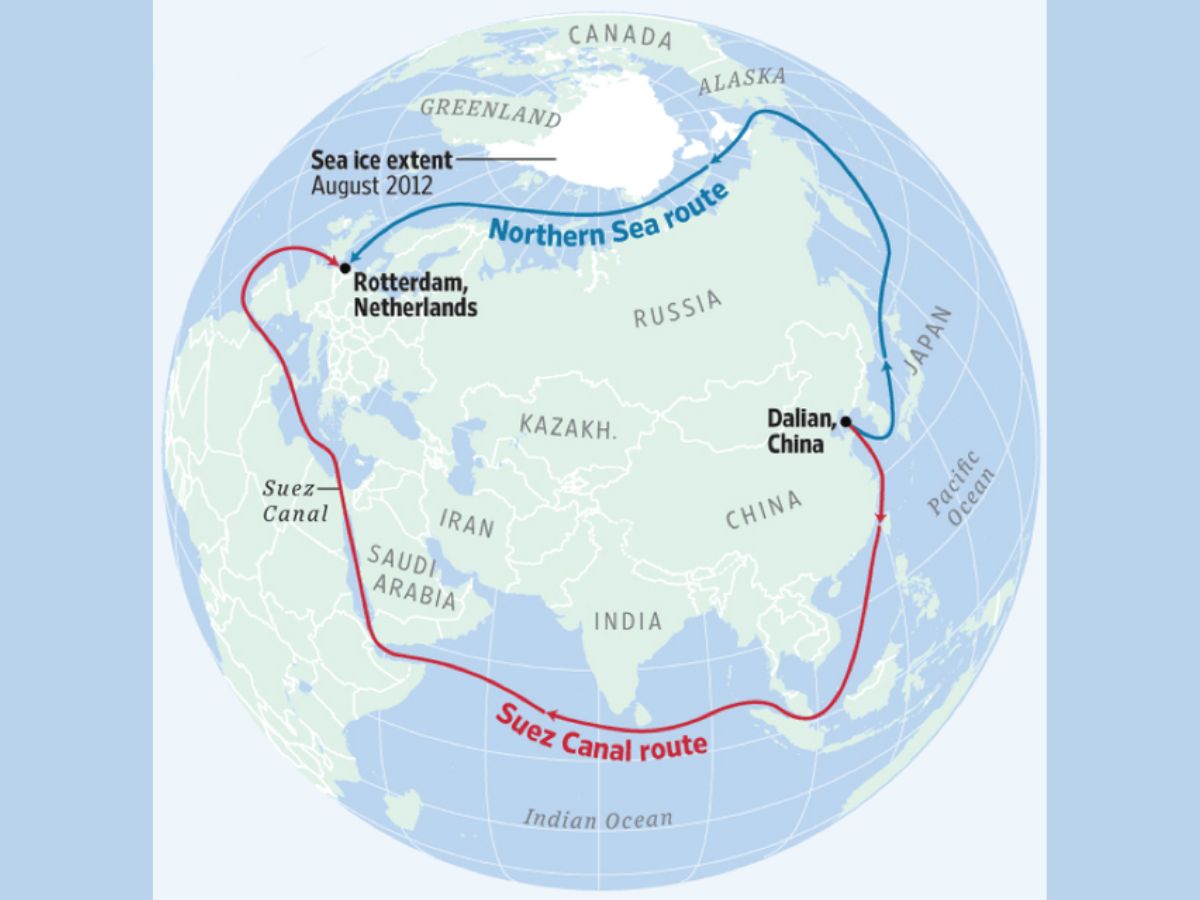
The possible Northern Sea Route compared to the existing Suez Canal route.
The Arctic has emerged as one of the defining arenas of geostrategic competition between the United States, Russia and China. Rapid climate change, creating accessible sea lanes and exposing vast resource potential, has brought renewed attention from the world’s major powers. Though President Trump has talked about “owning” Greenland during his first presidency, however, after the capture of Venezuelan President Nicolas Maduro on January 3, 2026, Trump ratcheted up the issue once again on January 9 by saying, “We are going to do something on Greenland, whether they like it or not, because if we don’t do it, Russia or China will take over Greenland…” This stance, coupled with threats of tariffs on European NATO allies for their opposition, has fractured traditional alliances.
During his Special Address to the World Economic Forum at Davos on January 21, President Trump reiterated that “this enormous, unsecured island is actually part of North America, that’s our territory.” He described Denmark as “ungrateful” and the United States as “stupid” for returning Greenland to Denmark after World War II, despite the continued US military presence on the island under the Agreement Relating to the Defence of Greenland, signed on April 27, 1951 and amended in 2004. The amended agreement affirms that Article II of the 1951 Defence Agreement applies to the establishment of new defence areas.
Denmark and Greenland have firmly rejected any notion of a sale, asserting Greenland’s sovereignty and emphasizing the existing security arrangements within NATO. Greenland’s growing centrality to great power rivalry stems from several interrelated factors, which are examined here.
Greenland lies at the north-eastern flank of North America, thousands of kilometres closer to Europe and Asia than continental United States territory, however, Trump has declared it a “part of America.” This positioning makes it integral to any Arctic strategy. As the Arctic ice cover retreats, Northern Sea Routes (NSR) and other polar shipping corridors are becoming seasonally navigable.
For example, the NSR can reduce the distance between Northern Europe and Northeast Asian ports compared with the traditional Suez Canal route by around 40%, but not necessarily resulting in saving costs, argues Liu Miaojia and Jacob Kronbak in an article. However, another study by the Netherlands Bureau for Economic Policy Analysis estimates that “overall trade cost reductions will increase the trade flows between both regions in average by around 10%” along the NSR, thus transforming the NSR into one of the busiest global trading routes.
China’s engagement with the Arctic has evolved in a structured and strategic manner, closely aligned with its broader connectivity and geo-economics objectives. The initiation of the Polar Silk Road (PSR) in 2017, followed by the release of China’s Arctic Policy White Paper in 2018, marked Beijing’s formal entry into Arctic affairs. Conceived as the northern extension of the Belt and Road Initiative (BRI), the PSR seeks to deepen cooperation between China, Russia, and Arctic states in order to develop emerging northern maritime routes and associated infrastructure. Within this framework, China and Russia have emerged as principal partners, leveraging complementary interests: Russia’s geographic advantage as an arctic country and resource endowment, and China as a “near arctic country” with its capital, technology, and shipping capacity.
A recent report by Xinhua states that since early 2025, the Russian government has begun large-scale infrastructure construction along the Northern Sea Route. From west to east, development focuses on five major ports: Murmansk port, located at the northernmost edge of European Russia; Arkhangelsk port; Sabetta port in the extreme north of the West Siberian Plain; Dudinka port in Siberia; and Provideniya port in the Far East. Moscow aims to develop these five ports into logistical hubs along the NSR, providing operational and support infrastructure for Arctic shipping. China remains instrumental in providing capital and technology; Chinese investments in the Russian Arctic, are estimated at approximately US $10 billion, particularly in strategic energy projects such as Yamal LNG and Arctic LNG 2, according to Prithvi Gupta of the ORF.
China has translated policy intent into operational presence in the Arctic. A study quoted by Erdem Lamazhapov and others for The Arctic Institute in 2023 revealed that between 2013 and 2021, China’s COSCO Shipping Specialized Carriers conducted 42 voyages along the NSR using 33 vessels, with 14 voyages requiring icebreaker escort, underscoring both the commercial potential and operational constraints of Arctic shipping. These developments illustrate how the Arctic has become a critical arena of Sino-Russian cooperation, driven by shared interests in energy security, maritime access, and the gradual reconfiguration of global trade routes under changing climatic conditions. The Xinhua report also revealed that the first container ship travelling from China to Europe via the NSR arrived at Felixstowe port in the United Kingdom. The container vessel, with a deadweight of nearly 25,000 tons, departed from Ningbo Port on September 23, 2025 and reached its destination in just 20 days after transiting the Arctic route, cutting transit time by half compared with the traditional southern shipping route.
Trump’s interest in Greenland is driven not only by its strategic Arctic location but also by its vast rare earth minerals, uranium, zinc, and other critical materials that are essential for high-technology industries, energy infrastructure, new energy vehicles, and defence systems. According to a Wion report, the island ranks eighth globally in rare earth reserves, with an estimated 1.5 million tons, notably at deposits such as Kvanefjeld and Tanbreez. The Kvanefjeld project, majority-owned by Australia’s Greenland Minerals, counts China’s Shenghe Resources as its largest shareholder and strategic partner. Washington views this involvement with concern, seeing the mining sector as a potential avenue for Chinese influence in the Arctic, particularly as China dominates global rare earth processing. Securing access to such resources underpins national economic and defence security strategies, particularly as competition with China intensifies in these industrial sectors.
Control of Arctic air and sea space carries profound strategic implications for early warning and defence against long-range ballistic missiles, cruise missiles, and emerging hypersonic threats. Due to the curvature of the Earth and the geometry of intercontinental missile trajectories, the shortest flight paths between Eurasia and North America pass over the Arctic. In this context, Greenland’s vast landmass and high-latitude location make it a critical node for missile-defence architecture, enabling the deployment of advanced radar systems, space-tracking sensors, and communications infrastructure capable of detecting, tracking, and cueing interceptors against incoming threats at the earliest possible stage.
This strategic logic underpins the United States’ renewed emphasis on strengthening missile-defence capabilities in the High North, including plans associated with the proposed “Golden Dome” missile-defence concept. Envisioned as an integrated, layered shield against ballistic, cruise, and hypersonic missiles, the Golden Dome would rely heavily on forward-deployed sensors and early-warning platforms in the Arctic region. Greenland, therefore, becomes indispensable as a forward detection and command hub, allowing the United States to identify and potentially neutralize threats long before they approach the continental homeland.
At the same time, China and Russia have made significant breakthroughs in hypersonic weapons systems and are actively modernizing and expanding their nuclear arsenals. Both states have tested hypersonic glide vehicles and manoeuvrable re-entry vehicles designed to evade existing missile-defence systems, thereby challenging US strategic deterrence. Russia has already deployed hypersonic systems such as Avangard, Tsircon, Kinzhal and Oreshnik, while China has demonstrated advanced hypersonic capabilities alongside rapid nuclear force expansion.
These developments have intensified US concerns over strategic vulnerability, elevating the importance of Arctic-based early-warning infrastructure. Unsurprisingly, both Beijing and Moscow have criticized and opposed US missile-defence initiatives, viewing them as destabilizing and as threats to strategic balance. As a result, Greenland has emerged not merely as a geographic asset but as a central pillar in the evolving contest over nuclear deterrence, missile defence, and strategic stability in the twenty-first century.
In summation, Greenland’s growing strategic salience is emblematic of deeper structural transformations shaping contemporary geopolitics: the rapid warming of the Arctic, intensifying competition over critical minerals and new sea lanes, and the re-emergence of great power rivalry in the High North. The Trump administration’s overt interest in acquiring Greenland, alongside coercive trade measures directed at European allies underscored the strain between established alliance norms and evolving US security imperatives driven by missile defence, resource security, and strategic competition with China and Russia. As Washington seeks to reinforce Arctic early-warning and defence architectures, and as Beijing and Moscow expand their economic, technological, and military footprints in the region, Greenland has become a focal point of intersecting strategic anxieties.
