
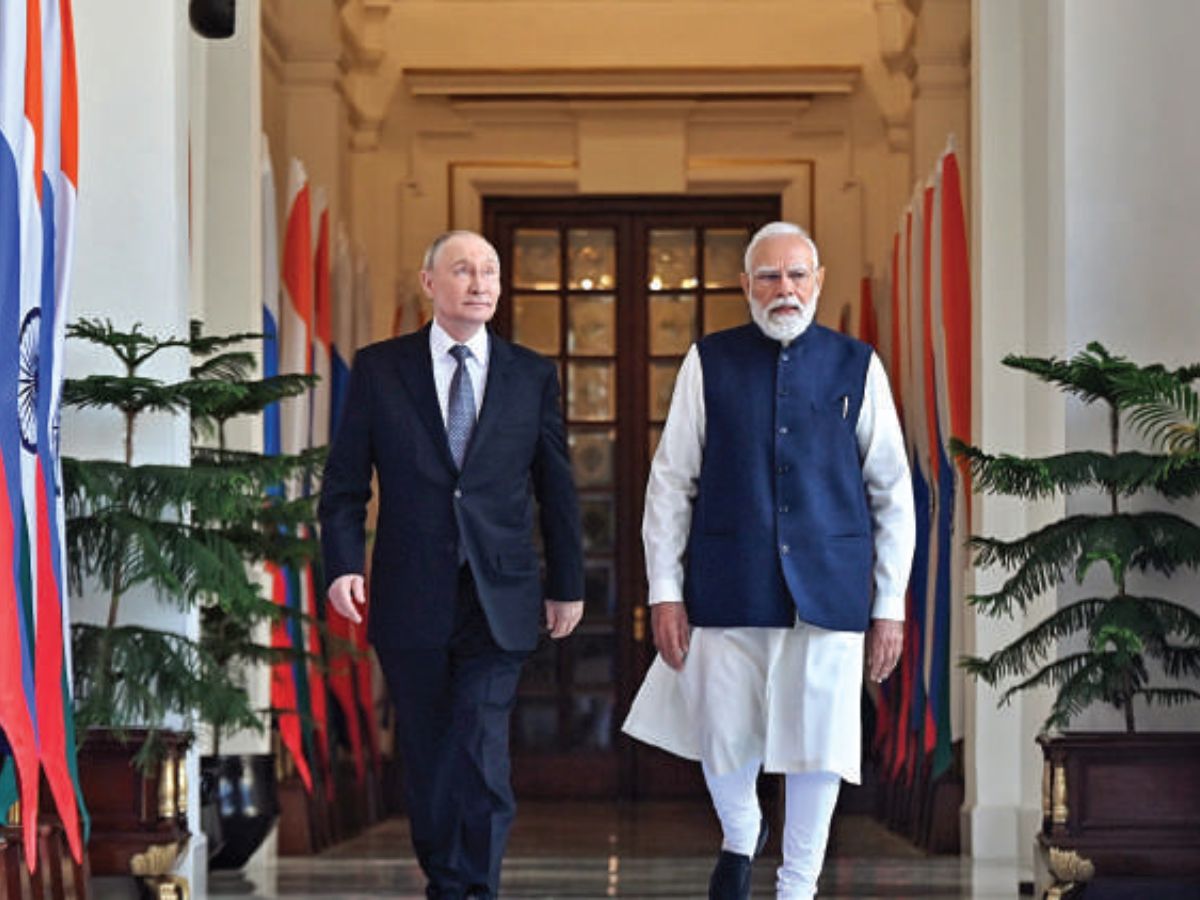
President Vladimir Putin’s two-day visit to India for the 23rd India-Russia Summit—his first since the Ukraine war—grabbed headlines across the country and much of the world. The American press announced, “Trump makes India-Russia ties great again.” China viewed it with disdain and downplayed it—meaning that it had registered. Europe watched from the side-lines with a hope that it could help end the Ukraine war, and the fear that India is tilting away from the western order towards Russia, shifting the power equations in its favour. In India, the dominant sentiment was towards a reaffirmation of ties, a hope of arms and nuclear deals in the offing, increased trade to off-set Trump’s disastrous sanctions, and getting back to a time-tested partner in the shifting geopolitical landscape of the world. There were a lot of expectations about the visit, and eventually it was all about optics and strategic signalling. For Putin, it was a political win, which demonstrated that Russia has been able to break away from the isolation that the US-led western order tried to impose upon it. For India, it was a statement that it has strategic and economic choices, which it can pursue while still adhering to our core concept of strategic autonomy. But it was more than optics and signalling. With Trump’s oil sanctions, India now has a direct stake in the resolution of the Ukraine war, and in the closed-door meeting between Putin and Modi, that would have been raised. Russia has virtually won the war and now just seeks to win the peace. Perhaps this meeting would help provide the nudge towards the acceptance of a peace deal. There was also the expectation that Russia would supply two additional batteries of S-400 air defence systems which had performed so credibly during Operation Sindoor. India has only received three of the five batteries contracted for in the deal—which it followed in spite of US threats of applying CAATSA against it. India will be looking at a rapid supply of the remaining two batteries and also for procurement of missiles expended during the war. It is also eyeing the upgraded S-500 Prometheus systems, upgrades to SU-30 MKI aircraft and also SU-57 Fifth Generation stealth fighters (which would be a fraction of the cost of the F-35s offered by the US). India has been weaning off Russian weaponry and had increasingly purchased more US and European hardware, but Russia remains its prime supplier. Russia too would be looking at lucrative orders, but its industry is facing shortages due to sanctions and the Ukraine war and may not be able to ensure timely delivery of our requirements. However, no new defence deal was signed, just an initiative to promote manufacturing of spare parts and joint ventures in India. The joint production of Brahmos was a success story and if followed up in other fields can provide a boost to Indian defence manufacturing. There are other issues of cooperation. The major one is the increase of bilateral trade which now stands at $69 billion. (Risen drastically from $8 billion just five years ago). But it is skewed very heavily in Russia’s favour. It exports over $64 billion—largely oil—with Indian exports contributing just a meagre $5 billion. This trade is projected to rise to $100 billion by 2030, especially if a Free Trade Agreement with the Eurasian Economic Union is worked out, which will provide new markets for Indian pharmaceuticals, textiles, gems, services and other products hit by US tariffs. Russia has also agreed to supply nuclear fuel and provide life cycle support for the Kudankulam Nuclear Power Plant (KNPP)—the Russian built nuclear plant, which is functioning at just a fraction of its capacity. The provision of nuclear fuel would raise eyebrows in the US, but ironically, Russia provides the same nuclear fuel to the US itself. The likely development of KNPP2 along with the Russian offer to deploy small modular reactors will provide a huge boost to India’s plans to generate up to 100 gigawatts of nuclear power by 2047. The personal welcome by Prime Minister Narendra Modi, the bonhomie on display, the red carpet, 21 gun-salute and presidential banquet (albeit an all-vegetarian one) offered good optics, but the takeaways have to carefully considered. The relationship was upgraded to a Special Privileged Strategic Partnership and Russia promised “an uninterrupted supply of oil.” But its purchase would have to be tempered and carefully moderated to counter-balance the impact of tariffs. The joint statement issued at the end of the visit also spoke of the provisioning of Indian workers to Russia, e-tourist visas to boost tourism, and cooperation in ports and shipping. What is significant is the development of transport corridors like the Integrated North South Transport Corridor, the Chennai-Vladivostok Eastern Maritime Corridor, and the Northern Sea Route through the Arctic—steps that will significantly enhance connectivity between the two geographically distant nations. Coming close on the heels of the Xi-Putin-Modi meeting at the SCO meet in September, and the improvement of Indo-China relations, this visit could have a large impact. It gives India a balance to counter the downslide of the Indo-US relationship. In spite of the occasional soundbite, there is too much inconsistency in the US stance. There has been no forward movement in the trade deal and India has to be prepared for a long haul in recalibrating ties, especially with flip-flops of the Trump administration. Turning back to a time-tested partner is a good option. It also strengthens our hand in dealings with China, Europe, and even the US. Trump’s policies have disrupted global equations, and shown the USA as an unreliable partner—even with traditional allies like India, Japan, Europe, and South Korea, and groupings like Quad and NATO. His recent pronouncement of US-China as “The G2” indicates a dramatic reversal of decades of US policy, and visualises just the US and China as the two leaders in the future world order. It is a disquieting concept, and though it could be overturned soon, has dangerous implications for the world. India’s reaffirmation of ties with Russia thus provides a hedge against the inconsistencies of US policies. It also raises the possibilities of a Russia-China-India troika. A strategic and economic convergence of the three powers would be something that Russia itself would welcome. It would provide a global alternative and also balance its own position, not only with the US and Europe, but with China itself. But that may be a far cry in the future. As of now, India has to navigate the choppy waters of changing geo-strategic equations. It is a delicate balancing act. India has to strengthen ties with Russia while still having enough space to manoeuvre and simultaneously develop our relations with the US and the West, and with other powers such as Japan and South Korea. It is only in the development of multilateral relationships—without putting all the eggs in one basket—that we would have the options to truly follow our core principle of strategic autonomy.
Ajay Singh is the author of eight books and over 200 articles. He is a recipient of the Rabindranath Tagore International Award for Art and Literature and a regular contributor to The Sunday Guardian.




