
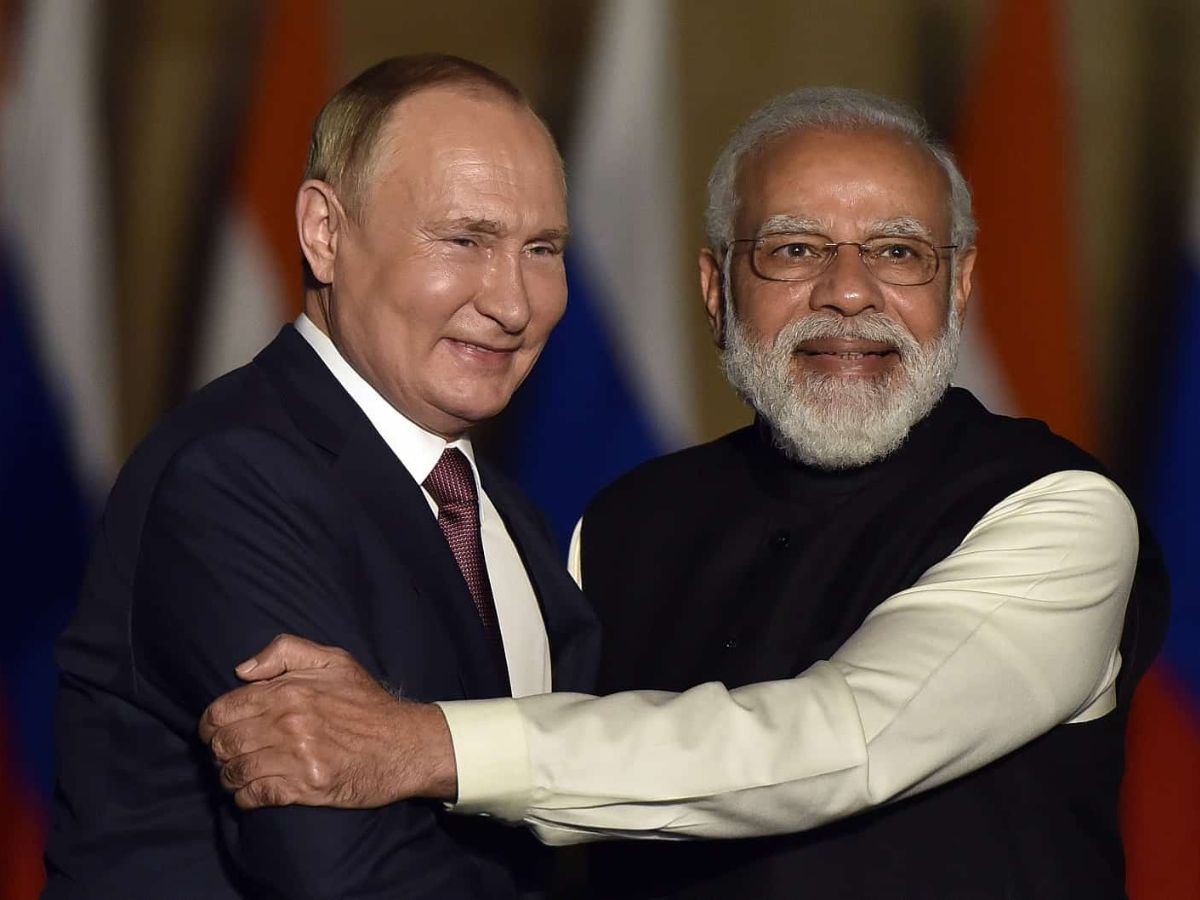
New Delhi recently hosted a diplomatic and economic spectacle that went far beyond protocol: a hug in the limousine, folded hands at the airport ramp, lamps flickering “Welcome Putin” across the Ganges, and an atmosphere of warmth signaling India’s clear stance in the shifting global power landscape. At the center of this sovereign assertion stood Prime Minister Narendra Modi.
The visit highlighted a hard economic reality: India exports only about $5 billion to Russia, even as bilateral trade has surged to approximately $69 billion by March 2025, up from $8 billion in 2020. This surge is driven almost entirely by India’s discounted crude imports, a pragmatic move that has strengthened energy security, curbed inflation, and shielded household budgets amid global price shocks. However, such a trade imbalance is unsustainable for a long-term partnership.
The PM Modi-Putin joint statement addressed this candidly: trade barriers must be removed, payment mechanisms stabilised, and a free trade agreement with the Eurasian Economic Union accelerated. By doing so, India is converting a structural weakness into opportunity, encouraging Russia to open its market to Indian pharmaceuticals, machinery, food processing, automobiles, textiles, and digital services.
Economic announcements reflect this strategic shift. Russia has cleared the way for large-scale Indian pharmaceutical manufacturing on Russian soil, transforming India from a medicine supplier into a healthcare ecosystem partner. Joint urea production in India will stabilise fertiliser supply and protect Indian farmers from global volatility. Nuclear cooperation, including the expansion of Kudankulam’s reactors and the offer of small modular reactors, reinforces India’s clean energy ambitions at a time when energy transition is vital for economic competitiveness.
A standout development is the labour mobility pact. With Russia facing a labour shortage, the US tightening immigration, and global demographics shifting, India’s young workforce can fill critical roles in Russia—from maritime experts to engineers, medical professionals, IT specialists, and skilled trades. If scaled as envisioned, this could create a new Indian diaspora in Russia, akin to the Gulf, boosting remittances, soft power, and India’s leverage on global issues such as climate finance, conflict mediation, and supply chains—a strategic economic move in action.
Vladimir Putin, in turn, assured India of “uninterrupted shipments of fuel,” vital amid volatile energy markets. Notably, India’s engagement with Russia coexists with growing ties to the US and Europe. A US trade delegation is scheduled to visit Delhi, and EU free trade talks are gaining momentum. India is expanding economic space across major power blocs without political alignment.
PM Modi emphasized both warmth and strategic intent, praising Putin’s consistent vision in nurturing the bilateral relationship over the past two-and-a-half decades. Putin reciprocated, describing their discussions over dinner as “highly useful,” constructive, and reflective of a special and privileged strategic partnership. He highlighted their personal rapport and regular communications, noting that bilateral trade could reach $100 billion.
The essence of PM Modi’s approach is clear: economic alignment without political alignment. India will buy oil at the best price, secure technology that strengthens domestic capability, sign mobility pacts for its youth, and pursue FTAs for export growth. India is not neutral—it stands for peace, which underpins markets, stabilizes trade, ensures energy flows, and drives growth. Today, Bharat is shaping this global conversation from a position of confidence.
Pradeep Bhandari is BJP National Spokesperson.




