The interim agreement marks a shift towards a more collaborative trade environment, designed to benefit both nations through tariff reductions, increased market access, and strategic economic alignment.
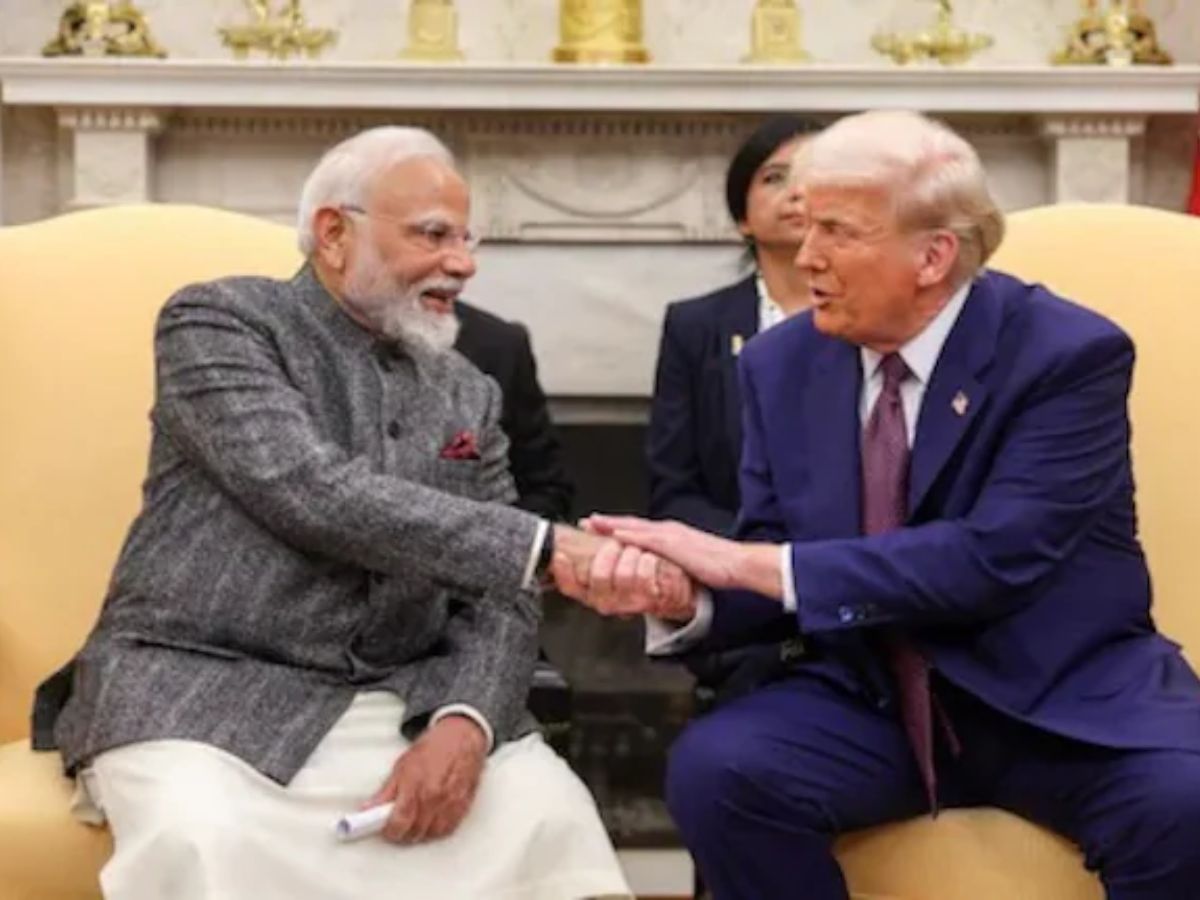
PM Modi & President Donald Trump (Image: File)
The India-US interim trade framework agreement signals a major de-escalation of trade tensions and will serve as a bridge toward a more comprehensive Bilateral Trade Agreement (BTA) which is expected to be signed in mid-March 2026. After the interim agreement was signed, President Donald Trump issued an executive order rescinding a punitive 25% duty on all imports from India over its purchases of Russian oil, the White House said.
Prime Minister Narendra Modi has welcomed the announcement of a framework for an India-US Interim Trade Agreement, hailing it as “great news” for both nations. He credited the breakthrough to the growing depth and trust in the India-US partnership and expressed gratitude to US President Donald Trump for his personal commitment to robust bilateral ties. PM Modi emphasized that the agreement will strengthen the Make in India initiative by opening vast new opportunities for hardworking farmers, entrepreneurs, MSMEs, and startup innovators. He highlighted that the deal is expected to create large-scale employment, particularly for women and youth. The Prime Minister noted that the framework will help build resilient and trusted supply chains and contribute to global economic growth. He framed the partnership as a critical step toward India’s goal of becoming a Viksit Bharat (developed nation) by 2047, focusing on future-oriented global collaborations.
Under the interim framework, the US has reduced import duties on Indian goods from a peak of 50% down to 18%. This marks a critical de-escalation of trade tensions. Indian exporters in labour-intensive industries—such as textiles, apparel, leather, gems, and jewellery—gain immediate competitiveness with the 18% tariff rate, which is lower than that of regional rivals like Vietnam and China. The agreement is expected to open a US$30 trillion market for Indian exporters, particularly benefiting MSMEs and labour-intensive sectors. The framework agreement establishes a path toward zero tariffs on high-value items like generic pharmaceuticals, aircraft parts, and diamonds upon the deal’s final conclusion.
Both nations have committed to strengthening supply chain resilience and coordinating on investment reviews and export controls to counter “non-market policies” of third parties. While this clause uses “diplomatic language”, it is a strategic effort to counter China’s economic influence and reduce reliance on Chinese-dominated supply chains.
India has agreed to eliminate or significantly reduce tariffs on all US industrial goods and a broad range of agricultural products like tree nuts, soybean oil, and wine. However, the interim framework includes specific provisions designed to protect the interests of Indian farmers by ring-fencing sensitive agricultural sectors while simultaneously expanding market access for Indian agricultural exports. The agreement ensures that India does not have to grant duty concessions on products considered critical to domestic food security and rural livelihoods. India has completely protected sensitive agricultural and dairy products from tariff reductions. These include wheat, rice, maize, soy, poultry, milk, cheese, and meat products. India has emphasized that safeguarding farmers’ interests was a non-negotiable core principle from the outset of negotiations.
The interim agreement provides that India intends to purchase $500 billion of US goods over the next five years, focusing on energy (oil, gas, coking coal), aircraft, precious metals, and technology like Graphic Processing Centers (GPUs). This commitment is a cornerstone of a broader agreement that reduces US tariffs on Indian goods to 18% and aims to more than double bilateral trade to $500 billion annually by 2030. Civil aviation will be one of the largest components of the $500 billion plan. Boeing alone may see orders worth $80 billion to $100 billion when including engines, avionics, and long-term maintenance contracts. Additionally, India will gain duty-free access to the US for certain aircraft parts, and the US will remove national security tariffs previously imposed on Indian aviation components. India also intends to purchase substantial amounts of US precious metals as part of the five-year, $500 billion commitment.
A core condition of the deal involves India significantly reducing its reliance on Russian crude oil in favour of energy imports from the US and potentially Venezuela. Russian crude has been sold to India at deep discounts ($10–11 below Brent). Replacing this with market-priced US crude may increase India’s annual import bill, though analysts suggest the overall impact on the bill might be less than 2%. Recently India has reportedly begun to slow its purchases from Russia. In January, they were around 1.2 million barrels per day, and are projected to decline to about 1 million bpd in February and 800,000 bpd in March.
The interim agreement states “In the event of any changes to the agreed upon tariffs of either country, the United States and India agree that the other country may modify its commitments”. This provision is intended to act as a “safeguard clause”. Thus, if one country unilaterally raises tariffs beyond the agreed levels, the other side can immediately revoke or adjust its own concessions without breaching the overall spirit of the framework. It reinforces the transactional nature of current USIndia trade, where every strategic or economic concession is tied to a specific reciprocal benefit. As both nations work toward a full Bilateral Trade Agreement (BTA), this clause ensures neither side is “locked in” to a deal if the other side’s domestic policy shifts. It acts as a deterrent, incentivizing both countries to uphold their commitments on sensitive issues, such as India’s reduction of Russian oil imports or the US’s maintenance of the 18% tariff rate.
However, India will remain excluded from the Generalised System of Preferences (GSP). The US had terminated India’s status as a beneficiary developing nation effective June 5, 2019, due to failure to provide “equitable and reasonable access” to its markets. The revocation affected roughly $5.6 billion worth of Indian exports, including agriculture, handloom, and engineering items. Despite recent diplomatic efforts and interim trade discussions, India has not been reinstated, meaning it is not receiving the dutyfree benefits that other developing nations currently enjoy under the US GSP program. Securing GSP restoration remains an important diplomatic goal, but GSP restoration is not a purely executive decision; it requires the US Congress to pass legislation to reauthorize the program. India must strive to get its GSP status restored in future negotiations.
Summing up, the interim agreement on the India-US trade deal is a significant, positive development in bilateral economic relations. It marks a shift towards a more collaborative trade environment, designed to benefit both nations through tariff reductions, increased market access, and strategic economic alignment. Industry groups in India have welcomed the agreement as a “historic milestone” for manufacturing, innovation, and stronger economic security cooperation between the two countries.
The agreement safeguards India’s sensitive agriculture and dairy sectors, with no tariff concessions on key products like wheat, rice, pulses, and milk. However, while the interim agreement on the trade deal offers a temporary “breathing room” and a new framework for economic engagement, the broader relationship remains subject to the unpredictable whims and transactional demands of the Trump administration.
Prabhu Dayal is a retired Indian ambassador.
