
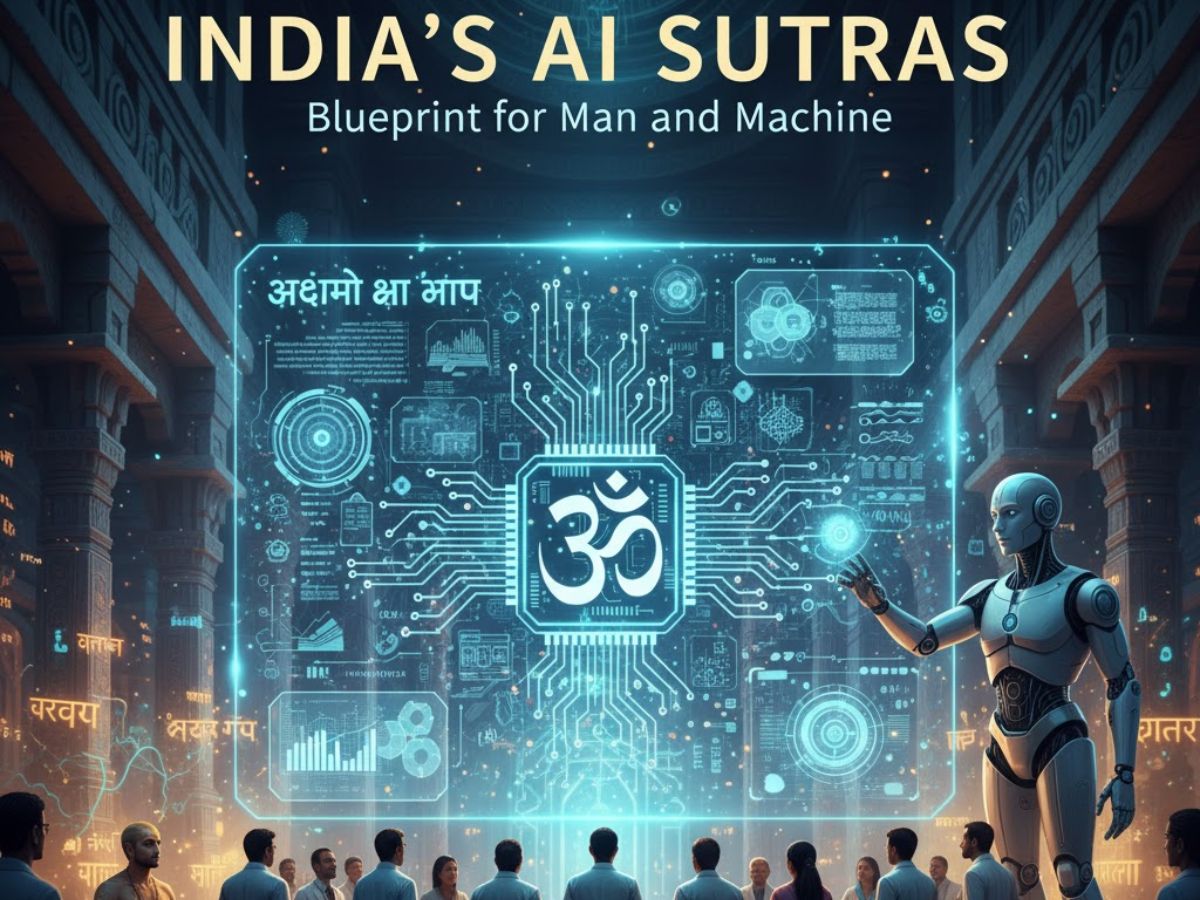
INDIA AI GOVERNANCE GUIDELINES
Imagine a farmer in rural Bihar, her fingers tracing the screen of a smartphone, diagnosing crop disease in Bhojpuri… or perhaps a small-town entrepreneur in Tamil Nadu accessing the same powerful AI tools as those wielded by tech giants in Bengaluru. This isn’t merely a distant dream, it’s the vision pulsating through India’s new AI Governance Guidelines, a blueprint attempting to weave artificial intelligence into every Indian life, not merely the privileged few.
Released by the Ministry of Electronics and Information Technology (MeitY), these guidelines represent a governance framework that treats technology not as a problem to be controlled, but as a force multiplier for national development… At a time when global conversations around AI are dominated by fear and heavy-handed regulation, India is choosing a different path—one that balances innovation with responsibility, ambition with caution.
The document opens with a refreshing honesty. AI, it acknowledges, is neither saviour nor villain… like nuclear energy or biotechnology, it’s a dual-use technology whose impact depends entirely on how we shape it. This recognition frees the framework from the trap of technological determinism, placing agency squarely in human hands and asking not “What will AI do to us?” but “What do we want AI to do for us?”.
APPROACHES ELSEWHERE
Globally, nations are adopting distinct strategies to govern AI, reflecting different priorities… The European Union’s AI Act, a landmark legally binding framework, employs a strict, risk-based approach, banning “unacceptable-risk” AI like social scoring and imposing heavy obligations on “high-risk” systems in areas like healthcare and critical infrastructure.
In contrast, the United States has prioritized innovation and leadership, with executive orders aimed at removing barriers to AI dominance rather than imposing comprehensive federal laws. The United Kingdom has opted for a flexible, sector-specific model that empowers existing regulators to oversee AI within their domains, avoiding a central AI authority to foster a “pro-innovation” environment.
Meanwhile, China’s regulations mandate strict content moderation and alignment with state ideologies, highlighting a focus on national security and social stability. International bodies like the OECD and the Council of Europe are also promoting interoperable standards to ensure AI remains human-centric and trustworthy across borders.
Is it not fascinating how these approaches mirror fundamental philosophical divides—control versus freedom, collective security versus individual liberty?
THE SEVEN SUTRAS: A MORAL COMPASS FOR MACHINES
At the heart of the Indian guidelines lie seven principles, deliberately called “sutras”—a Sanskrit term suggesting threads that weave together wisdom… These are not rigid legal clauses but guiding lights for the nation’s AI journey.
First and most fundamental is that Trust is the Foundation… Without public confidence in the technology, the institutions building it, and the regulators overseeing it, the entire edifice of AI-driven progress crumbles.
This is followed by People First, a principle that cuts through the hype about autonomous systems replacing humans… It insists that AI should augment human capability, not supplant human judgment, with humans remaining in control of critical decisions.
The third sutra, Innovation over Restraint, marks India’s distinctive position on the global stage… It signals that India is a competitive hub for AI development, encouraging responsible innovation rather than defaulting to excessive caution.
This ambition is balanced by a steadfast commitment to Fairness and Equity, ensuring that AI systems work for everyone, fighting algorithmic bias with the same vigor as other forms of discrimination.
To enforce these ideals, the principles of Accountability and Understandable by Design are paramount… The guidelines propose a graded liability system where responsibility for an AI’s actions is clearly assigned and proportionate to the risk involved. AI systems must also be transparent, capable of explaining their decisions in simple terms to the people they affect.
Finally, Safety, Resilience, and Sustainability ensures that AI systems are robust, secure, and environmentally responsible—a crucial consideration given the enormous energy demands of large-scale AI models.
DEMOCRATIZING THE BUILDING BLOCKS OF AI
One of the most revolutionary aspects of the guidelines is its focus on democratizing access to the fundamental resources that make AI possible: computing power and data.
The IndiaAI Mission is already making significant strides by making over 38,000 Graphics Processing Units (GPUs)—the specialized chips that power AI—available to startups and researchers at subsidized rates. Furthermore, a secure cluster of next-generation GPUs is being established for strategic and sovereign applications, ensuring India’s self-reliance.
On the data front, AIKosh, a national data platform, has already onboarded over 1,500 datasets, operating on a permission-based architecture that allows data contributors to retain control while fuelling innovation.
The guidelines also propose special financing schemes to help Micro, Small, and Medium Enterprises (MSMEs) adopt AI, offering tax rebates, subsidized GPU access, and sector-specific toolkits. This is AI governance that understands economics, not just ethics.
A TECHNO-LEGAL APPROACH TO GOVERNANCE
Perhaps the most innovative element of the framework is its “techno-legal” approach… Rather than relying solely on traditional rule-making, the guidelines propose embedding legal and ethical requirements directly into the technology architecture.
India’s Digital Public Infrastructure (DPI)—such as UPI and Aadhaar—has already proven this model can work at a population scale by baking privacy and security into their design… Applying this philosophy to AI means creating systems that are self-regulating, where the technology itself enforces the rules of responsible use.
While championing innovation, the guidelines do not shy away from the real dangers of AI, such as deepfakes, misinformation, and algorithmic bias, with a particular focus on protecting vulnerable groups like women and children.
To address these threats, the framework proposes a national AI incidents database to track and analyse harms, informing smarter, evidence-based regulation. An expert committee will also be established to develop standards for content authentication, such as watermarking AI-generated content to help citizens distinguish real from fake.
Implementing this ambitious framework requires a new institutional architecture… A three-tiered structure is proposed, with an AI Governance Group (AIGG) at the apex to coordinate policy across ministries. This group will be supported by a Technology & Policy Expert Committee (TPEC) providing technical depth, and the operational backbone will be the AI Safety Institute (AISI), which will handle testing, standards development, and safety research.
This “whole-of-government” approach ensures that India can address the cross-cutting risks of AI in a coordinated manner.
AI FOR HUMANS
With these guidelines, India is not merely responding to the AI revolution; it is attempting to lead it… By building on its unique strengths in DPI and championing a model of inclusive innovation, India offers a compelling vision for the Global South and the world.
The framework’s phased action plan—with short, medium, and long-term goals—acknowledges that governing a fast-moving target like AI requires agility and continuous learning… It rejects false choices between progress and protection, aiming to create an AI ecosystem that is both dynamic and democratic.
For the average Indian, this promises that AI will be a tool for empowerment, not a black box making mysterious decisions, distributing opportunity more widely and ensuring that digital dreams align with democratic values.
Is this not the ultimate paradox of our technological age—that machines must become human to serve humanity?
The guidelines attempt to navigate this labyrinth by placing agency back in human hands, asking not what AI will do to us but what we want it to do for us. In a world increasingly dominated by algorithms and automation, India’s approach represents a philosophical stance as much as a policy document—a recognition that technology without humanity is merely sophisticated machinery, and progress without protection is merely reckless ambition.
The true measure of these guidelines will not be in their technical sophistication but in their ability to touch the lives of those at the margins, ensuring that the digital revolution does not become another form of exclusion.
Perhaps in this lies India’s greatest contribution to the global AI discourse—not just in what we build, but in how we choose to wield it.
Brijesh Singh is a senior IPS officer and an author (@brijeshbsingh on X). His latest book on ancient India, “The Cloud Chariot” (Penguin) is out on stands. Views are personal.




