
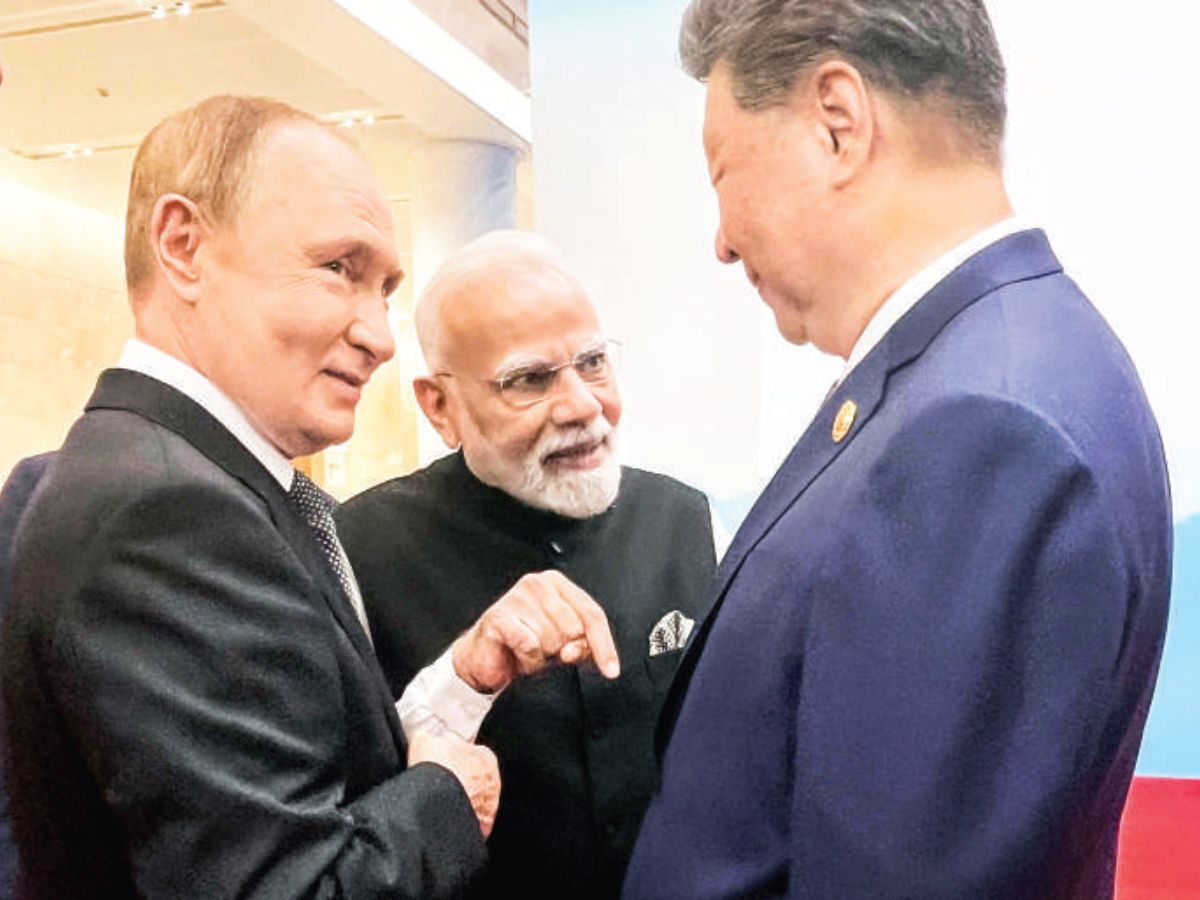
China’s hosting of the 25th SCO Heads-of-State Summit in Tianjin from August 31 to September 1, 2025, marked the largest gathering in the organization’s history. President Xi Jinping used the platform to advance a sweeping Global Governance Initiative (GGI), underscoring SCO’s evolution from a security bloc into a broader geopolitical and economic forum. The summit delivered the Tianjin Declaration, approved a development strategy through 2035, and unveiled multiple cooperation frameworks covering energy, AI, digital economy, and sustainable infrastructure. With the relative decline of the US and broader Western dominance, Xi Jinping positioned China as a proponent of multipolarity and of building a fairer and more equitable international order. Xi’s intervention comes at a time when US President Donald Trump has unsettled not only rivals but also allies through his sanctions and tariff policies, and China perceives both an opportunity and a normative responsibility to occupy the emerging governance space, particularly through institutional frameworks such as the SCO.
Though the SCO has provided space to India and Russia for diplomatic manoeuvrability, however, like BRICS, SCO remains China’s arena. As President Xi Jinping highlighted, with the participation of 26 countries and cooperation spanning more than 50 areas, the SCO now has a combined economic output of nearly US$30 trillion. China’s cumulative trade with other SCO member states has already surpassed US$2.3 trillion. Although Prime Minister Narendra Modi’s SCO statement outlined India’s approach to the organization through three pillars—Security, Connectivity, and Opportunity—these domains remain largely driven by China, even if they bring benefits as well as fears to neighbouring states. Xi further noted that “nearly 14,000 kilometres of international land transport routes are in operation among member states, and the China-Europe Railway Express has operated more than 110,000 train services.”
The optics from the RIC troika—Russia, India, and China—were unmistakable. The three signalled a shared determination not to be bullied by the United States. China conveyed that it had sufficiently diversified its markets and remained open to a “win-win” arrangement with Washington, while Russia underscored the resilience of its partnership with Beijing, insisting that US sanctions would not deter its pursuit of objectives in Ukraine. India, while conscious that China and Russia are not major export destinations for its products, nonetheless sought to hedge against US pressures in the wake of Trump’s tariffs. In this sense, the SCO has provided the RIC a significant platform to advance their foreign policy agendas. Yet this development should not be misinterpreted as India “abandoning the West” in favour of closer alignment with Beijing. Structural challenges in the bilateral relationship, ranging from unresolved border disputes to enduring geopolitical mistrust, remain acute and continue to shape the strategic outlook on both sides.
India and the United States must reflect on their deteriorating relations and adopt measures that emphasize long-term strategic priorities over short-term optics. Their shared interests far outweigh occasional disagreements or rhetorical outbursts, particularly since no serious structural issues divide them. The incremental steps taken by India and China to place their relationship back on track reflect sensible and pragmatic thinking. The resumption of the Kailash Mansarovar Yatra in Tibet, the reopening of border trade routes at Nathula, Lipulekh, and Shipki La, the issuance of visas to Chinese tourists, the introduction of three new confidence-building measures (CBMs) for border management, and the restoration of flights between India and China were measures long overdue. These, however, should not be viewed merely as reactions to Trump’s tariffs, but rather as part of the ongoing dialogue at multiple levels between the two countries. Both sides are approaching this rapprochement with pragmatic caution, balancing immediate tactical engagement against persistent long-term strategic divergences.
Although the SCO formally adopted India’s vision of ‘One Earth, One Family, One Future’ and explicitly condemned the Pahalgam terror attack in the Tianjin Declaration, Pakistan’s participation in China’s September 3 military parade underscored the continuing Sino-Pak entente aimed at counterbalancing India’s rise. No one should be surprised if Pakistan ends up testing the Chinese weaponry showcased at the parade against India in the near future, as was the case during Operation Sindoor. This juxtaposition highlights the duality of regional diplomacy: while India secures symbolic recognition of its concerns within multilateral frameworks, Beijing simultaneously reaffirms its strategic partnership with Islamabad. The issue of cross-border terrorism is no different.
In this context, a key question moving forward is whether the reset in India-China relations will translate into tangible economic outcomes. Much will depend on whether Chinese investment meaningfully flows into India to support its manufacturing ambitions, and whether China opens its markets to Indian IT, pharmaceutical, agricultural, and marine products, or whether structural mistrust and geopolitical rivalries continue to constrain the scope of economic cooperation. The answer will help determine whether the rapprochement remains symbolic and tactical, or evolves into a more substantive reorientation of regional engagement as promised by the SCO.
China’s launch of the GGI and the SCO Development Bank, along with its display of the nuclear triad, drones, AI, and laser weapons before 20 heads of state, including Putin and Kim Jong Un, demonstrates a carefully choreographed assertion of both soft and hard power. On one level, Beijing positions itself as a provider of global public goods and an architect of alternative governance frameworks through economic and institutional initiatives in the post-American era. On another, the military display underscores China’s expanding hard-power capabilities and its intent to deter the US and its allies. It is also likely to increase China’s weapons exports in the global market.
Taken together, these moves highlight China’s ambition to shape a multipolar order in contrast to what it views as a unilateral and protectionist US system, while rallying support among states seeking alternatives to Western-dominated structures—an alliance increasingly seen by the West as an authoritarian, anti-US axis. In view of the above, India’s future strategy must prioritize building a globally competitive manufacturing base, a credible defence-industrial complex, and advancing frontier technologies such as semiconductors, AI, and biotech. Human capital development is critical, alongside securing energy and green competitiveness. Expanding trade through FTAs, leveraging digital public infrastructure, and mobilizing finance for manufacturing and technology will strengthen resilience. Equally important are state capacity reforms for efficient delivery and a proactive role in setting global standards. Regionally, India must anchor connectivity in South Asia, Southeast Asia, and the Indian Ocean, while balancing ties across major powers.
B.R. Deepak is Professor, Center of Chinese and Southeast Asian Studies, Jawaharlal Nehru University, New Delhi.




