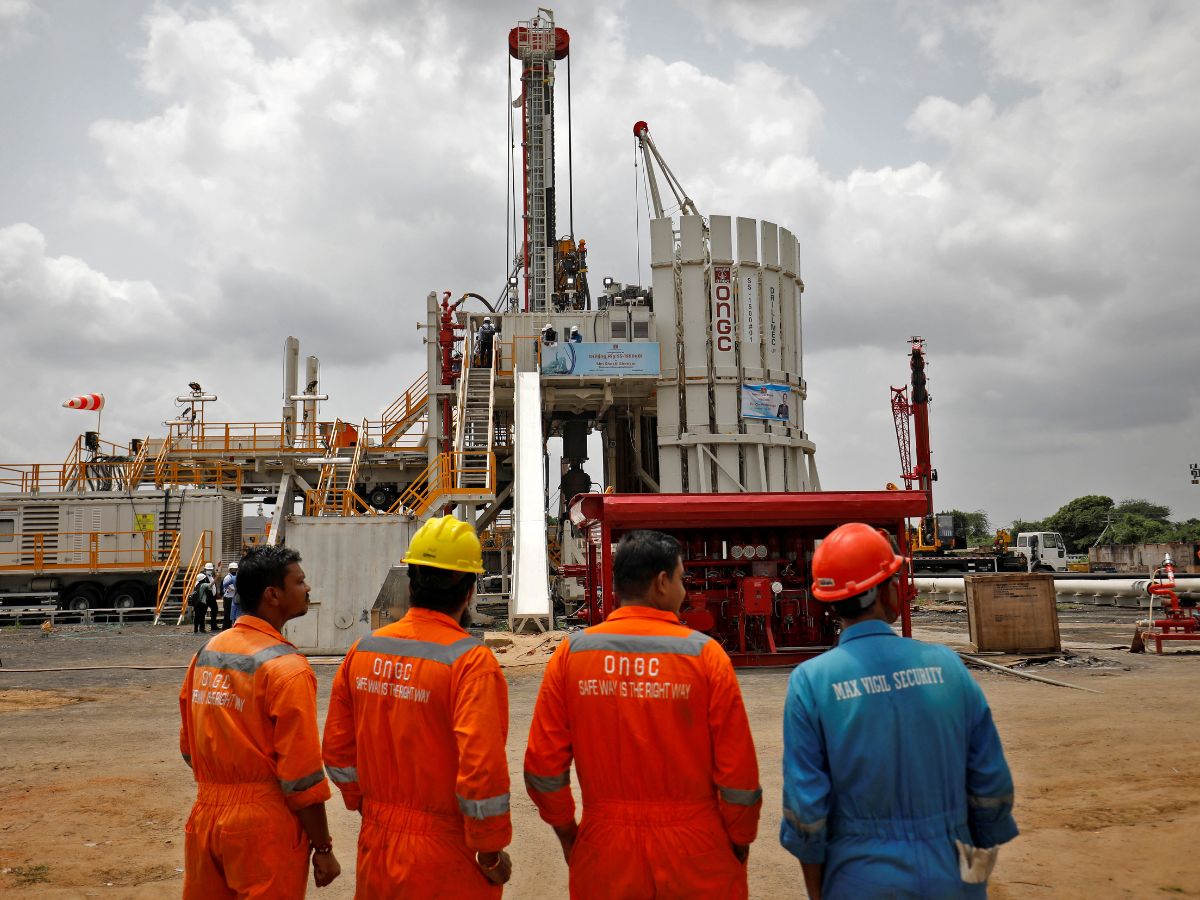
Like oil, talent has to be constantly refined, sedulously developed, intentionally transformed. It then can power the 4th Industrial Revolution or Tech Economy 4.0 as oil did the 2nd Industrial Revolution.
— Rig Veda
Indians are civilizationally gifted with the greatest of intellectual and creative talent from time immemorial to the present. In my travels around the world as a diplomat, if I could say one consistent brand equity that Indians have, it is that they are seen as being cerebral and innovative, diligent and hardworking.
From the ramparts of the Red Fort in August 2025, Prime Minister Narendra Modi reminded the nation that India’s journey to Viksit Bharat will be powered not by resources extracted from the ground but by the creative energies and intelligence of its people, this mightiest of asset we have—latent human capital. He highlighted artificial intelligence, new age manufacturing, semiconductors, green energy, and space as the commanding heights of the age that India must not merely participate in, but lead. The message was clear: the true mandate of a Viksit Bharat lies in the mobilisation of its exponential talent.
With 1.43 billion citizens and over 900 million under the age of 35, India is the most populous and one of the youngest societies on Earth. This largest youth cohort in history, if equipped with critical skill in all areas of human endeavour into the future, will yield the greatest demographic dividend. It can thus become our civilisational inflection point, the human capital moment that can propel us from being a rising power to a system-shaping force in the global economy.
Talent is the new oil, and India is poised to become its largest reservoir and its most reliable supplier to the world. This, however, requires that like oil it has to be constantly refined, sedulously developed and intentionally transformed. It then can power the Fourth Industrial Revolution or Tech Economy 4.0 as oil did the Second Industrial Revolution—in India and beyond.
It can generate the skills needed for a fast-changing portfolio of extant and future jobs, fuel economic growth, and drive innovation. It is India’s Brahma Astra in harnessing the benefits from the four favourable trends identified by global analysts as favouring India—the four Ds of Demographics, Digitalisation, Decarbonization and Diversification of global supply chains.
For too long, the idea of brain drain haunted India’s development discourse. In the 1970s, Jagdish Bhagwati’s proposed brain drain tax idea reflected the fear that sending our brightest abroad was impoverishing the nation. Sanjaya Baru’s recent revival of that thesis, describing a “secession of the successful”, is a nostalgic lament out of step with present realities.
India has turned emigration from loss into leverage, and it continues to do so ever more. Remittances now exceed $135 billion annually, the highest in the world, outstripping FDI inflows. Indian origin leaders helm major global corporations from Google and Microsoft to Chanel and IBM. Far from seceding, the diaspora acts as a living bridge and a soft power multiplier. Many plough back their brain power, entrepreneurship, and financial resources into the mother country.
There is some element of brain drain, but increasingly as conditions for “talent harvesting”, entrepreneurship and financial returns improve, brain circulation and brain gain acquire momentum.
As I argued in my chapter India Rising: Strategic Issues in the International Trading System in the 2007 volume Indian Foreign Policy, India’s greatest test was always how to turn its vast labour force into productive human capital as a currency for trade, investment, technology, soft power of people-to-people exchanges, and be a leading force for globalisation.
That insight is even more urgent today, as Prime Minister Modi’s reforms in skilling, digital infrastructure, and innovation convert this demographic abundance into India’s and the world’s most valuable strategic resource.
Demographic reversals are accelerating across the developed world. China is ageing faster than it is growing, while Europe and Japan are already super-aged. The United States, long the magnet for global talent, faces visa bottlenecks and a dependence on foreign-born scientists that it increasingly views as a vulnerability.
By contrast, India enjoys the advantage of demographic abundance and democratic dynamism at scale. This creates a complementarity–competitiveness continuum in many areas. For example, as ageing societies in the developed world face acute shortages of caregivers, India’s youthful population can and is filling this gap, making the care economy both a domestic growth engine and a global export sector.
But it is not ageing alone that defines the future. Artificial Intelligence, robotics, quantum computing and other Fourth Industrial Revolution technologies are transforming labour markets at breathtaking speed. The World Economic Forum’s Future of Jobs Report 2025 projects that AI will automate 25%-30% of tasks by 2030, while Reid Hoffman has predicted the end of the traditional nine-to-five job by 2034.
However, sunrise sectors like green technology, care economy including healthcare, fintech, advanced manufacturing, etc., will rise in demand. Therefore, we must skill, reskill and upskill not just for today’s jobs, but for the hybrid professions and portfolio careers of tomorrow.
Yet, global mobility is becoming increasingly unpredictable as protectionism rises in destination countries. The United States Administration has placed 55 million visa holders under continuous vetting. Attacks on the H1B visa system will affect Indian talent working in the US as they account for 70% of such visa holders. This year’s numbers already reflect a dramatic 46% drop in student visas for Indians. The MAGA agenda is increasingly targeting Indian students and professionals with discriminatory barriers.
Such measures not only threaten the very channels and bridges through which India has historically leveraged its talent globally but also choke the circulation of high-quality human capital. Indian students are the largest cohort of foreign students—420,000 in 2024—in the US and are estimated to spend over $16 billion, a trade benefit for the US. Moreover, Indian students power US innovation ecosystems and are central to the success of Silicon Valley.
But it’s time to turn these challenges of human resource protectionism in the US into recognising the urgency of building our own Silicon Valley: world-class universities, research clusters and centres of excellence, and attracting global talent including of Indian origin.
Projecting talent outward must also be strategic. China has shown how to create talent settlements abroad by coupling skills with cultural and language training. India should not confine itself to the Anglosphere. Our surplus human capital should be embedded not only in the United States, United Kingdom, Australia, Canada and New Zealand but also in Japan, Germany, France, Latin America, and Africa.
Economic diplomacy must deliberately secure such access, supported by language and cultural orientation. This is the new frontier of outward FDI coupled with human capital settlements that expand India’s influence while serving the needs of a rapidly changing global economy.
Meanwhile, talent itself has become the sharpest wedge in geopolitics. The United States-China rivalry is as much about people as it is about chips or ships. Washington restricts Chinese STEM visas even as Beijing offers million-yuan packages to lure its diaspora back. Europe and Canada court frustrated H-1B holders, while the UAE and Singapore dangle golden passes.
In this great game, Indian talent is already indispensable, powering laboratories, hospitals, IT parks, and start-ups worldwide. The challenge is to channel this circulation to India’s advantage, ensuring that skills, networks, and the wealth generated abroad reinforce rather than bypass our national growth story.
We must make sure that when Indian billionaires quit London or turn away from America, they choose India as much as Dubai, Singapore, Portugal or Switzerland. If we aspire to be the world’s Talent Powerhouse, we must also be a magnet for that financial capital and entrepreneurial energy, offering regulatory certainty, safe cities, and an aspirational quality of life—or risk building others’ prosperity instead of our own.
Modi’s India has already anticipated building a talent-rich future. The National Research Foundation is being seeded to catalyse university-industry partnerships and scale up R&D spending towards 3 percent of GDP by 2040. The IndiaAI Mission is building indigenous capability in AI ethics and applications across agriculture, health, education, defence, and governance.
Coupled with semiconductor and quantum initiatives, these investments signal that India is not content with being the back office of the world, but is positioning itself as the design lab, the data hub, and the innovation engine of the Fourth Industrial Revolution.
What India now needs is an institutional anchor to integrate this effort. A National Talent Agency must bring together the Ministries of Education, Skill Development, Labour, Commerce, External Affairs, and Science and Technology into a single framework. Today, our approach remains fragmented. Such an agency would align curriculum reform, skilling, labour market needs, trade agreements, diaspora engagement, and technology frontiers into one coherent strategy.
In its attempt to lead the talent agenda toward a multipolar world, India has foregrounded mobility and skilling as engines of inclusive growth. At the G20 New Delhi Leaders’ Declaration it endorsed just transitions in labour markets. At the WTO, India continues to advocate liberalisation of Mode 4, the temporary movement of service providers, and could lead efforts to modernise trade rules for the era of digital cross-border work.
An International Skill Passport, building on India’s digital public infrastructure, could allow workers to carry verified credentials instantly recognised across borders.
Equally important are bilateral FTAs that embed talent mobility. The UK-India BTA agreement, which exempts Indian professionals from double social security contributions and greater access, offers a model. As multilateralism falters, India must pursue similar compacts with the EU, Australia, Japan, ASEAN and others to secure predictable pathways for its talent to move to these countries to provide services.
The strategy ahead must be bold and multi-layered. A National Apprenticeship Corps can guarantee placements, reducing the learning-to-earning gap. A Global Talent Compact with G20 partners can ease visas, recognise qualifications, and encourage circular migration. A Women’s Workforce Mission must lift female participation to 50% by 2040. A Global Indian Talent Network can harness diaspora expertise for national missions in AI, green energy, and defence tech.
Above all, a National Talent Agency can bring coherence and ambition to this mega strategy: India as the Talent Power of the twenty-first century, just as it has been the Pharmacy of the World and the model for Digital Democracy.
Prime Minister Modi has placed youth at the centre of India’s civilisational rise. The time for India to rise as the world’s Talent Powerhouse is now. With the discipline of policy, the ambition of innovation, and the energy of its young people, Bharat will not only build a Viksit Bharat by 2047 but also shape the multipolar world order.
The challenges to reach the goals he has set before us are immense, but so too is the strength of our people. It is time to rise up and claim India’s human capital century.
Lakshmi Puri is a former Assistant Secretary-General of the United Nations and Deputy Executive Director of UN Women; and a former Ambassador of India.
