
It was President Donald Trump who unleashed an economic Cold War against China during his first term in office. He did conclude an agreement with China in 2020 during the last year of his administration and amidst presidential election campaign, making China promise to buy more American goods to manage the imbalance in bilateral trade, among other things.
After Trump lost the election to Joe Biden in 2020, many expected that his successor would not continue the hard policy choices on China and would rather seek to improve ties with China. But several factors, including the Ukraine War where China apparently sided with Russia, made Biden toughen the US policy towards China. The Speaker of the House of Representatives, Nancy Pelosi, who was a well-respected leader of the Democratic Party, touched China’s raw nerve when she made an official visit to Taiwan. It angered China so much that it conducted massive live fire exercises around the Taiwan Strait, making Taiwan almost nervous and since then China’s military manoeuvres to assert its military dominance has never ceased.
President Trump, after his victory in the presidential election of 2024 and reentry into the White House in January 2025, sharpened his economic attack on China and renewed the atmosphere of an economic Cold War against China. While Trump was harsh on almost all countries of the world, including the allies, potential adversaries and neutral nations, he was singularly severe on China by threatening tariff rates of about 155% or more.
In the backdrop of the American President blowing hot and cold on his tariff rates, it is cumbersome to make any sense of his actual policy on tariff. It has been, however, clear by now that there is no particular logic in his tariff policy except that he has weaponized tariff to achieve his foreign policy goals and thus there is no pattern in his tariff policy.
The best examples of this are found in his stated reasons for imposing high tariffs on countries. He raised the tariff on import of goods from Brazil because he did not like the legal proceedings against Bolsonaro, his friend and former president of Brazil. He raised the tariff on Canada because of an advertisement in Ontario on Ronald Reagan’s views on tariff. He, among other things, threatened high tariff on China, Mexico and Canada due to the import of fentanyl into the US. He imposed 25% tariff on India, since India buys Russian oil, although it is perfectly legal to do so.
However, no other country could take the bull by the horn except China. Beijing restricted the export of rare earth materials and imposed countermeasures against Trumpian tariffs and other issues, such as refusal to buy American soyabeans. President Xi Jinping punched where it hurt Trump the most. Rare earths restrictions threatened American civilian and military manufacturers that depend on China for critical materials and ban on soyabean imports weakened one of the important support bases of Trump—farming communities.
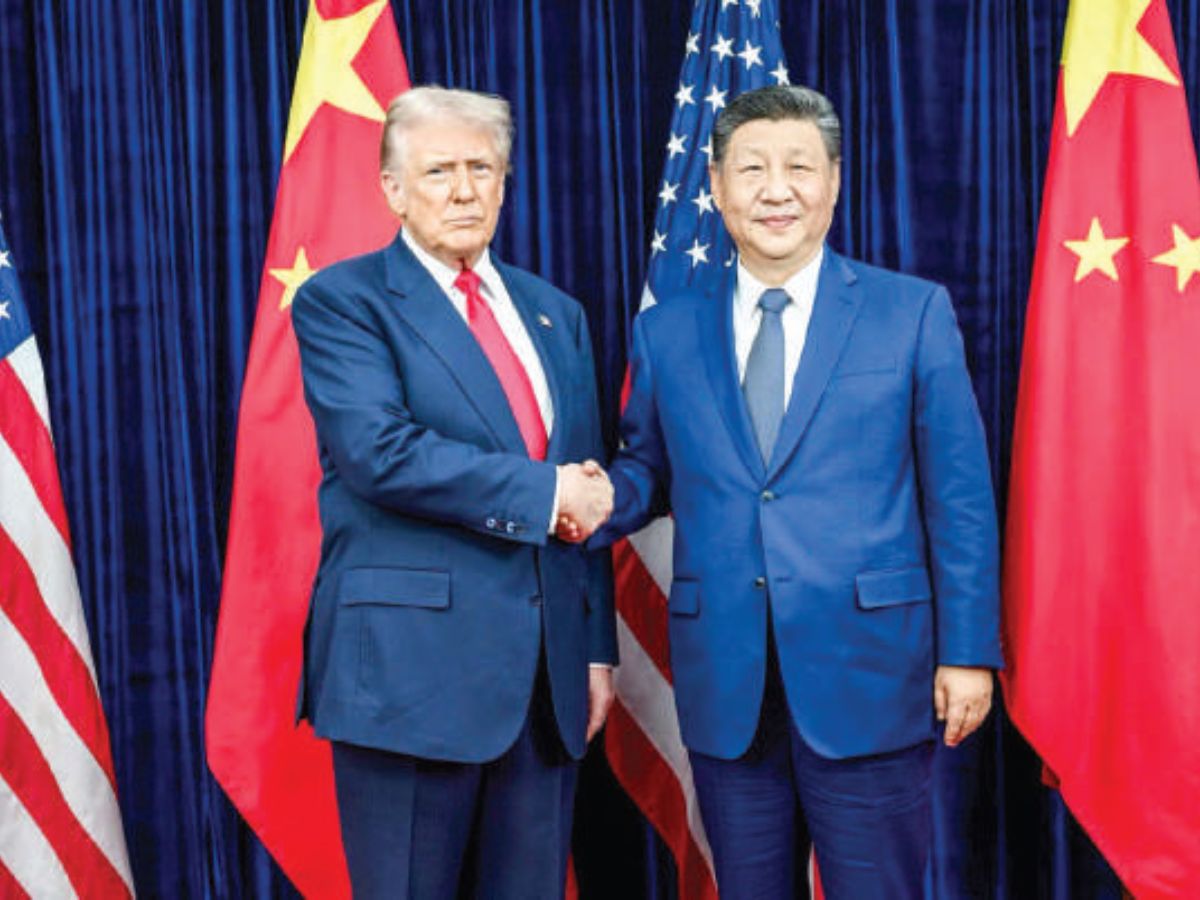
The Trump-Xi summit in Busan, South Korea, is the first attempt by the US and China to start a new détente. China, as per the statement of President Trump, has agreed to postpone implementation of its rare earth export controls by one year. Beijing also has offered to buy millions of tons of soyabean from the United States and control the export of fentanyl. President Trump declared victory soon after meeting President Xi Jinping. He offered only to reduce tariff on Chinese goods by about ten percentage points and that means, according to him, the overall US tariff on Chinese goods will now be 47% from the earlier 57%.
But is it really a Trumpian triumph? First, that there was no discussion on the crucial Taiwan issue during the Trump-Xi meet cannot be called a victory for the US. Secondly, Trump could not push China to stop buying Russian oil and this was not a success of Trump’s goal to end the Ukraine war. Thirdly, China only postponed the export control of rare earth materials for one year, whereas the US would take at least ten years, according to experts, to reduce its dependence on rare earth. Fourthly, Trump failed to rope in China to any nuclear arms control efforts. A little before he would meet the Chinese strongman, Trump said that he had instructed his Department of War to resume nuclear tests. But soon after the summit, China advised the Trump Administration to abide by the nuclear test moratorium agreed upon after the signing of the CTBT.
Fifthly, Trump maintained complete silence over the need for maintaining peace and stability in the Indo-Pacific. It was Trump who had first signed a national strategy report clearly mentioning the term “Indo-Pacific.” It was Trump who had revived the Quad security dialogue in 2017. And now Trump felt it was imperative to avoid any mention of “Indo-Pacific” during his dialogue with Xi.
In a way, China appears to have had an upper hand in the outcome of the Trump-Xi summit. But it is a fragile détente and it can end anytime and the intended visit by Trump to China in April next year may not even take place. First of all, details of the agreement are not known yet. Secondly, the initial excitement over the outcome of the summit may not survive the test when it comes to actual implementation of the agreement. Third, other critical issues, such as the nuclear arms control may create new tension. For example, China reportedly is fast expanding its nuclear arsenal and may be able to achieve parity in number of missiles and warheads with the US and Russia by 2035.
Thus, the Trump-Xi summit is at the moment a temporary relief and good for the global political economy and perhaps stability of the Indo-Pacific region. But India has to be on its constant watch and recalibrate its approach from time to time. India’s current efforts to normalize and strengthen ties with China should continue and India’s ties with the US should not come on the way of improvement in Sino-Indian relations.
Chintamani Mahapatra is Founder Chairperson, Kalinga Institute of Indo-Pacific Studies and Editor, India Quarterly.




