The India-Russia relationship must be understood for what it is today, not what it was 50 years ago. It is no longer the sentimental bond of the Cold War; it is an interest-based partnership that survives only as long as both sides find utility in it.
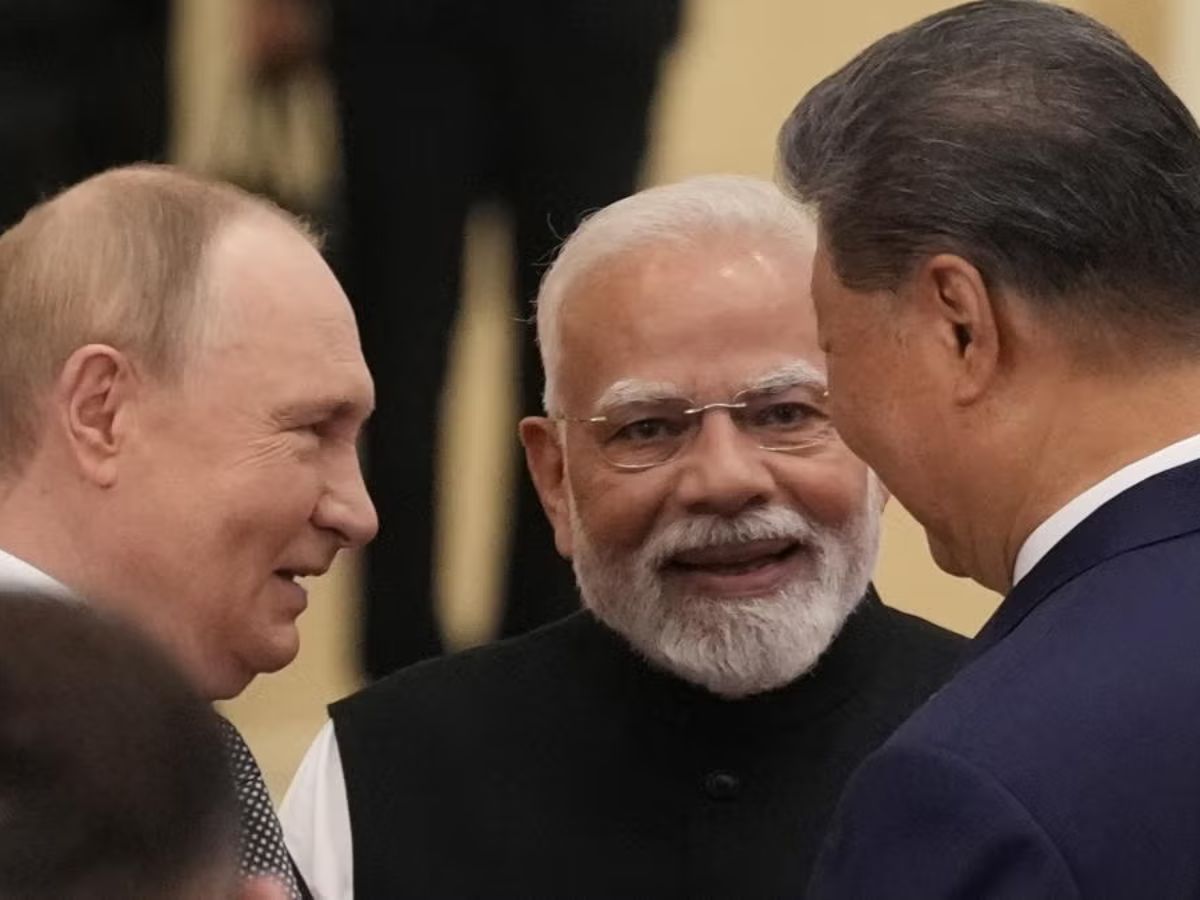
India’s Russia strategy faces a China-centric reality (Image: X)
Russian President Vladimir Putin visited New Delhi from 4-5 December 2025 for the 23rd India-Russia Bilateral Summit. The optics were striking amid cold India-US relations: Prime Minister Narendra Modi broke protocol by personally receiving Putin at the airport without prior notice. At the summit, both sides repeated the familiar narrative of a “time-tested friendship” and a “special and privileged strategic partnership.” This served India well for decades, but today it is largely a comforting fiction—one that obscures how decisively Russia’s strategic orientation has shifted, perhaps irreversibly, toward China.
Majority in India still speaks of Russia through the warm haze of the past. The Soviet vetoes at the UN, the diplomatic solidarity during the 1971 war, the supply of advanced defence platforms during India’s most vulnerable decades; these memories are deeply embedded in India’s strategic psyche. Yet today, they are sentimental memories with little relevance to the tough realities of current great-power politics.
Russia, unlike India, has not remained suspended in Cold War nostalgia. Sanctions, pariah status in Europe, diplomatic isolation and battlefield attrition have compressed it into China’s strategic orbit with a force that Delhi seems reluctant to acknowledge. The numbers alone tell the story. China-Russia trade hit an unprecedented $245 billion in 2024, and the expansion was driven not by grand strategy but by necessity: Beijing has become Moscow’s default supplier of everything—from machine tools to dual-use electronics, the very components that keep Russia’s war machine running.
Though India and Russia coordinate their ties through the India-Russia Intergovernmental Commission (IRIGC), founded in 1992 and composed of two divisions—the IRIGC-TEC, covering trade, economic, scientific, technological, and cultural cooperation, and the IRIGC-M&MTC, which oversees military and military-technical cooperation—the outcomes over the past three decades have been far from satisfactory, as reflected in the meagre bilateral trade volume of $68.7 billion in 2024-25, which looks less like a geopolitical achievement and more like a byproduct of discounted crude.
Once the oil factor is stripped away, the relationship is revealed to be dangerously narrow, lacking any serious economic depth. India remains dependent on Russia for S-400 Triumf, INS Vikramaditya, and a few other platforms such as Su30-MKI, Brahmos missiles, T-90 tanks, India’s conventional and nuclear-powered submarines, AK-203 assault rifles rolled out on the basis of joint research, development, and co-production. India’s exports to Russia remain negligible, and the two sides have no coherent industrial or technological symbiosis. The truth is uncomfortable: Russia depends on China; India depends on Russian oil and military equipment.
China-Russia strategic calculus is also demonstrated by the choreography of recent great power diplomacy. Beijing sent Premier Li Qiang and CMC Vice Chairman, Zhang Youxia to Moscow days before the Trump administration dispatched envoy Steve Witkoff and Jared Kushner to hawk a 28-point peace plan (reduced to 19) that Moscow only partially entertained despite the fact that it requires Ukraine to surrender additional territory to Russia, limit the size of its military, and formally abandon its bid to join NATO. Following the American retreat, China dispatched Foreign Minister Wang Yi, a pre-emptive assertion of primacy albeit both talked about “a high degree of consensus on Japan-related issues.”
Russia’s “consistent and unwavering” support for China on issues related to Taiwan, Xinjiang, Xizang (Tibet), and Hong Kong underscored Moscow’s alignment with Beijing on its most sensitive concerns. Wang, for his part, emphasized that China and Russia must enhance communication “at critical moments,” referring to the shifting geopolitical environment affecting both countries, as reported by CGTN. Just before Putin’s departure for India, Kremlin spokesperson Dmitry Peskov reiterated that China is Russia’s “privileged strategic partner” and affirmed Russia’s readiness “to enhance and develop our cooperation with China in various fields, without limits.” Peskov’s reassurance that Russia is willing to develop a “no-limits” partnership with India just as with China sounds flattering but has its limitations.
This does not mean India should distance itself from Russia. Far from it. Russia remains central to India’s energy security, legacy defence systems, nuclear cooperation and strategic balancing in Central Asia. But the relationship must finally be understood for what it is today, not what it was 50 years ago. It is no longer the sentimental bond of the Cold War; it is an interest-based partnership that survives only as long as both sides find utility in it.
The problem remains that there are no takers outside Russia for Prime Minister Modi’s claim that “India is on the side of peace” with respect to the Russia-Ukraine war. Indeed, the stance has already incurred economic costs: the United States imposed an additional 25% tariff on Indian imports of Russian oil. As long as Russia remains embroiled in Ukraine, India’s policy of “multi-alignment” and its efforts at rapprochement with the US and Europe will remain in jeopardy. And as long as the India-Russia-West triangular dynamic remains in a state of uncertainty, China will continue to gain.
Reality is less sentimental. Russia’s dependence on China is structural, not temporary; its resentment toward Western pressure is deep; its strategic patience in Ukraine contrasts sharply with Donald Trump’s urgency to broker a settlement; and its ability to diversify partners is constrained by China’s economic weight. If India-Russia ties are to remain relevant, they must rapidly evolve into a technology-driven, co-development partnership that insulates both sides from third-country pressures—precisely what Peskov claims Russia seeks, and precisely what China will quietly work to prevent. Whether New Delhi can navigate this tightrope remains uncertain. India’s best hope is an end to the Russia-Ukraine war and a subsequent normalization of Russia’s relations with the United States and Europe.
