The return of great power competition has made the subcontinent even more complex.
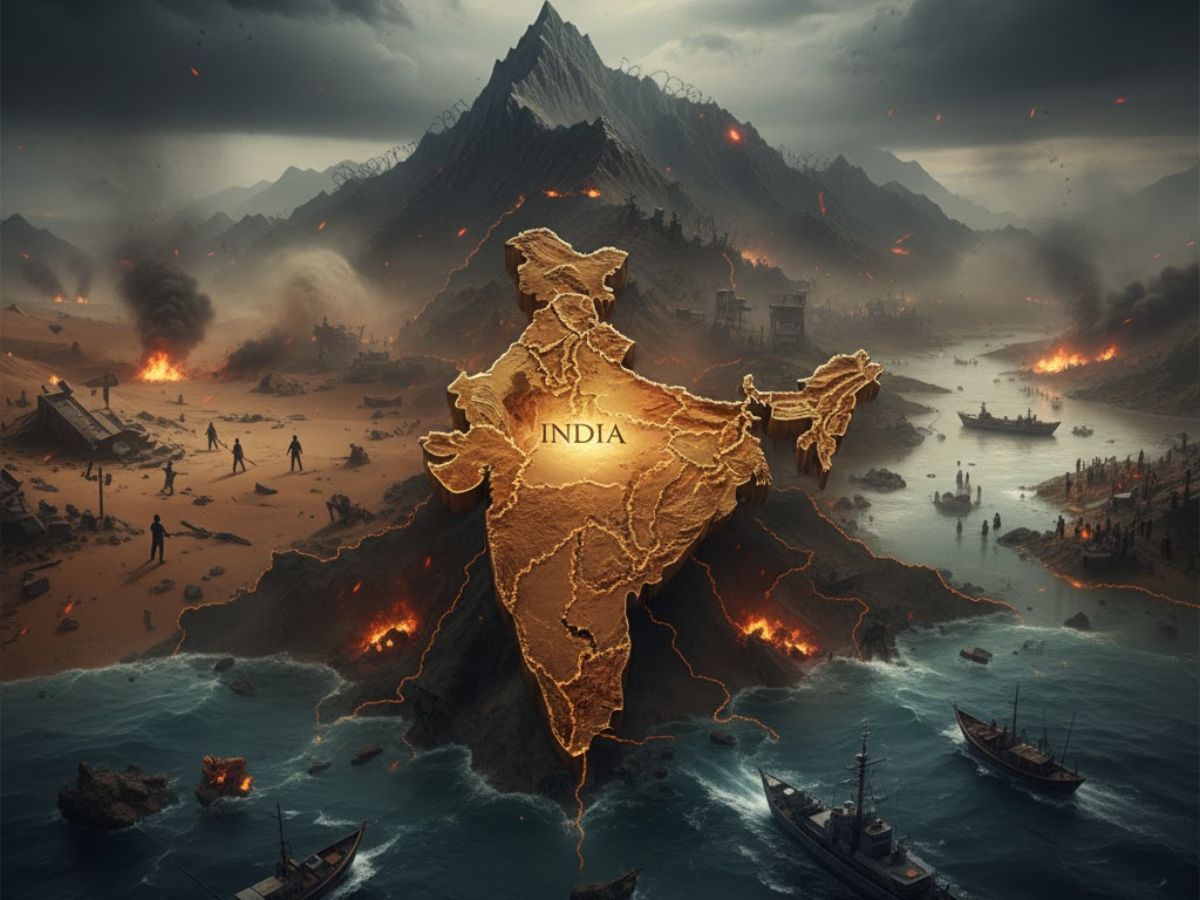
India’s neighbourhood faces growing instability, much of it fueled by external interference and regional rivalries. (Image: File)
India’s neighbourhood is currently undergoing one of its most turbulent phases in recent memory. Across the subcontinent, political transitions, internal conflicts, and shifting alliances have created a climate of persistent instability. The region that once hoped for cooperative growth has become a mosaic of unrest. Yet, a large part of the current turbulence appears to be manufactured by external players, who focus on keeping India engaged without directly intervening in India’s rise as a global power. This turbulence has been instigated by external powers exploiting internal rifts to bring about undemocratic regimes in Pakistan, Bangladesh, and Nepal, and they now are working together for furthering the interests of that external power.
CHAOS AND LOOMING INSTABILITY
Pakistan is again sinking into political and economic decay. The recent military interference in civilian politics and growing unrest in Balochistan and Khyber Pakhtunkhwa show that its internal fault lines are widening. Hatred for India remains the only glue that holds its fractured polity together, a substitute for governance and reform. Afghanistan continues to be a zone of instability with insecurity manifested in conflicts with both of its major neighbours, i.e., Iran and Pakistan. In the Maldives, sharp political swings and the rise of the “India Out” sentiment reflect how external influences manipulate local politics. In Sri Lanka, too, things are hardly normal. Economic mismanagement and overdependence on Chinese loans have created significant vulnerabilities.
Each of these crises is different, yet they reveal a common thread: regional instability thrives when domestic weaknesses invite external exploitation. Bangladesh’s sudden political shift after the fall of Sheikh Hasina’s government has added a new dimension to this uncertainty. The re-entry of Western players in Dhaka’s politics marks a reversal of the stable trajectory the country had maintained for years. Nepal too remains fragile, with its leadership frequently shifting alignments between Beijing and New Delhi. The recent Gen Z revolution is still in its early stages. From an Indian perspective, its implications are still unclear.
Nonetheless, these constant fluctuations across India’s neighbourhood show that regional politics have never truly moved beyond the old colonial legacy of power games. Since independence, most neighbours have seen alternating waves of pro-India and anti-India regimes. For many of them, blaming India remains the easiest route to political legitimacy. Religious mobilisation, primarily through Islamic identity politics, has repeatedly been used to ignite anti-India sentiment. It has become a political habit to define nationalism in opposition to India rather than in pursuit of internal progress. This pattern has created a cyclical instability that keeps the region volatile and prevents genuine regional cooperation.
GREAT POWER POLITICS RETURNS
The return of great power competition has made the subcontinent even more complex. China continues to expand its influence across Asia with an aggressive combination of economic leverage and territorial assertion. Its strategy of using loans, ports, and infrastructure to secure strategic control has destabilised smaller nations. Yet, China’s attempts to intimidate India have met with a resolute response. The border stand-offs over the last few years have demonstrated that India will not be coerced into accepting unilateral changes to its sovereignty.
The US, too, has sought to reassert its presence in South Asia, often under the pretext of promoting democracy or maintaining balance. Its involvement in Bangladesh’s political shifts is a recent example of this selective moralism. The contradiction between its professed values and its behaviour in the region is glaring. Washington continues to speak of counterterrorism while maintaining military ties with Pakistan, a state that has nurtured the very networks responsible for instability in South Asia.
More recently, the foreign policy orientation that began under Donald Trump has left a long shadow on global politics. His transactional view of alliances and disregard for long-term stability have disrupted many regional equilibria. The attempt to pit powers against each other for short-term strategic gains has weakened multilateral norms. In South Asia, this approach has emboldened smaller nations to play one major power against another, deepening uncertainty rather than fostering stability. The legacy of Trump’s policies continues to shape American behaviour in the region, where the focus remains on tactical manoeuvring instead of consistent engagement.
India has had to adjust to this crowded strategic landscape. Unlike the earlier decades when it was treated as a secondary player, India today asserts itself as an independent pole of power. It no longer views itself as a passive observer but as an active shaper of regional and global developments. The shift from dependence on Western approval to strategic self-confidence marks the most significant transformation in Indian foreign policy since independence.
INDIA’S APPROACH FORWARD
In such an unsettled environment, India must continue to rely on realism guided by principle. Caution and clarity should define its policy choices. The region’s volatility demands that India’s diplomacy remain firm, consistent, and rooted in long-term national interest. Strategic patience, rather than reactive emotion, should drive decision-making. India’s foreign policy draws strength from its civilisational ethos. The belief in Vasudhaiva Kutumbakam provides India with a moral foundation that is not dependent on opportunism. When India extended vaccine aid during the pandemic, it acted out of conviction, not calculation. Yet, goodwill must be matched with strategic awareness. The region will not stabilise through idealism alone.
New Delhi must continue to build partnerships that reflect mutual respect and shared benefits. Connectivity projects, digital cooperation, and energy corridors can anchor regional growth on terms that prevent dependency on external powers. India’s engagement with neighbours should combine generosity with firmness. The message must be clear that while India supports regional autonomy, it will not allow external interference that threatens collective stability. India’s experience has shown that its resilience lies in quiet confidence, not loud assertion.
Throughout history, India has survived invasions, ideological subversion, and political manipulation. Its strength has come from the ability to adapt without losing moral clarity. The same spirit must now guide foreign policy: strong enough to deter, prudent enough to accommodate.
CONCLUSION
This rise of manufactured turbulence in India’s neighbourhood is real. It reflects a profound transition in the balance of power, wherein old alignments are breaking down, and new equations are emerging. Amid this churn, India’s stability, democracy, and growing economic strength stand out as rare constants. The challenge ahead is to transform this stability into leadership that reassures, not dominates. India’s task is not to control its neighbours but to create a regional environment where stability and cooperation are in everyone’s interest. It must guard against the divisive games of great powers and the manipulative politics of those who seek to exploit India’s rise. By combining moral purpose with strategic realism, India can turn its turbulent neighbourhood into a zone of opportunity. In this journey, India’s calm strength and civilisational confidence will remain its greatest assets.
Prof Santishree Dhulipudi Pandit is the Vice Chancellor of JNU.
