
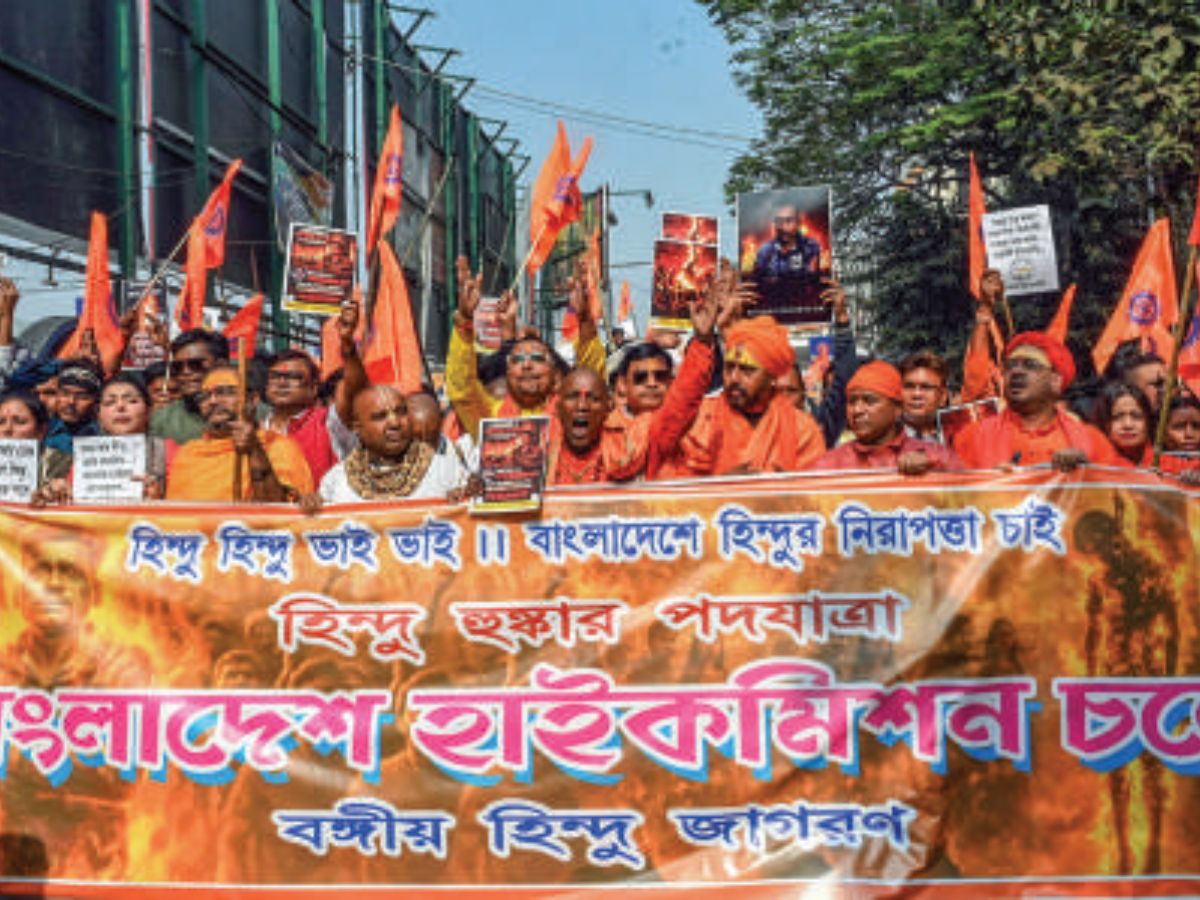
In the autumn, among the many festivals of “Sharoda Utsav” comes Durga Puja. In the magnificent collection of songs to welcome the Goddess and bring her to life is the powerful chant “Jago Ma”. Should not India do the same? Wake up and shed our illusions and come to terms with the visceral hostility just across our eastern border?
For many, including me, it was the land of our ancestors, and full of myths and legends, recounted by our parents about its syncretic culture, etc. What is happening now is like a nightmare. With its creation with our help in 1971, one thought Bangladesh was a testimony to the fragility of the Partition. A final peace on the east and west, will only be possible with the unmaking of irrational and irrelevant borders created by ignorant colonizers without any thought of history. India had a rare option in ‘71 to sort out this issue permanently in the east. We did not do so. Once more these historical errors come back to haunt us.
Looking back, the series of events in July and August 2024 were initially described as the result of a spontaneous uprising. But there was a hidden agenda. On 24 September 2024, Muhammad Yunus publicly stated at a gathering of the “Clinton Global Initiative” in New York that the regime change operation, far from being spontaneous, was “meticulously designed”. An atmosphere of anarchy prevails in Bangladesh, with mob rule and planned targeting and intimidation of Hindus, replacing governance and rule of law. The agenda of the Islamists is to terrorize and drive the religious minority population out of Bangladesh. Attacks on 15 million strong minority communities of Bangladesh, including Hindus, Buddhists, Christians, as well as the Shias, Ahmadiyyas and others have been brutal.
Fundamentalist Islamist groups have unleashed violent attacks on religious minorities across the country, involving desecration of places of worship, abductions and rape, lynchings, extra judicial executions, killings, forced conversions, along with wanton destruction of homes and business establishments. Even where there is irrefutable evidence, no action has been taken against the culprits. Hindus and other minority communities across Bangladesh have resisted to the extent possible and sought protection of their rights as citizens of Bangladesh.
The persistent denials by Yunus that these attacks were stray “political” acts have further encouraged the mob. India’s High Commission in Dhaka and Consulates in Chittagong, Khulna, Rajshahi and Sylhet have been attacked inflaming Indian public opinion. Attacks on minorities in Bangladesh have aroused deep concern in India. There is the danger that the volatile situation in Bangladesh could spill across borders, disrupt communal harmony and create serious law and order problems in India.
In independent Bangladesh, the Constitution adopted in 1972 was based on the four pillars of democracy, nationalism, secularism, and social justice. It is now all un-done. The Islamists want to reverse any secular remnants in Bangladesh and want to shape it into a hard core, anti Indian, Islamic theocratic Republic.
Tarique Rahman, who has taken charge of the Bangladesh Nationalist Party after 17 years in exile in the UK, may gain some sympathy votes, following the death of his mother, Khaleda Zia. He has been acquitted in all cases against him, indicating a possible political understanding between Yunus and himself of the future political arrangements. His reputation of corruption and lack of integrity and rumours of millions stashed away in Swiss and UK accounts, may damage his chances. He holds Hasina responsible for the rapid decline of his mother’s health in prison. To that extent, he would have a strong grudge against India for having given refuge to Hasina.
What about the Jamaat e Islami (JeI) prospects? Having collaborated with the Pakistani army, it had never done well earlier in elections. It sees the present tensions as its best opportunity to grab power. This does not augur well for India. The National Citizen Party formed by radicalized student leaders is in a weaker position. It is a sobering portrait of what awaits India if a coalition of India haters and India baiters come to power in Bangladesh. Never has our national security situation seemed more challenging and grim. Pakistan wishes to enter into a mutual defence pact. China is ever present.
The pathological hatred being demonstrated towards Hindus and the lynchings are more troubling. They are inflaming public opinion, particularly in the east, especially West Bengal and Assam. Both states have large Muslim populations. Then, there is the threat, made openly by some, to our Northeast. In my considered opinion, India should electrify our border, back up the BSF with regular Army battalions, talk tough or soft as the occasion demands, and once the trade deal is done, talk to the Americans. Under no circumstance should we consider the military option, as some hotheads want. So do the Chinese and Pakistan.
Bangladesh will become India’s Ukraine. Its terrain is treacherous and ideally suited for guerrilla warfare. We should be ready to consider all other options, soft and hard, including cutting off electric supplies, stop rice exports and refuse to agree on the Ganges Water Treaty till they come to their senses. They will come to their senses. They have no other option.
In the meantime, remember that we Indians, especially Bengalis, whose homeland was former East Bengal, need to change our mindset. Our neighbour who we helped to liberate, hates Bengali Hindus in India, perhaps even more than Pakistani Muslim Punjabis hate Hindu Punjabis in India. They particularly hate Bengali Hindus like me, whose ancestors came from East Bengal. T.S. Elliot had said: “For last year’s words belong to last year’s language, And next year’s words await another voice, And to make an end is to make a beginning.” Is that what India needs to do vis-à-vis the new Bangladesh post Hasina? Is it not a good time for us, including me, to shed our innocence and ignorance and accept a new reality? Indeed, that time has come. Awake, our beloved Motherland. Jago Ma.
-
Bhaswati Mukherjee is a retired Indian Ambassador.




