
What is taking place in the Middle East is, or ought to be, a war against the clerical regime that has ruled and ruined Iran since 1979. Earlier, the Shah of Iran had been persuaded to permit his most virulent critic, Ayatollah Ruhollah Khomeini, to be permitted to go into exile in France rather than be imprisoned and executed the way so many critics of the Shah were. In the safety of France, supported financially by the anti-Shah emigre community in France, Ayatollah Khomeini penned one astringent essay on the Shah every other day. Copies of these were smuggled into Iran and laboriously cyclostyled and made into copies that were distributed throughout Iran. As a consequence, much to the dismay of SAVAK, the dreaded secret police of the Shah, Ayatollah Khomeini had much more influence in Iran although in exile than he ever had while in Iran. Very soon, the Ayatollah became the dominant voice within the clerics as a consequence of the abuse he verbally heaped almost daily on the Shah. By 1979, enough members of the public were so fed up with the regime of the Shah that they took over the streets of the main cities in the country.
Had he remained a cleric rather than the de facto Head of Government of Iran, the Ayatollah would have done his country a service. A democratic government headed by a supporter (while in exile) of the Ayatollah was elected the first President of Iran. Abolhassan Banisadr had been amongst the strongest backers of the exiled Ayatollah, but he soon aroused the ire of Khomeini for his adherence to democracy. A popular whirlwind was whipped up by Khomeini against Banisadr, and the latter fled into exile to save his life. Khomeini made a huge mistake in supporting the students who had taken over the sprawling US embassy compound in Tehran, taking the diplomats hostage. They were released only on the day President Jimmy Carter lost in the Presidential polls to Ronald Reagan. The taking over of the embassy premises and taking diplomats hostage signalled the start of the tension between the US and the clerical regime in Tehran, run in the manner of an absolute dictatorship in the way the regime of the Shah had been.
To their dismay, the people of Iran found themselves having exchanged the dictatorship of the Shah, Reza Pahlavi, for the dictatorship of Ayatollah Khomeini. The people of Iran remained subjugated to an absolutist government, which executed and imprisoned far more people than the Shah had done during his worst spells of despotism. Khomeini was succeeded by Ayatollah Ali Khamenai, who too abjured the values of democracy and continued the dictatorial ways of his predecessor. While Khomeini died of age and natural causes, Khamenei was killed by a US strike on the house he was then staying in. The manner of his death has shattered the fear that Iranians had of the Supreme Leader. No future successor, who is likely to meet the same fate as Khamenei, will be able to so terrify the people of Iran that they refuse to protest the system that has made them slaves in their own land.
Given that, it is a matter for consideration as to whether regime change in Iran could have been engineered through rousing the populace rather than by resort to kinetic action. That the clerical regime as practised in Iran since 1979 is an anachronism is undoubted. That would have been, as in 1979 the natural way of engineering regime change. Not from dictatorship to dictatorship as in 1979 but from absolutism to democracy, of the kind practiced by Banisadr during his brief stint as the elected President of Iran. The risk in kinetic operations is that they may trigger a backlash of what may be called “terrortrons”, those susceptible to the call to terror of those fostering such methods.
Iraq in 2003 should not be repeated in Iran, for there the takeover of the country by the US military germinated terror groups of high velocity. Months from emerging victorious in his kinetic war on Iran the way President George Walker Bush declared “Mission Accomplished” in Iraq on a battleship. While planning operations, care needs to be taken that it is seen by the Iranians as being directed not at Iran as such but on the clerical despotism represented by the Supreme Leader system. Law in Iran is what the Supreme Leader wants, the opposite of the Rule of Law in democracies, such as the rejection of the tariff tantrums of President Trump by the US Supreme Court.
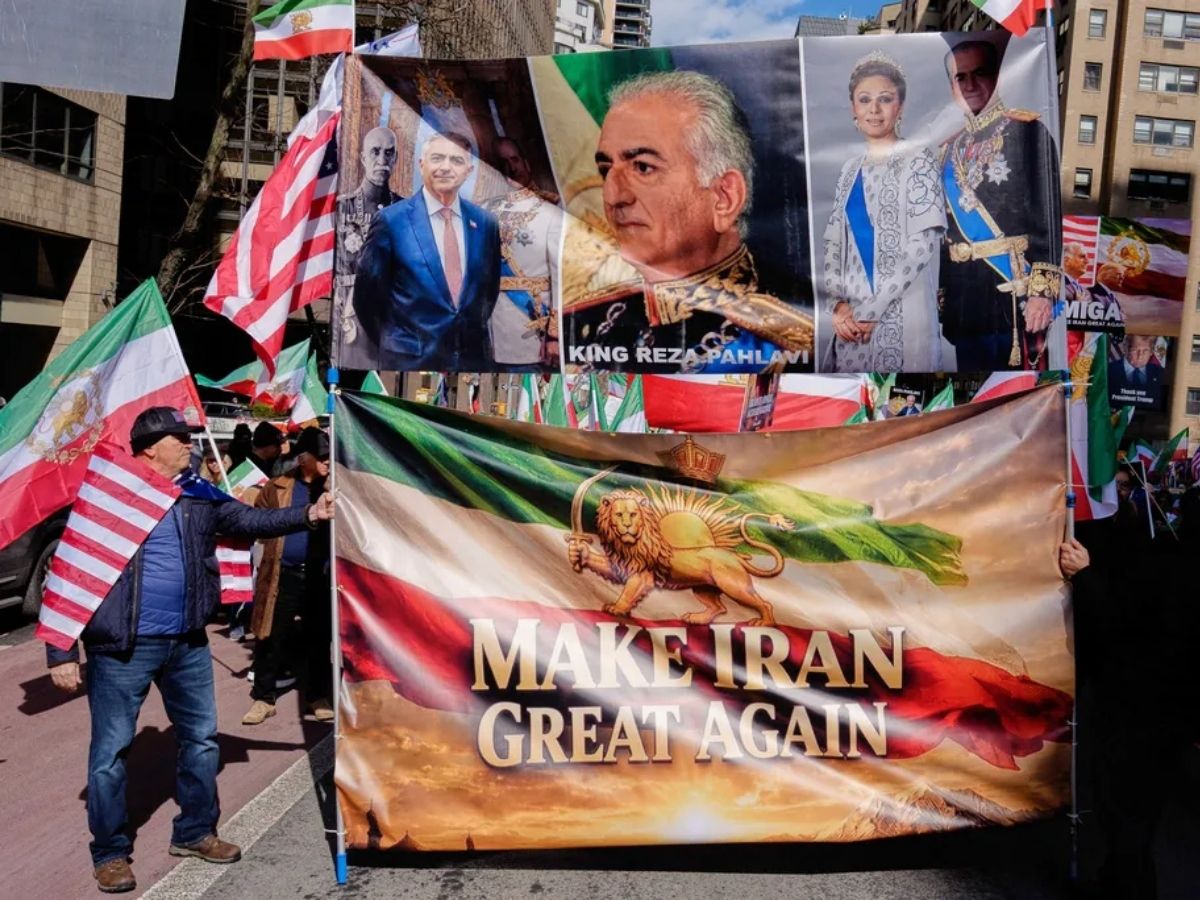
It would be amusing, were it not to show how removed President Trump is from the reality on the ground in Iran, that he wishes the son of the deposed Shah to be the new ruler of Iran. The people of Iran deserve democracy, not another monarchy. As for the son of the Shah, he would be well advised to keep away from Iran, or else he may meet the same fate as Najibullah in Afghanistan or Muammar Gaddafi in Libya. The people of Iran want democracy, not a restoration of the Pahlavi dynasty. And that is what they should at last get, once the clerical regime meets its end.