
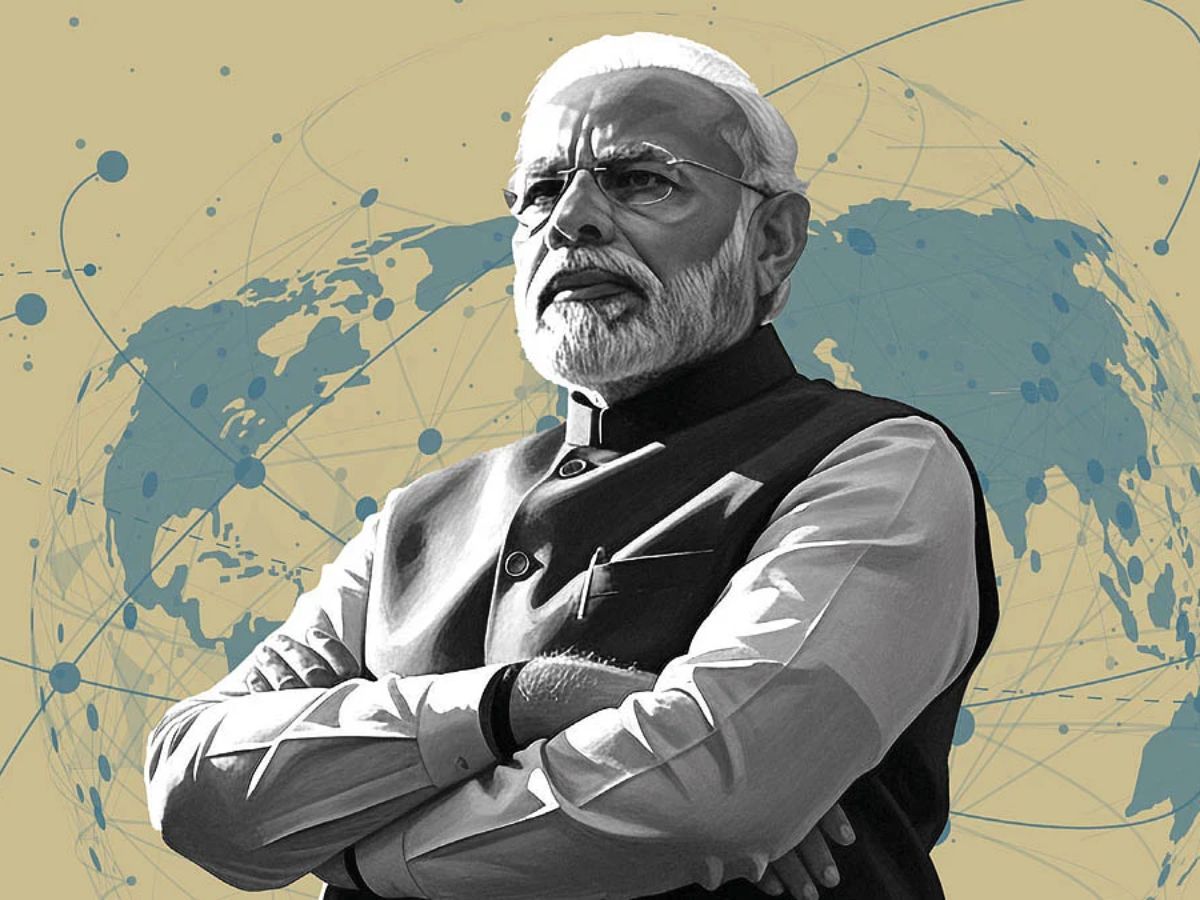
Prime Minister Narendra Modi is already India’s third longest-serving Prime Minister and is easily the country’s most consequential leader since Jawaharlal Nehru. He has navigated India through myriad challenges and has likely contributed more to India’s infrastructure than all his predecessors combined. While Modi began his first term, India was the world’s 10th largest economy. Today, it is the 4th and could push into the third position soon. As China heads off the demographic precipice, India could even move into the number two position in the decades to come.
Of course, China and India’s other adversaries are not going to accept India’s rise quietly. China and Pakistan will seek to constrain India through asymmetric means. Even though New Delhi maintains cordial relations with Tehran, Iranian proxies sometimes use their unofficial status to attack Indian interests, yet give Tehran plausible deniability when they do so. The normal insurance rate for ship-borne cargo, for example, is about 0.3% of the cargo’s value but, when Houthis target Indian, Greek, or Cypriot ships, that insurance rate more than triples, putting Indian commercial interests at a competitive disadvantage to Chinse competitors.
The ouster of Sheikh Hasina’s government in August 2024 coupled with interim leader Muhammad Yunus’ antagonism to India and fealty to Pakistan and China, suggest India barely avoided a far worse crisis in Bangladesh. Rather than relax, New Delhi should recognize that those external intelligence operatives behind Yunus and Jamaat-e-Islami will simply try again, both to attack Bangladesh’s sovereignty and India’s control over the Seven Sisters.
In 2022, I visited Cabo Delgado, Mozambique’s northern province, to interview Islamic State prisoners captured by local security forces and their Rwandan partners, as well as to inspect the material they had with them when captured. In many cases, the extremist tracts came straight from Karachi or Lahore via Mombasa or Dar es Salaam. Democratic Republic of Congo church leaders complained that Pakistanis working as UN peacekeepers were inciting extremism by teaching locals more extreme practices and intolerant interpretations of Islam. China, meanwhile, is increasingly influential if not dominant in Sri Lanka, the Maldives, and is willing to compete with India in Mauritius. British Prime Minister Keir Starmer’s Chagos policy opens the door to potential malign influence in that archipelago.
These challenges suggest that, as India rises, Modi must establish a regional doctrine and security doctrine commensurate with India’s economic infrastructure and role in the world. In short, it is time for a Modi Doctrine akin to the U.S. Monroe Doctrine. President James Monroe declared the United States would be the preeminent power in the Western hemisphere and that the United States would not tolerate European militaries and interference in the region. Old school Indian policymakers might interpret the Monroe Doctrine, recently revived by President Donald Trump, as a manifestation of American imperialism but historically at least, the opposite is true. Monroe’s policy was anti-imperialist. He articulated that Washington would interpret any European attempt to interfere in the affairs of independent American countries as a hostile act against the United States. Monroe did not seek to colonize South America; he sought to prevent France, Spain, and Portugal from seeking to reestablish their empires against the aspirations of newly independent countries.
Haiti, Colombia, Chile, Mexico, Venezuela, Paraguay, Argentina, Costa Rica, El Salvador, Guatemala, Honduras, Nicaragua, the Dominican Republic, Panama, and Brazil each won independence from France, Spain, or Portugal prior to Monroe’s declaration. Their former colonial masters each sought to reverse that status and reconstitute empire. Monroe stopped that ambition in its tracks.
A Modi doctrine might similarly protect the countries of the Indian Ocean basin from the predatory ambitions of China. A Modi Doctrine would not impede freedom of navigation and lawful commerce. But Chinese debt diplomacy in Bangladesh, Sri Lanka, and Kenya and its salivation of bribing and coopting politicians in the Maldives and Mauritius aims at neo-colonialism. China might pursue Belt-and-Road ports and port facilities in Colombo, Hambantota, Chittagong, Kyaukphyu, and Bagamoyo, but India should use all its diplomatic and economic leverage to extract the Chinese. Nor are Chinese-funded port projects the only inroads of Chinese exploitation and imperial ambition. Whereas privateers and tall ship flotillas defined European encroachment in Latin America in the early 19th century, today, the forward manifestation of Chinese colonial exploitation are China’s fishing fleets that poach fishing beds, violate exclusive economic zones and pursue unsustainable practices. The Indian Navy should help defend all Indian Ocean basin countries from Chinese predation. The Chinese navy might support China’s fishing fleet against the Filipino coast guard, but it could not bully the Indian Navy in the same way. The longer Modi waits, the harder establishing security throughout the Indian Ocean will be. More than 280 crore people living in countries bordering the Indian Ocean will depend on the security India can provide. Chinese ships might pass through its waters, but they should have no base or dual use military facility in the region. Regional security and small state sovereignty and independence require India to be the paramount power.
-
Michael Rubin is director of policy analysis at the Middle East Forum and a senior fellow at the American Enterprise Institute in Washington, DC.




