Vance’s statement about his wife, Usha Vance, was not a private comment made in the warmth of family life. It was a deliberate, public declaration meant to send a signal. Not to God, but to voters. J.D. Vance represents the same mindset that once sent missionaries to ‘save’ the souls of India.
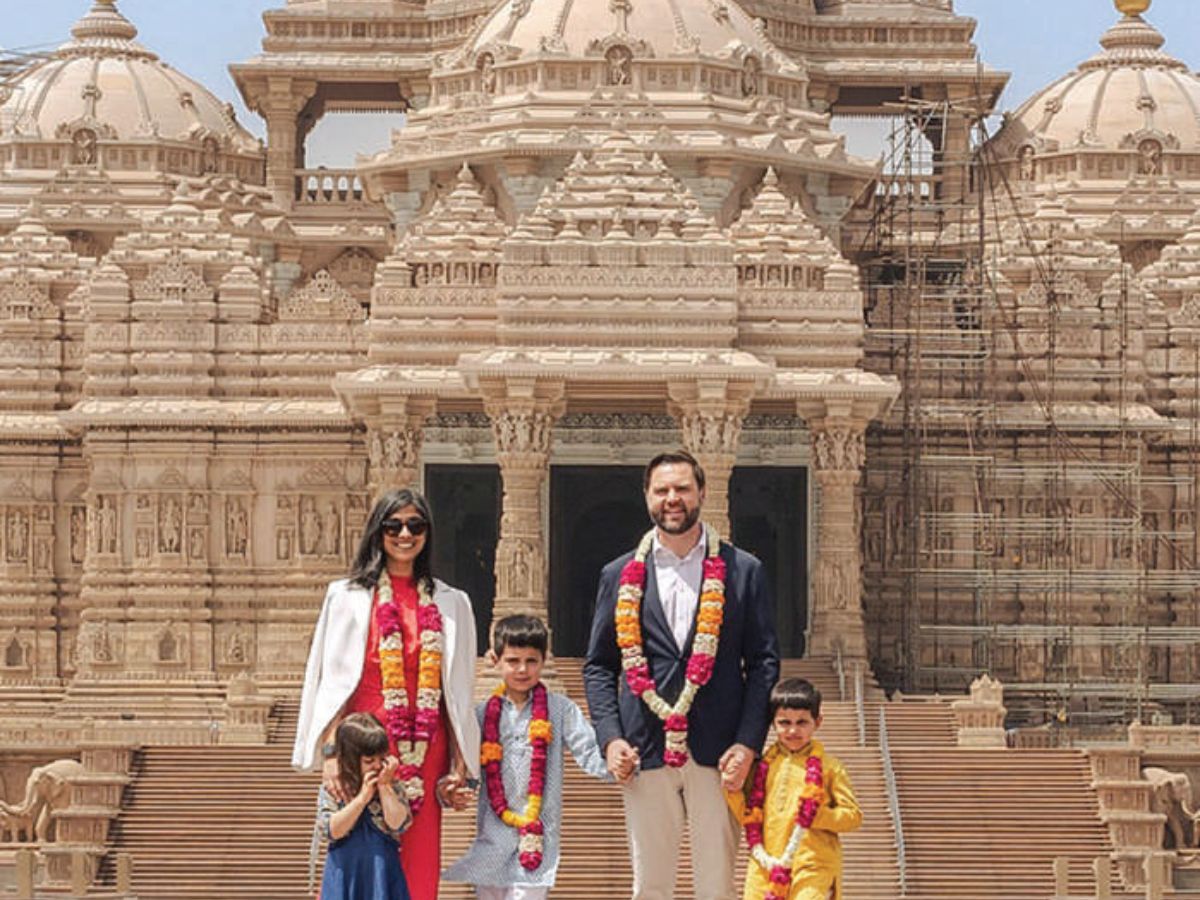
US Vice President J.D. Vance, his wife Usha Vance, and their children at the Akshardham Temple, in New Delhi on 21 April. (Image: ANI)
When the Vice-President of the United States, J.D. Vance, told a gathering of Christian conservatives that he hopes his Hindu wife will one day be moved by Christianity, he didn’t just reveal his faith, he revealed his hollowness. Behind the carefully polished words of a man desperate to sound godly was the unmistakable echo of arrogance. The arrogance that sees another’s faith as inferior, another’s belief as incomplete, and another’s identity as something to be corrected.
Vance’s statement about his wife, Usha Vance, was not a private comment made in the warmth of family life. It was a deliberate, public declaration meant to send a signal—not to God, but to voters. His message was clear: “Look, I’m one of you. I believe my wife’s faith needs saving too.” That’s not love. That’s politics dressed up as piety. In that moment, the Vice-President of the United States revealed something the world has long suspected about America’s political evangelicals—they preach about freedom of faith, but they only respect freedom when it looks like them, talks like them, and prays like them.
Let’s be honest—J.D. Vance didn’t stumble into Christianity because of divine revelation alone. He stumbled into it when he stumbled into political ambition. The man who once wrote “Hillbilly Elegy” as a tale of moral awakening found that salvation also came with votes. By converting to Catholicism in 2019, Vance didn’t just find Jesus—he found a constituency. But when he said he “hopes” his Hindu-raised wife will be “moved by Christianity,” the mask slipped. Hope, in this case, is a polished word for expectation. And expectation is a polite word for pressure.
If this were the other way around—if Usha Vance had said she hopes her Christian husband would one day embrace Hinduism—imagine the outrage. The Western media would have called it “religious coercion,” “cultural subversion,” or “Hindu nationalism gone global.” But when the Vice-President says it, it’s sold as romance, as devotion, as a Christian man’s loving concern for his wife’s soul. That’s not love. That’s religious vanity.
Let’s call it what it is—Hinduphobia wearing a suit and tie.
When a man of power looks at one of the world’s oldest and most profound faiths—a civilisation that gave humanity yoga, meditation, the concept of karma, the zero, and spiritual pluralism—and implies that it’s somehow lacking, that is prejudice. It’s the colonial mind speaking through an American accent.
J.D. Vance represents the same mindset that once sent missionaries to “save” the souls of India—the same moral imperialism that saw spiritual diversity as disorder and polytheism as sin. Only this time, it’s happening not on a ship to Goa, but in the living room of the Vice-President’s house in Washington, D.C.
You see, when a White American man publicly announces that his Hindu wife’s faith is a work-in-progress, he’s not preaching the Gospel—he’s preaching hierarchy. And in his hierarchy, Christianity stands on top, while Hinduism—and by extension, the East—remains a curiosity, a waiting room before “real faith” begins.
It’s amusing and tragic how American politicians weaponise religion. They speak of freedom while enforcing conformity. They claim to follow Christ while using Him as a campaign mascot.
Vance’s version of Christianity isn’t about compassion or acceptance—it’s about conformity and control. He’s less a disciple of Jesus and more a salesman of a sanitised, politically convenient religion.
The irony? His wife, Usha, represents exactly what America claims to celebrate—diversity, intellect, self-made success. The daughter of Hindu immigrants from Andhra Pradesh, she went to Yale, earned her own place in life, and married a man from a completely different world. That’s the American dream. Yet her husband now wants to “upgrade” her faith, as if it’s an outdated software.
This is where J.D. Vance exposes himself: he cannot stand the idea that his wife’s spiritual truth might be different—and equally valid. For a man who preaches Christian humility, his ego seems quite divine.
Imagine this. Suppose a Hindu political leader in India publicly said that his Christian wife should one day “return to Sanatan Dharma.” The entire Western media would explode in outrage. Headlines would scream: “Hindu Extremism at Home,” “India’s Religious Intolerance,” “Hindu Right Targets Christian Wife.” But when an American Vice-President says the same thing in reverse, the headlines soften. It becomes “an expression of faith,” or worse, “a husband’s spiritual hope.”
This is how narrative manipulation works. When the West converts, it’s called salvation. When the East holds firm, it’s called fanaticism.
Faith is a personal dialogue with the divine, not a political press release. No man, however powerful, has the right to turn his wife’s soul into a symbol of campaign virtue. By declaring his hope for her conversion, Vance didn’t just disrespect Hinduism—he disrespected his wife’s autonomy.
Faith cannot be forced, not even with a smile. Conversion is not communion. It’s conquest when it comes from superiority. And if Vance truly believed in the Christian message of love, he would know that Jesus never said, “Love thy neighbour after they become like you.” He said, “Love thy neighbour.” Period.
For decades, the West has positioned itself as the moral guardian of the world—lecturing India on religious freedom, tolerance, and pluralism. But the same West rarely looks inward at its own spiritual chauvinism.
Hinduism, with its openness and philosophical depth, doesn’t need validation from a politician who discovered God when he discovered campaign donors. What Vance said is not just personal arrogance—it is cultural arrogance. His statement tells us one thing clearly: Western political Christianity still cannot coexist with equality. It must dominate, it must convert, it must “save.”
What this episode exposes is more than one man’s religious insecurity. It exposes a Western hypocrisy that still looks at Indian faiths through the same colonial lens—fascinating, but not enough.
It’s time India stopped accepting lectures on tolerance from countries that can’t even respect the faith of their own Vice-President’s wife.
The same West that flinches when someone says “Bharat Mata ki Jai” seems perfectly comfortable when a powerful man implies that Hinduism is incomplete. That double standard is not democracy. It’s disguised discrimination.
J.D. Vance has every right to his faith. What he doesn’t have is the right to belittle another’s. Faith, when used to uplift, is beautiful. But faith, when used to impose, becomes tyranny.
The Vice-President should remember: Jesus didn’t convert anyone through power—He inspired through love. And if Vance truly wants to lead by Christian example, he should begin by respecting his wife’s Hindu roots, not hoping she abandons them.
Because in the end, a man who wants to save the world but cannot honour the soul sitting next to him at the dinner table has already lost his moral compass. That’s not faith. That’s hollow politics pretending to pray.
Savio Rodrigues is the founder and editor-in-chief of Goa Chronicle.
