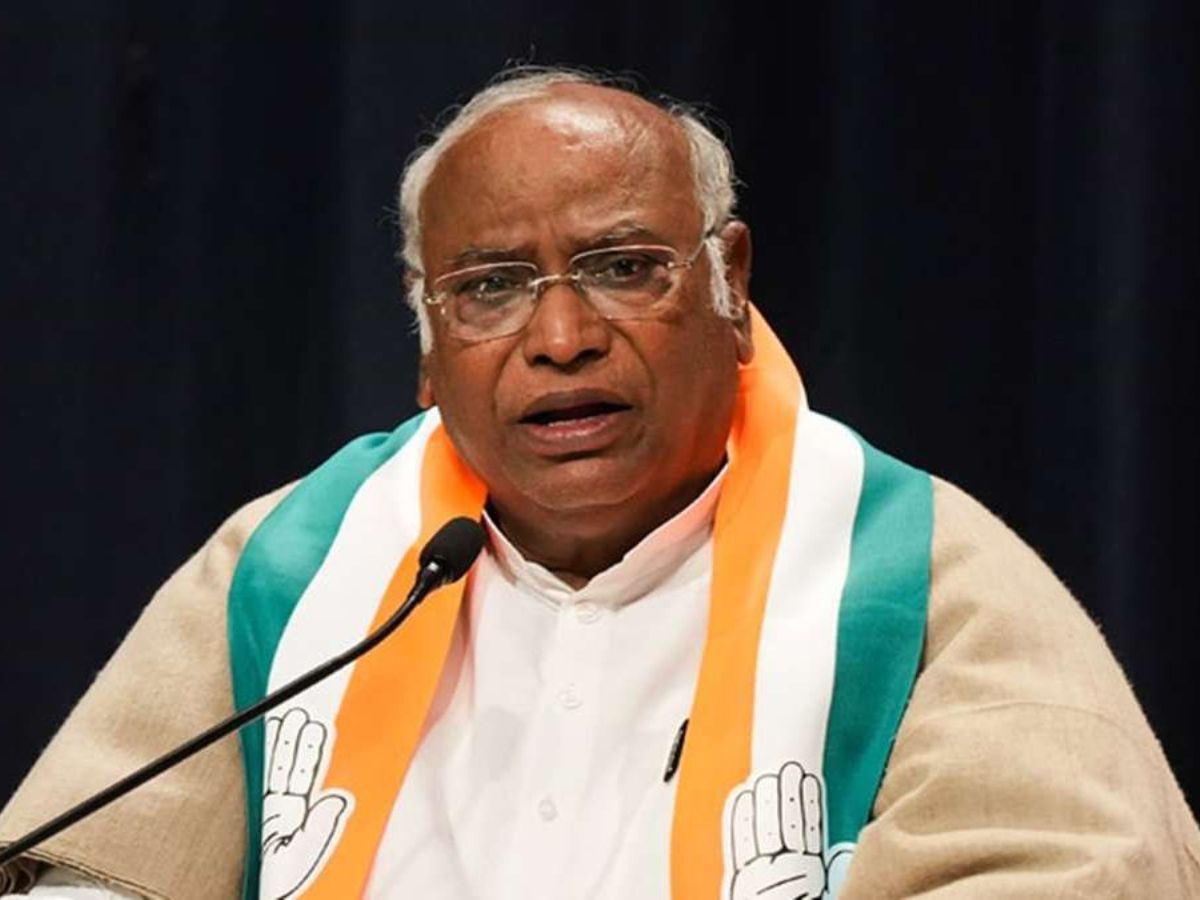
In Frame: Congress President Mallikarjun Kharge. (Image: INC)
By launching a fresh attack on the Rashtriya Swayamsevak Sangh in the midst of the Bihar campaign, Congress president Mallikarjun Kharge appears to be working towards the consolidation of Muslim votes on one hand, and playing the secular card on the other.
The problem is that the current Congress leadership has repeatedly failed to understand that it should try and distinguish, politically at least, between the RSS and the BJP. Yes, the BJP draws its strength from the RSS, but the Sangh has, in the past, supported the Congress on multiple occasions and it is therefore politically naïve to drag it in the electoral battles.
Kharge’s comments were in context of praise being heaped on Sardar Patel by the BJP on his birth anniversary on Friday wherein he recalled that the former Home Minister had banned the RSS following the assassination of Mahatma Gandhi in 1948. He went on to criticise the Sangh thereafter.
There is no doubt that the BJP leadership has over the years been trying to usurp the legacy of the Sardar, who was a very tall leader, but someone whose loyalty and commitment to the Congress was unflinching. Yes, he should be honoured, and his contribution in uniting the country, after the British transferred power, was monumental. For some odd reason, the Congress, has not given him and his role as much importance as it should have, and thus the BJP, has been making a conscious attempt to take over his legacy.
The Bihar polls are on, and the Congress, which has no organizational network to reap political dividends of all the efforts put in by Rahul Gandhi, has decided to deploy new tactics. The attack on the RSS and the personal criticism of the Prime Minister by Rahul, the Leader of Opposition, are all a part of this new strategy.
However, the Congress high command must understand that it does not need to prove its secular credentials to anyone, and if it tries to woo the Muslim voters, it also has to undergo the risk of losing those who have been influenced by the heavy dose of Hindutva, which the BJP keeps on giving. Amongst the multiple reasons which led to the Congress losing power in 2014 was the fact that in the second term of the UPA, an impression had been created, rightly or wrongly, that the party had tilted towards the minorities and had been ignoring the majority community.
This factor had hurt the Congress and it has in the last 11 years not been able to re-assure the Hindus that it was also pursuing causes and issues regardless of any community preferences. The BJP on the other hand, has constantly branded the Congress as “anti-Hindu”, something which the Congress has not been able to counter effectively.
The Congress has to be aware that the Muslims in particular have no choice but to vote for the Congress or any alliance it is in. But simultaneously, other communities are as important. In Bihar, the Muslims and Yadavs are solidly with the Mahagathbandhan, but if the Alliance has to win, it has to also have sufficient appeal amongst other communities.
The original Congress vote base was that of Brahmins, Muslims and Dalits. Over a period of time, the vote base has eroded and all three sections had at one point moved away from the party, preferring other outfits including some of the allies of the Congress. The Brahmins, who were the mainstay, shifted to the BJP as well like other upper castes. In the process, the Congress was left with no particular section backing it.
The Muslims have the compulsion of being with the Congress now, since the BJP by its politics has left them with no option. However, the challenge before the party is on how to get back the Brahmins for instance. In the last 11 years, the Congress has not propped up a single Brahmin face at the national level.
The Gandhis have an appeal cutting across communities but it is not sufficient to help the party win. Caste politics is a reality in India and the Congress must introspect and figure out that why after 1984, it has not been able to secure a majority of its own at the Centre. Obviously, its vote base has dwindled and shifted.
There is a section in the Congress which believes that it shall come to power after the people get frustrated and reject the BJP and the NDA. This is a negative approach and obviously not the answer to rebuilding of the organizational network. The party has to rethink and understand the realities if it wishes that Rahul’s efforts should bear some fruits.
Bihar is a complex state where caste equations and alliances matter more than anything else. It is the most political state in the country and its residents have concerns which need to be addressed. Nitish Kumar continues to be popular amongst certain sections but is now proving to be the weak link in the NDA. If he underperforms, the impact would be on the overall outcome.
The BJP is backing him out of compulsion and not because it sees any future of the state in him or his policies. It also realises that without the support of women and EBCs, it cannot hope to lead the NDA to a majority.
The Congress must have a rethink of its tactics. It should, to begin with, play down its criticism of the RSS. Between us.
