
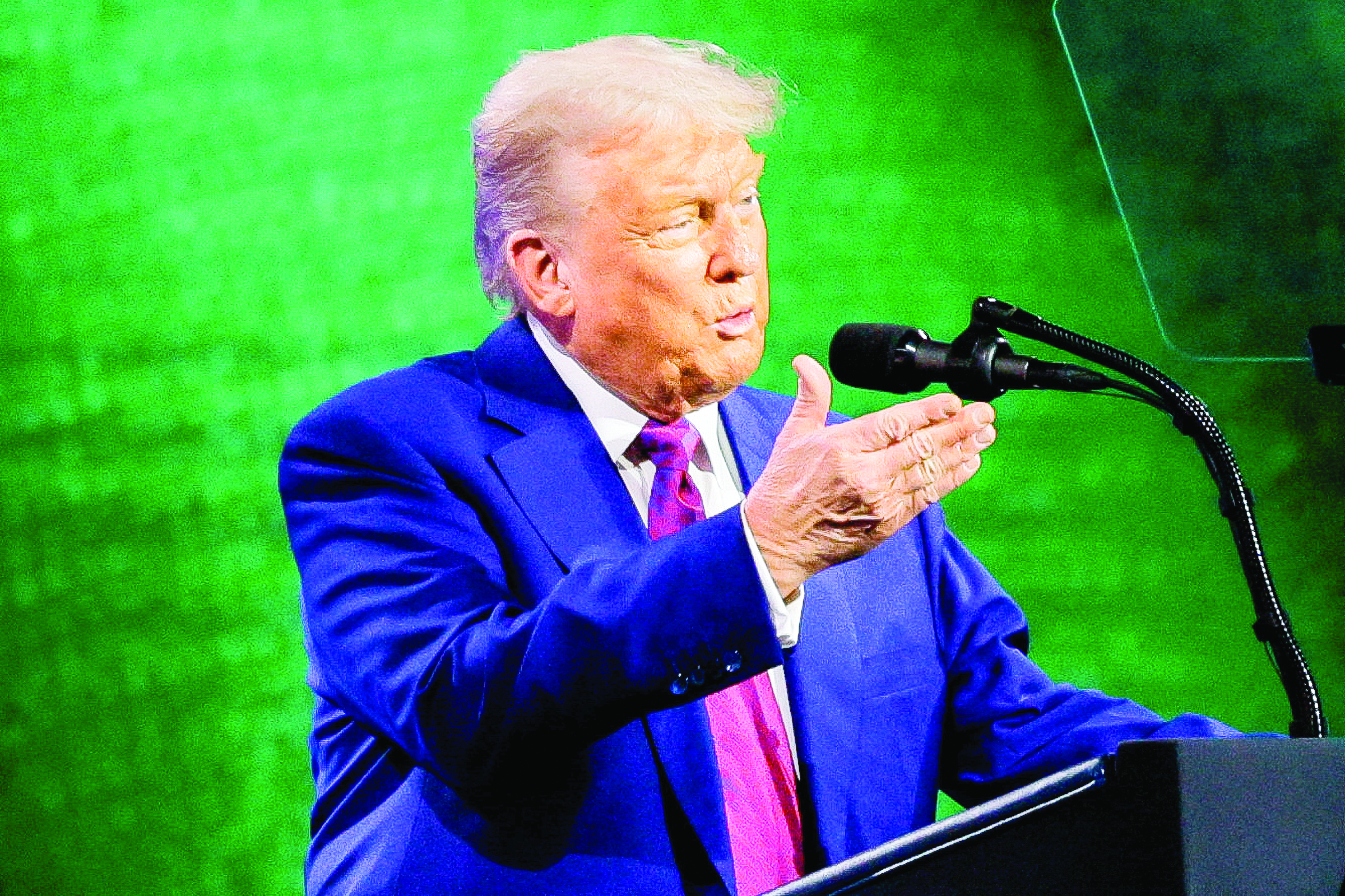
There is little that India can do to check President Donald Trump’s almost daily posts on his own social media app, Truth Social. Through the random thoughts, threats, and occasional executive orders put up there, the site has become the virtual mouthpiece of the Trump 2.0 Administration.
Of much greater significance than this “Trumpian” mode of communication are the actual contents of his mostly stray, half-baked, and only occasionally considered posts. A common characteristic of almost all of them is the reeking mercantilism—the kind that says, “you tell me what you can do for me, and then I will offer what I can do.” Every resultant deal, irrespective of how it is arrived at, is lauded publicly by Trump or his minions.
More often than not, thereafter, the heads of the governments involved get praised disproportionately and enter Trump’s good books. No doubt, such reconciliatory acts do, somewhat, soothe their earlier belittling at the hands of the President of the USA. But unfortunately, the entire process of deal-making rarely brings satisfaction or credit to the parties involved.
Repeatedly going along a transactional path, both in trade and foreign affairs, risks the assiduously built global leadership of the USA. The trust of almost the entire post-war Europe was earned by cultivating relationships and influence through alliances, cultural diplomacy, and a rule-based order that assured friends and allies of Washington’s reliability.
From the Marshall Plan and economically rebuilding war-ravaged Europe to extending NATO to assure their future security, to Fulbright program, American trust has hitherto been rooted in building confidence— not in balancing trade accounts or collecting payments to enforce it—as eloquently pointed out by Frank F. Islam, a Washington-based civic cum thought leader. In Trump’s view, most allies are “freeloaders” since they do not meet his transactional benchmarks, with trade deficits being unacceptable. He somewhat deliberately ignores the basics of trade and resultant specialization.
Instead, he prioritizes immediate and short-term gains over longer-term ones. Treating existing alliances as business contracts, is bound to impact the stability of ties and effect a shifting of trust and future relations, be these strategic or commercial.
Already a tectonic change in the global arena is becoming visible, with both China and Russia emerging more confident and optimistic than before. This is a wake-up call for the US lest it becomes too late, with new alliances and partnerships already being formed. USA must recognize that blatant pressure tactics and near-blackmailing would make it lose friends and allies. Having staunch supporters in different parts of the globe was a highly favourable factor underpinning its global supremacy.
INDIA AND THE RECENT AMERICAN MERCANTILISM
In the last two decades, India and the US have been gradually coming closer through a host of deliberate measures taken by successive Republican as well as Democratic administrations. These include a pact for civilian use of nuclear materials, defence cooperation, joint military exercises, and evolving mutual arrangements in the sharing of technology, energy, and counterterrorism.
India came to be perceived as a counterweight to China in the Indo-Pacific. The re-activation of the four-nation Quad—which China had called an “Asian NATO”—envisages India as a possible bulwark against the Dragon’s designs in the South China Sea and elsewhere. President Trump’s misgivings about India appear to have stemmed from New Delhi publicly contradicting his claim that he had played a critical role in effecting a cessation of the four-day war between India and Pakistan in late May 2025.
The situation grew more pronounced when Pakistan, in contrast, credited Trump for the breakthrough and even nominated him for a Nobel Peace Prize for preventing a sharp escalation of the conflict between the two nuclear powers.
The resultant embarrassment seems to have touched a raw nerve with the President. Thereafter, he has altogether pivoted in favour of Pakistan. Trump, his Treasury Secretary Scott Bessent, and Trade Adviser Peter Navarro have accused India of making enormous profits from the sale of petroleum products using the discounted crude imported from Russia. For continuing to buy crude oil from the sanctioned Russia, India has also been accused of financing Russia’s war effort in Ukraine.
The fact that India’s purchase of Russian crude had been informally “cleared” by the US administration, since it would help soften the international prices, is now being conveniently ignored. Also overlooked is the point that besides India, China and the EU are bigger buyers of Russian crude, and that the USA itself, at times, bought refined Russian crude from India. These specious charges against India surfaced when Russia ignored Trump’s efforts to broker a deal on stopping the ongoing Ukrainian war.
Beyond labelling the Indian and Russian economies as “dead economies,” Trump’s Truth Social posts claimed that India is a closed economy with the highest levels of protective tariffs, and that it is a difficult country with which to negotiate a Bilateral Trade Agreement. No doubt, negotiators over five rounds of trade negotiations have flagged India’s red lines—no open access to US agriculture, dairy, and genetically modified products, and the use of tariffs to protect the Indian automobile and component manufacturers.
In response, the US has imposed a tariff of 25% on all Indian imports (compared to the earlier 2-3% under the US-accepted Most Favoured Nation treatment). For continuing to buy Russian crude, a penalty of 25% would also become payable from April 27th. Combined, these tariffs total 50% and are set to significantly impact the competitiveness of about 55% of Indian exports and raise prices for American consumers.
Trump also seems to be linking the penalty, or the “secondary tariff,” as he calls it, with the outcome of his deliberations with Russian President Vladimir Putin. Recently, following the discussions in Alaska, President Trump was upbeat about a potential peace agreement between President Zelenskyy and Putin, indicating that importers of Russian crude were unlikely to be penalized.
However, after convening a summit meeting two days later with heads of key European nations and representatives of NATO he was less sanguine. He suggested that the Kremlin might not be interested in striking a deal at all, adding, “this would create a rough position and we’re going to find out about President Putin in the next couple of weeks.” Such a pusillanimous stand is hardly reassuring to India.
To crank up the pressure on Moscow, additional sanctions are being threatened by Trump upon countries continuing to buy Russian oil if Russia does not make peace. Given his marked reluctance to confront China or the EU, India remains the only likely target for this punitive measure.
DEALING WITH THE CHALLENGE AHEAD
Going forward, it is imperative for India to not isolate itself from the US or its allies. The national objective of integrating with the global centres of commerce, capital, and technology must remain intact. India needs all these modern factors of production wherever they might be. From time to time, to safeguard its own interests, India would need to counterbalance one so endowed nation against another.
However, in the process, the relations with no nation must be perpetually ruptured. The emerging global fragmentation necessitates India keeping open all possible doors and windows. In the context of Trump’s recent trade measures, maintaining strong ties with the US—the world’s foremost source of modern technology, capital, and India’s leading trading partner—is crucial.
To succeed, this requires mature diplomacy, complemented by discreet engagement through back channels. This was recently demonstrated by the leaders of Japan and Vietnam when in similar predicaments. To facilitate this, a prerequisite is to refrain from criticizing President Trump on any issue, howsoever provocative his posts, verbal statements, or written missives might be. Once his larger-thanlife ego is pricked, he tends to reach explosively.
An annoyed and angry Trump, vested with vast and diverse powers which the Constitution of the USA grants a single functionary, becomes almost unmanageable. To combat him, the opposite party must have significant leverage over his country—a la China today, and to an extent, Russia. For India, without any worthwhile hold except its recent thaw with China, lying low and quietly suffering him—tough as it might be—is a wise option. In fact, Trump should even be praised, deservingly or otherwise, at regular intervals.
Trump often boasts about his administration’s ability to win big concessions from others. In the case of the BTA with the UK, India had done well to concede on a few red lines. In a similar vein, it must appease Trump by granting him a few such talking points. In non-sensitive agriculture areas, for instance, duty-free imports could be allowed of US apples, almonds, walnuts, soya, and corn oil for producing cleaner fuel. Also, easy import of American spirits like bourbon and Californian wine can be granted.
The US suggestion to permit genetically modified crops or food items, however, should be flatly turned down. The existing import tariffs on automobiles and their components may not remain a blockade. A planned transition to lower tariff rates on them, and on several machinemade engineering and electronic products, can be evolved. External competition, rather than prolonged protection, would assist in improving quality and reducing production costs. India might consider offering the highly transactional Trump an upfront assurance to significantly increase its purchase of crude oil and LNG.
As of now, the four big suppliers of crude to India are Russia, Iraq, Saudi Arabia, and the UAE. These Middle East nations have held their share in India’s crude imports of four million barrels a day. Till 2024, the discounted Russian crude had come in lieu of purchases from Nigeria, USA, Mexico, Colombia, Ecuador, Gabon, and Congo. Since then, even without any government directive, Russian crude imports have been declining. With increased engagement in sourcing from the US, West Africa, and Latin America, Indian importers are enhancing their energy security and mitigating potential geopolitical risks.

In 2025, US supplies have averaged 271,000 barrels per day, already surpassing imports from Nigeria, Kuwait, and several African and Latin American sources. With the price gap between Russian crude and openmarket oil narrowing to just $2 per barrel, a deliberate course correction toward greater US sourcing can be further intensified. India could consider assuring Trump that over the next four years, it would buy as much crude from the USA as from Russia.
Without doubt, US supplies would need to remain competitively priced and move within a narrow band, especially since the transportation costs would be somewhat higher. To operationalize such an assurance, higher obligations to purchase American oil could be imposed upon private Indian importers and refiners.
Reportedly, after rapidly ramping up their discounted purchases from Russia soon after 2021, they had booked excess profits of $16 billion by processing and reselling it in international markets. Such acts seem to have riled Trump enough to impose a 25% penalty on all Indian exports to the USA. No doubt, in the months ahead, there will be several ups and downs. At the end of the day, however, India’s success will hinge on its ability to remain flexible and adapt to the new game Trump has set in motion.
Dr Ajay Dua, a development economist, is a former Union Secretary, Commerce & Industry.


