The relationship with Russia is unique as they share technology, for example, the sequential lease of two Akula-class, nuclear-powered, attack submarines (SSNs), was used for finalizing the design of India’s SSNs and for training the first sets of crews to operate them.
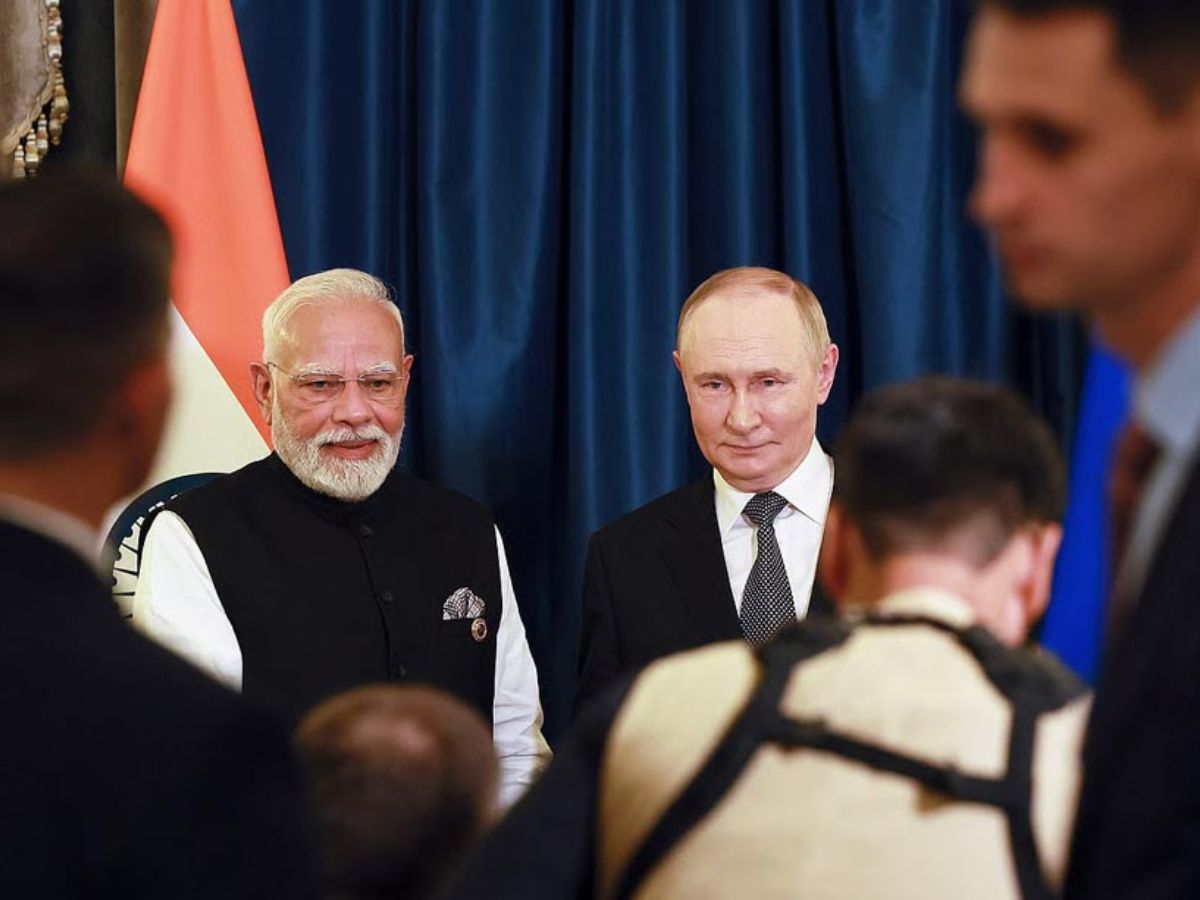
No big announcements, but India-Russia ties stay strong (Image: X)
Russian President Vladimir Putin travelled on a state visit to New Delhi on 4–5 December 2025 for the 23rd annual summit meeting between India and Russia. Since their first annual summit in 2000, the meetings have continued annually, without a break, except for the two years when the Covid-19 pandemic put a worldwide hold on travel. The summit focused on solidifying economic ties, including the “uninterrupted” shipment of Russian oil and the rupee and ruble trade settlements. Agreements were signed across diverse sectors, including nuclear energy, space, critical minerals, healthcare, tourism and the development of transport corridors like the International North-South Transport Corridor (INSTC).
As is invariably the case when Indian policymakers meet their Russian counterparts, major areas of strategic concern are discussed, namely, defence purchases, nuclear power generation and space technology.
DEFENCE TIES
India remains the world’s biggest buyer of Russian defence equipment, accounting for 30–40% of Russia’s annual defence exports. But apart from the purchase of new weapon systems, India maintains a huge inventory of Russian equipment spanning all three Services, from tanks, infantry combat vehicles, anti-aircraft systems, artillery guns, fighter and transport aircraft, attack helicopters, utility helicopters to ships and submarines. These include platforms such as T-90 tanks, Sukhoi-30MKI aircraft, and frontline warships such as the frigate “INS Tushil” and “INS Tamal,” two of which have been built in a Russian shipyard in Kaliningrad. Another two are earmarked to be built in India, in partnership with the Kaliningrad yard.
Some weapons systems are produced in India as part of licensed productions such as infantry combat vehicles and joint production such as the AK 203 assault rifle. Russia remains an important source of defence equipment, spare parts, engines and components for defence platforms that are being assembled/produced in India. There is also a large amount of ammunition imported for these weapon systems. Hence serviceability of legacy equipment with Russian support remains an operational imperative for India even as it shifts to indigenisation.
The relationship with Russia is unique as they share technology, for example, the sequential lease of two Akula-class, nuclear-powered, attack submarines (SSNs), was used for finalizing the design of India’s SSNs and for training the first sets of crews to operate them.
The BrahMos, the mainstay of India’s missile force, is an example of joint development and production which demonstrated its capability during Operation Sindoor and is now also being exported.
Amongst the contemporary state-of-the-art equipment currently under delivery is the S-400 Air Defence Missile System which is considered to be one of the world’s most lethal air defence missile systems. It has a range of 400 kilometres and can process up to 80 targets simultaneously. Three squadrons of the S-400 system, which were delivered before Operation Sindoor, shot down a number of Pakistani fighter jets in that operation. While the delivery of two squadrons is remaining.
India went ahead with buying the S-400 even at the risk of being hit with sanctions by the US government. The Countering America’s Adversaries Through Sanctions Act (CAATSA) was introduced in 2017 to discourage countries from buying the S-400 system.
Asked in a television interview about the possibility of the US administration blocking the supply of these ultra-high-performance weapons systems to the Indian military, President Putin said, “Both India and the world recognize that India cannot continue to be treated the way it was treated 77 years ago. India is a major global player, not a British colony, and everyone must accept this reality.”
India is also understood to have expressed interest in upgrading the Indian Air Force’s fleet of 272-strong Sukhoi 30MKI. There was also speculation regarding the purchase of SU-57 aircraft but no deal was inked during the visit.
As per reports, a previously negotiated deal for India to lease a nuclear-powered attack submarine from Russia, valued at approximately $2 billion, was reportedly finalised around the time of the visit, with delivery expected within two years. This specific deal was not part of the main summit announcements but was a significant development concurrent with the visit.
However, the anticipated announcements on major defence deals did not happen. India has not concluded any major defence deals with Russia since the Ukraine conflict in 2022. There have been delays in the delivery of several platforms and spare parts as Moscow has prioritised its own defence needs. This is a trend that predates the war in Ukraine as India strengthens its domestic production.
RECIPROCAL EXCHANGE OF LOGISTIC SUPPORT (RELOS)
A military logistics-sharing pact, Relos, which was signed on 18 February 2025, was ratified by Russian Parliament a day ahead of the visit. The agreement will facilitate mutual access to ports and military facilities for exercises and support during operations and expand India’s maritime footprint and ambitions, extending its presence from the Indian Ocean to the Arctic.
Relos is a bilateral logistics pact that outlines procedures for dispatching military units, conducting port calls, using airspace and airfields and providing logistical support during missions, joint exercises and humanitarian or disaster-related operations.
Relos significantly extends India’s strategic reach, particularly for the Indian Navy, by granting access to Russian naval ports along the Northern Sea Route from Vladivostok to Murmansk.
By creating a logistics network that spans the Arctic to the Indian Ocean, the pact strengthens interoperability between the two-armed forces. It boosts India’s operational reach and logistical resilience, while Russia receives reciprocal access to Indian naval bases in the Indian Ocean Region.
For the Indian Navy which operates many Russian-origin platforms, access to Russian ports for maintenance is operationally vital. Allowing both countries to locate forces in each other’s territory for limited periods is an extremely important agreement.
Incidentally, India signed its first logistics pact, LEMOA, with the US in 2016 and France in 2018, Australia and Japan in 2020, and is in discussions with Oman and Philippines.
THE JOINT STATEMENT
The Joint Statement following the Summit condemned terrorist attacks in India and Russia, including the Pahalgam attack in Jammu and Kashmir and the Crocus City Hall attack in Moscow.
Military and Military-Technical Cooperation has been a pillar of the Special and Privileged Strategic Partnership between India and Russia, which has grown from strength to strength through several decades of joint efforts and fruitful cooperation, steered by the IRIGC-M&MTC.
Further, the partnership is reorienting to joint research and development, co-development and co-production of advanced defence technology and systems in view of India’s quest for self-reliance. This shift is important for future platforms which include the next generation of fighters, aircraft and marine engines and missiles.
Both sides agreed to encourage joint manufacturing in India of spare parts, components, aggregates and other products for maintenance of Russian-origin arms and defence equipment under the Make-in-India program through transfer of technology and setting up of joint ventures for meeting the needs of the Indian Armed Forces as well as subsequent export to mutually friendly third countries.
CONCLUSION
While the Russia-India defence ties remain vital, the Ukraine war and shifting geopolitics, including Russia’s interactions with China, are challenging the partnership. But ultimately, the visit demonstrated the depth and resilience of the India-Russia “Special and Privileged Strategic Partnership”, which both sides stressed is rooted in mutual trust and respect for each other’s national interests. The absence of a big-ticket defence deal doesn’t limit Russia’s role. It will continue to be one of the most important players for India’s defence needs. Long-standing defence cooperation with Russia was reaffirmed with discussions on new contracts for submarines and fighter jets and joint production initiatives, despite American pressure to diversify.
The discussions and agreements laid a strong foundation for future cooperation that moves beyond a traditional buyer-seller dynamic towards a more integrated defence-industrial partnership. Putin’s visit was significant for defence ties because it shifted the focus from direct arms purchases to joint development, production, and maintenance of military equipment, aligning with India’s “Aatmanirbhar Bharat” (self-reliance) initiative.
A central message being that India maintains strategic autonomy and has multiple foreign policy options, while reengineering its relationship with Russia.
Maj Gen Jagatbir Singh, VSM (Retd) is formerly of the Indian Army.
