PM’s initiative was not about rewriting history but reopening it so that Indians can decide for themselves what their heritage means. That is democracy at its purest essence.
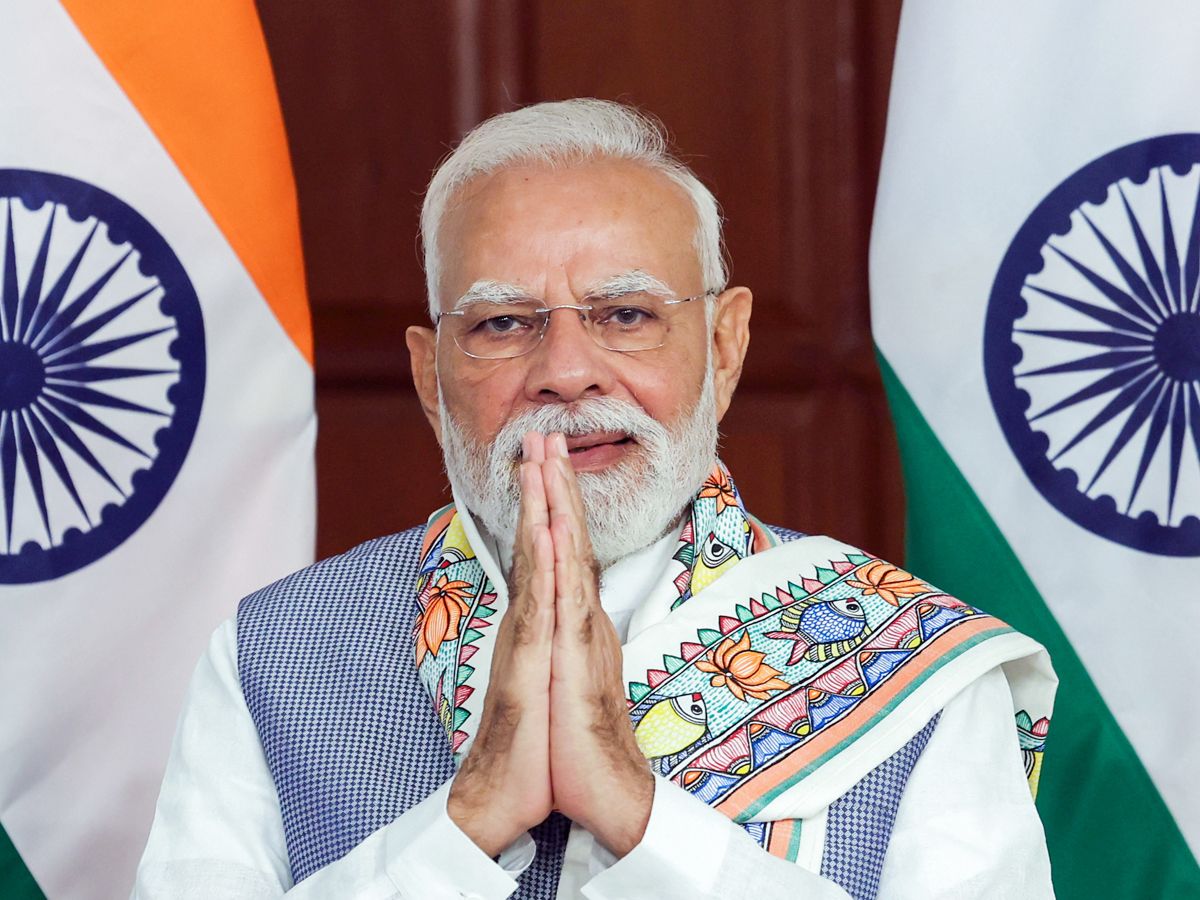
PM’s call to sing Vande Mataram is an invitation, not an imposition. (Image: DD News)
In a democracy, symbols are sacred, but their interpretations, adoptions, and usage are human and therefore political. India’s national song, Vande Mataram, embodies that paradox. It is not just a melody of devotion, but the spirit of a civilisation that has always revered the land as its mother, and Indians as her children. Yet, for decades, the Left and the Congress establishment have sought to decide who may speak of that reverence, who may interpret it, who must stay silent, and especially, who should forget about it.
What is unfolding today is not “dirty” politics, as some Left outlets claim, but the long-overdue democratisation of conversations about our country and our past. For too long, Congress has monopolised not only the instruments of power but also the vocabulary of nationalism itself. It claimed the right to define what was patriotic and what was not, what could be sung and what must be censored. It exalted its own decisions as sacrosanct while branding all alternative voices as divisive.
Although composed and sung for decades, it was under Jawaharlal Nehru’s presidency in 1937 that Vande Mataram was adopted by the Congress Working Committee (CWC). Yet, it was also declared that only the first two stanzas should be sung, while others should be quietly forgotten. The song that stirred revolutionaries and inspired countless martyrs was suddenly severed, with stanzas invoking Maa Durga, Maa Lakshmi, and Maa Saraswati, deemed “unsuitable.” Later, in his correspondence with Netaji Subhas Chandra Bose, Nehru argued that the song’s “background” might “irritate Muslims.” So, a song that united millions under the banner of freedom was suddenly regarded as potentially communal.
The problem is not necessarily that Nehru made a political judgement, because in a democracy, every leader has that right. The problem is that his judgement was elevated to dogma. For decades, it was forbidden to question that decision. When anyone tried, the reflex response from the Congress and its ideological cousins on the Left was to label the questioner as “majoritarian,” “reactionary,” or a recently popular term, “communal.” The very people who preached the virtue of debate refused to allow discussion on their own historical choices.
In doing so, the Left and the Congress converted intellectual discourse into a closed circuit of moral superiority. They monopolised nationalism but divorced it from its roots in civilisation. They claimed to represent a plural India, but their politics silenced the civilisational voice that had nourished that plurality for millennia. And Vande Mataram matters because it is a test of our intellectual honesty.
This month, Prime Minister Narendra Modi inaugurated the 150th anniversary celebrations of the song “Vande Mataram.” He released commemorative coins and stamps, but, remarkably, he encouraged the citizens to pursue the full rendition of the song. This was an honest call, an act of restoration, not an act of partisanship. The Left sees it as an attempt to “appropriate” national symbols. But how can one appropriate what belongs to everyone? Modi’s initiative was not about rewriting history but reopening it so that Indians can decide for themselves what their heritage means. That is democracy at its purest essence.
The Left’s discomfort is telling. It advocates for free speech but swiftly censors when it sees intellectual pluralism. It applauds dissent only when it serves their narratives. The moment someone questions, they recoil behind moral outrage. Hundreds of such examples can be found, whether in Nehru’s decisions, Congress’ compromises, or the distortions of post-Independence historiography, and the pillorising of figures like Savarkar and Bose. Such selective outrage is what has stifled our collective memory for decades, enabling the selective amnesia we face today.
Coming back to Vande Mataram itself. Written in 1875 by Bankim Chandra Chatterjee and immortalised in Anandamath, the poem was a celebration of the motherland as divine. It drew from India’s civilisational habit of sacralising the land, insisting on the relationship and bond between people and place. Rabindranath Tagore himself composed the song’s tune and first sang it at a Congress session in 1896. It inspired movements from Bengal to Punjab, echoed in the cries of revolutionaries facing the gallows, and became the emotional grammar of India’s struggle for freedom.
Yet, once power shifted from struggle to governance, the moral vocabulary of nationalism underwent a change. Eager to appear secular to the Western audience and perhaps to feel virtuous, Nehru’s Congress began erasing India’s soul. Its leaders were diverse, its rhetoric inclusive, but the decisions, be it political or ideological, were all centralised around one man’s sensibilities. Suddenly, India’s traditions were treated as relics, its symbols as inconvenient, and its spirituality as superstition.
The result of this Congress’ love for secularism was an India where the Left congratulated itself for intellectualism while erasing anything that reminded it of its own culture. The irony? Those who advocate debate on every moral, religious, or cultural issue suddenly lose composure when their version of history is questioned. The Left glorifies dissent as the highest democratic virtue but cannot tolerate dissent against its own narrative.
What the BJP is doing today is not politicising Vande Mataram but reclaiming it for discussion, something that the Left denied for decades. PM Modi’s call to sing the full version is an invitation, not an imposition. It invites India to remember that patriotism and pluralism are not opposites but twins born of the same civilisational soil. It asks citizens to recognise that revering the motherland is not exclusionary, but rather the foundation of coexistence.
It is also a reminder that national unity cannot be built on selective amnesia. We cannot forget that decisions taken under the guise of “sensitivity” in 1937 contributed to deepening communal divides. To call that out is not communal but responsible. A mature democracy should be able to look back and say, “Yes, this was a mistake, and we must learn from it.” The BJP’s position today, far from being reactionary, is precisely that: a call to acknowledge, not erase, our past.
But we must also be aware that the larger issue extends beyond a single song. It is about intellectual honesty and the right to revisit history without being vilified. The Congress may have symbolised India for a generation, but its version of India was partial, and many times, performative. It celebrated dissent as long as it was directed outward, never inward. In contrast, today’s Bharat is confident of its democratic traditions and unapologetic about its civilisational identity. It is finally reclaiming the right to question everything, including the choices of its political ancestors.
Vande Mataram endures because it transcends politics. To question the political history around it is to purify our democratic conscience. India’s strength lies not in denying debate but in deepening it. And if the Left finds that uncomfortable, it reveals more about their insecurity than about the health of our democracy. In this sense, Vande Mataram is not divisive but unifying. What divides us is the hypocrisy of those who claim to value freedom while fearing the consequences of open debate. To restore the song in its fullness is not to politicise it but to return it to the people from whom it was taken. And after all, that is what a true democracy should do.
Prof Santishree Dhulipudi Pandit is the Vice-Chancellor of JNU.
