Any dissension within the Quad and fissures in America’s Indo-Pacific partnerships will be music to ears in Beijing, after having called out the grouping as an Asian NATO in the making.
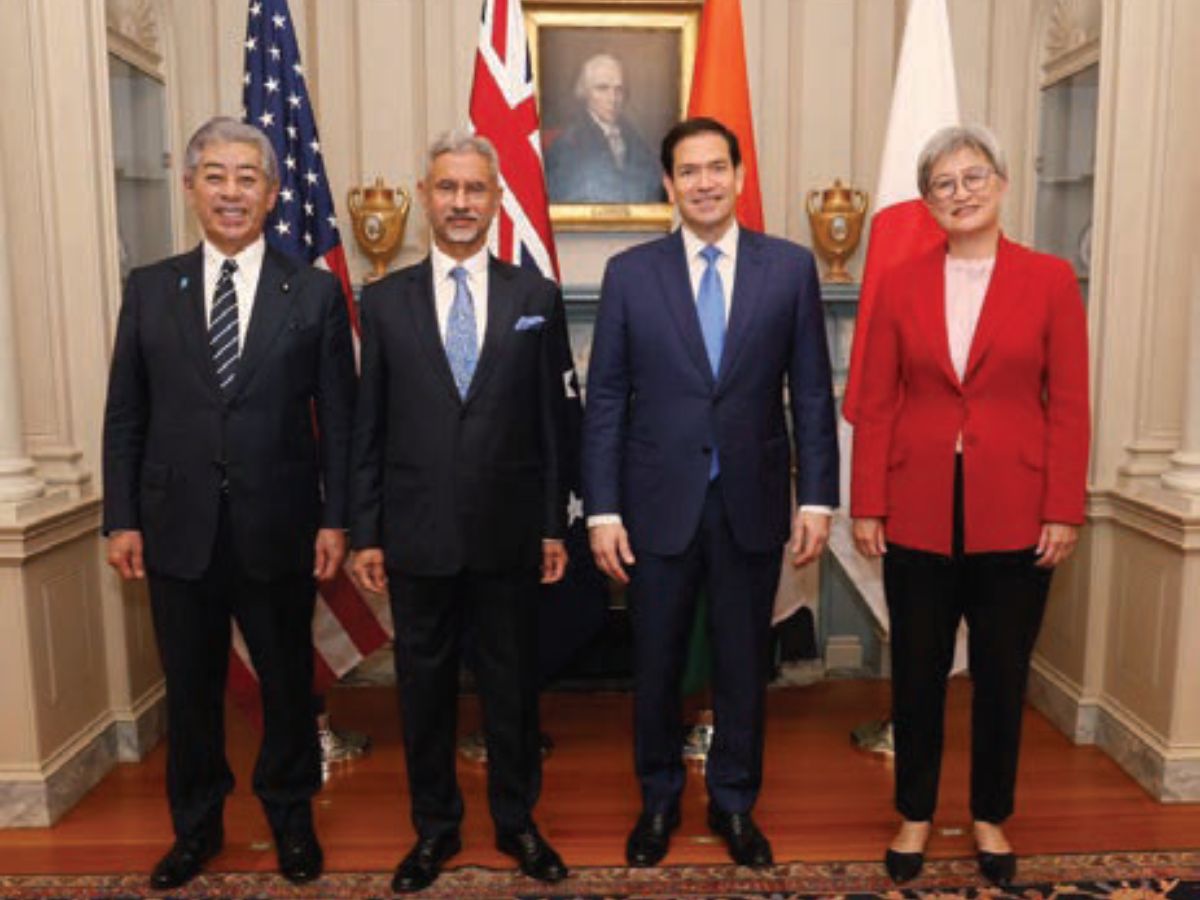
While Washington’s inconsistent approach raises doubts, India, Japan, and Australia are strengthening bilateral ties to maintain regional stability and cooperation amidst shifting global power dynamics. (Image: File)
With President Donald Trump blowing hot and cold on the India-US relationship that was once called a “defining partnership of the 21st century,” the future of the Quadrilateral Security Dialogue (Quad) and more immediately, the fate of the Quad Leadership Summit scheduled in New Delhi is under the scanner. Conjectures abound, particularly on the likely nonattendance of President Donald Trump, even as the ambassador designate to India, Sergio Gor, landed in the Indian capital to connect with the Indian leadership and get a lay of the land before he presents his credentials. While the Quad is ideally driven by its strategic purpose and goals, it cannot be ignored that the absence of the US President from the leadership summit will emit confusing signals about the immediate future of this grouping.
The Trump administration’s approach to the Quad is indeed bewildering. It was during Trump 1.0, that the Quad was revived in 2017 from a deep slumber, with the relay baton being taken over by the succeeding Biden administration. It was during his first term that the Pacific Command was rechristened the Indo-Pacific Command. Even as he took oath for his second term as the US President, foreign ministers of the Quad countries had convened in Washington DC to take stock of their Indo-Pacific partnership. Earlier this year in June, the Foreign Ministers met again in Washington DC to emphasise strengthening “maritime and economic security, critical and emerging technologies, and responding to regional challenges.”
The Indo-Pacific over the years had emerged as America’s region of priority in shaping the future of great power relations with China and in building a new set of like-minded partnerships to manage the architecture of regional governance. While differing in who best can deal with a rising China, the China challenge is largely seen as a bipartisan issue in Washington. However, Trump’s escalating tariffs across the Indo-Pacific and his administration’s push to allies and partners in the region to increase defence spending have upended the continuity in terms of engagement. At the advent of the second Trump administration, it was apparent that non-traditional security issues, most particularly the focus on climate change and green transition were going to take a backseat. But none of the Indo-Pacific partners were really prepared and ready for the roller coaster ride that ten months of Trump’s second term has given.
The optics of the Shanghai Cooperation Organisation (SCO) summit in Tianjin bringing together Prime Minister Narendra Modi, President Xi Jinping and President Vladimir Putin was enough to give brownie points to doubters of the Quad. Any dissension within the Quad and fissures in America’s Indo-Pacific partnerships will be music to ears in Beijing, after having called out the grouping as an Asian NATO in the making. Moreover, the way Trump and his close advisers have oscillated like a pendulum, has really thrown the India-US partnership off balance despite robust institutional linkages built across multiple sectors in the last 25 years, and has injected uncertainty into concerted efforts like the Quad.
Recently, a lot of literature has emerged on the temporary and strategic repercussions of different permutations and combinations born out of the turbulence caused by America’s shifting and fleeting priorities. This includes, among others, a looming revival of the Russia-India-China (RIC) trilateral, the SCO getting a new boost, and the strengthening of the expanded BRICS in times of leadership deficit in global governance. Moreover, the other constituent members of the Quad, India, Japan and Australia, through their growing bilateral ties, have given signals of continued resolve to strengthen the minilateral grouping. For instance, India and Japan have a joint vision for the next decade to steer the “Special Strategic and Global Partnership.” India’s Defence Minister Rajnath Singh, in his recent visit to Australia, participated in the Australia-India Defence Industry Roundtable in Sydney to strengthen bilateral defence industrial collaboration.
Concurrently, the relative breakthrough in India-China tenuous relationship post the Galwan clashes has thrown up more questions about regional competition and cooperation. For instance, China Eastern Airlines is reportedly going to resume Shanghai-Delhi flights from November 9. Lately, some buzz has also started on the lines of reactivating the “Australia-Japan-India” (AJI) trilateral to pull resources and combine intent to manage the strategic currents of the Indo-Pacific, as the United States seems to be developing mission creep in the region.
On the other hand, China is pushing its agenda across the region through multinational platforms such as the Xiangshan Forum, and ambitious projects under the trifecta of Global Security Initiative (GSI), Global Development Initiative (GDI) and Global Civilization Initiative (GCI). This happens at a time when the Trump administration chose to pull the plug from one of America’s most important agencies, impacting development and humanitarian assistance in the Indo-Pacific region, the US Agency for International Development (USAID), with operations in more than 30 countries in the region.
The world will be intensely watching the proceedings of the upcoming ASEAN Summit and more particularly the East Asia Summit, in Malaysia, wherein the leaders of the major stakeholders of the Indo-Pacific region would be coming face-to-face including the US President. Despite the new lows in India-US dynamics as a result of avoidable public showmanship from Washington and the pressure tactics even as trade talks continue, functional convergences and institutional linkages have been bright spots, anchoring the relationship. For instance, the Indian Navy warship INS Sahyadri would, reportedly, join the maritime exercise “Malabar” to be hosted by the US at Guam, one of its military bases in the western part of the Pacific Ocean.
Despite the relative ease in India-China relations, sustaining a robust Quad will be a stabilising force in the Indo-Pacific, and its purpose remains quite firm among India, Japan and Australia. Therefore, it is on Washington’s part to infuse energy that has been absent, with President Trump’s presidential focus lacking despite the Department of Defense and Department of State maintaining that the US was very much involved in the region. Keeping the Quad tab open is crucial, because it has emerged as a functional yet informal minilateral grouping that can contribute to the distribution of public goods in the Indo-Pacific, and in the process, remain an important cog in the wheel as far as Indo-Pacific governance architecture is concerned. The Trump administration and his Indo-Pacific team need to put their act together because the US is already showing signs of becoming the “weak link” in the Quad.
Monish Tourangbam is a Senior Research Consultant at the Chintan Research Foundation (CRF), New Delhi.
